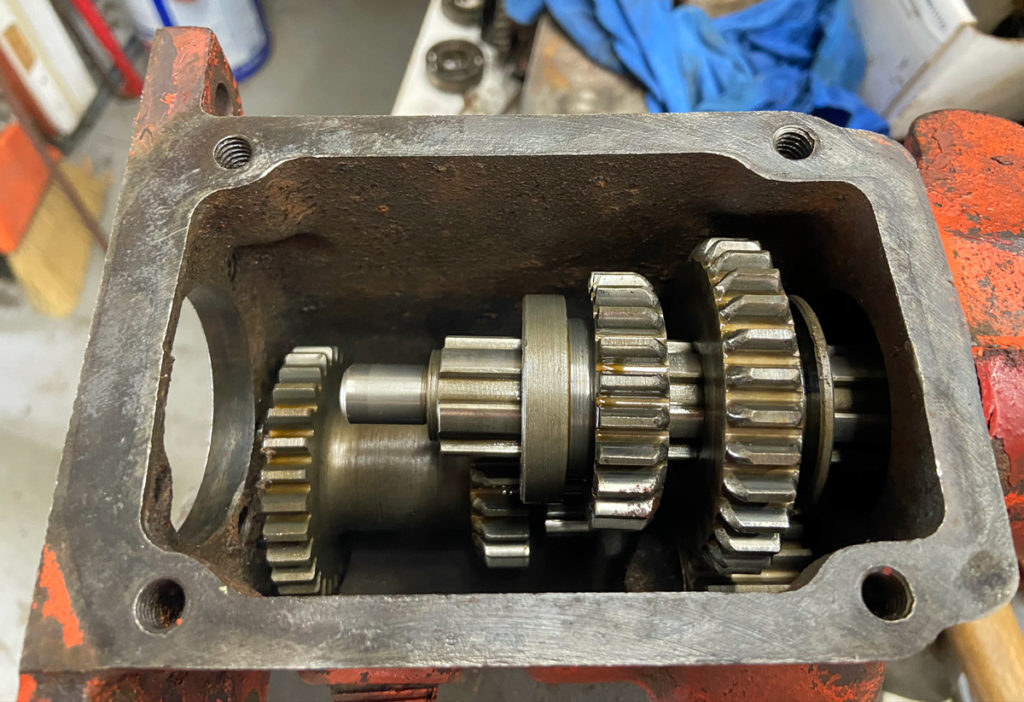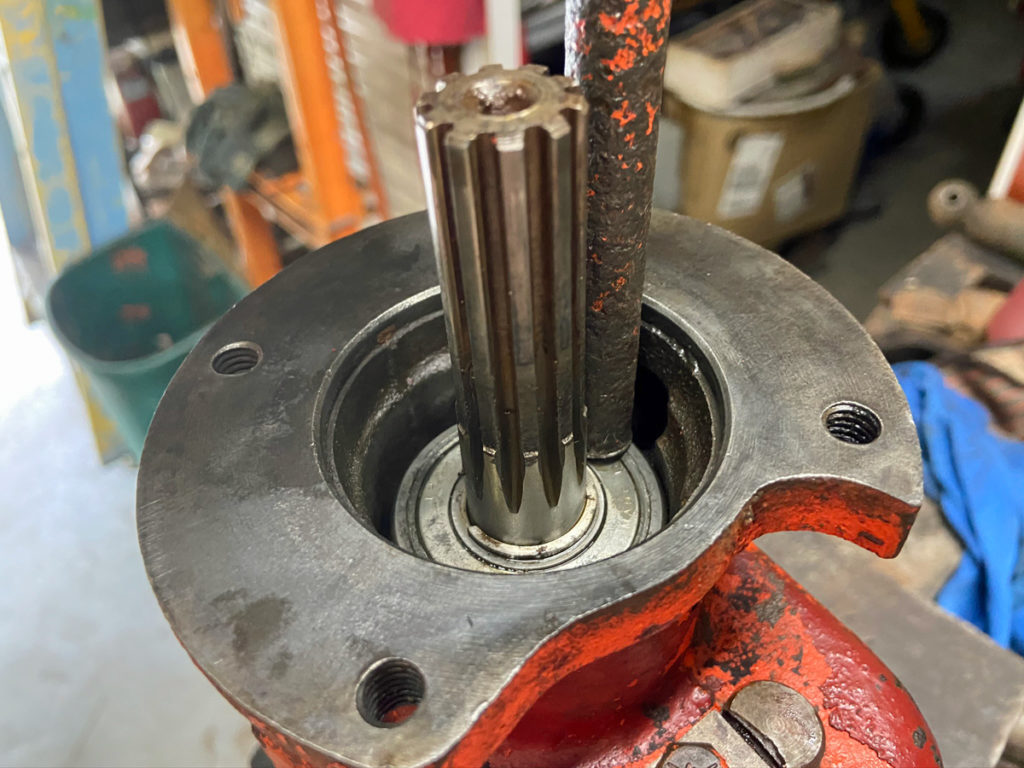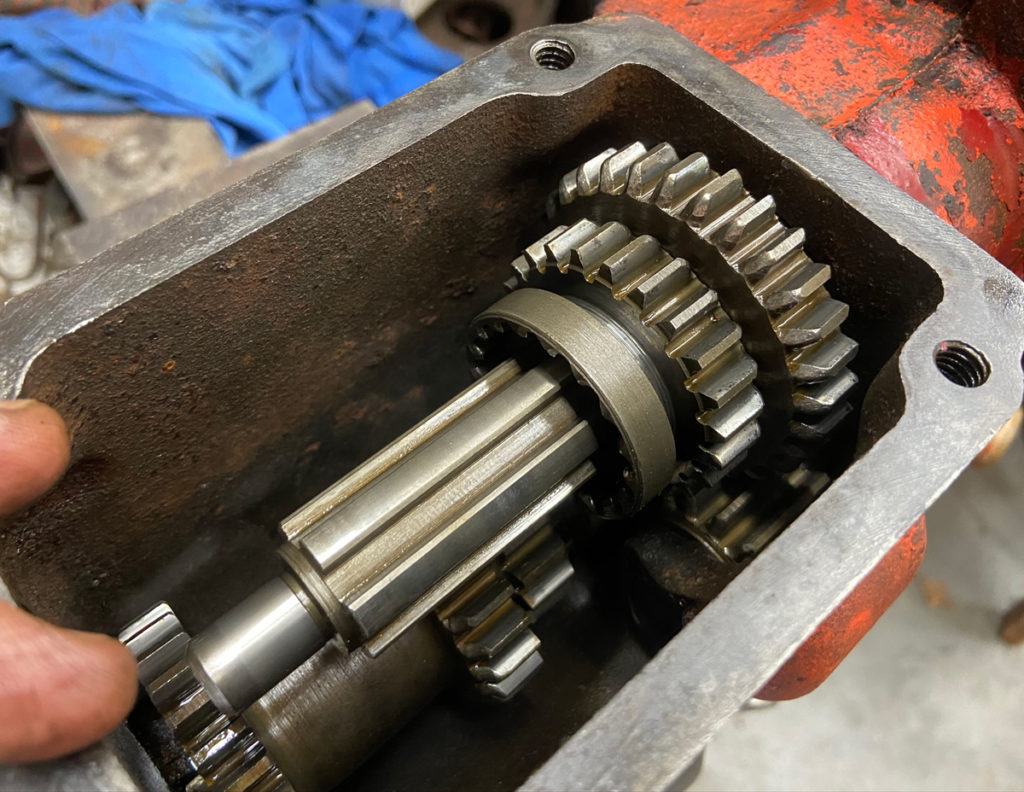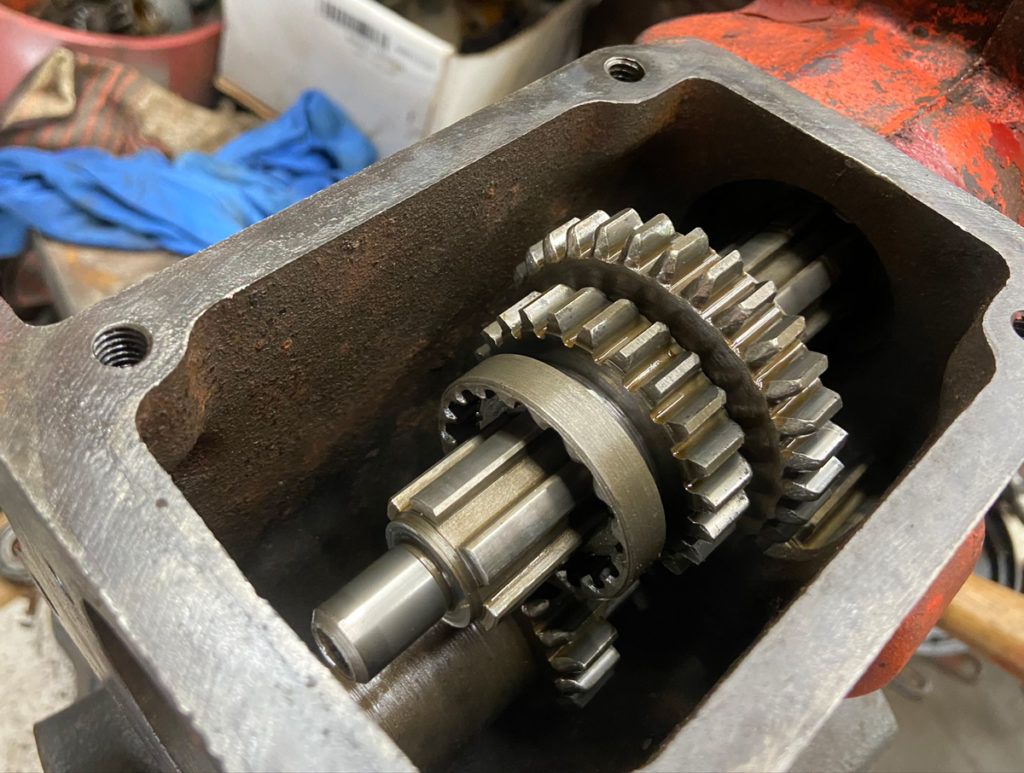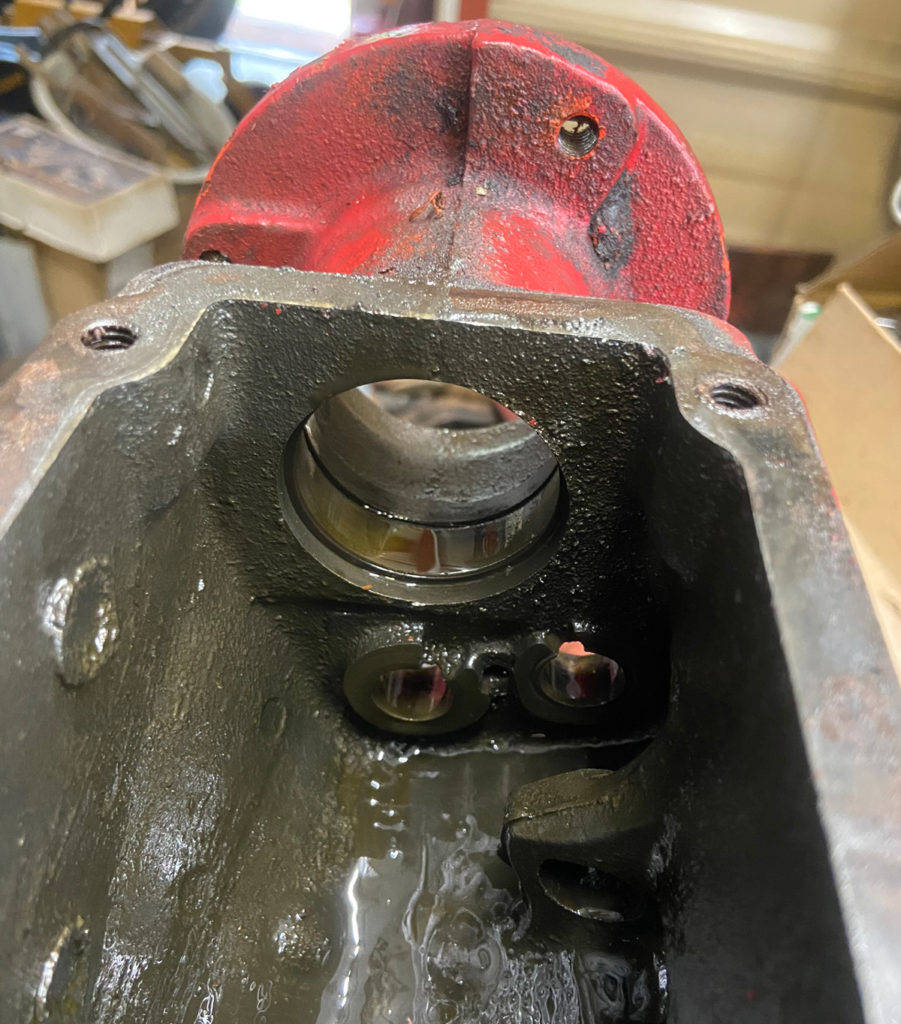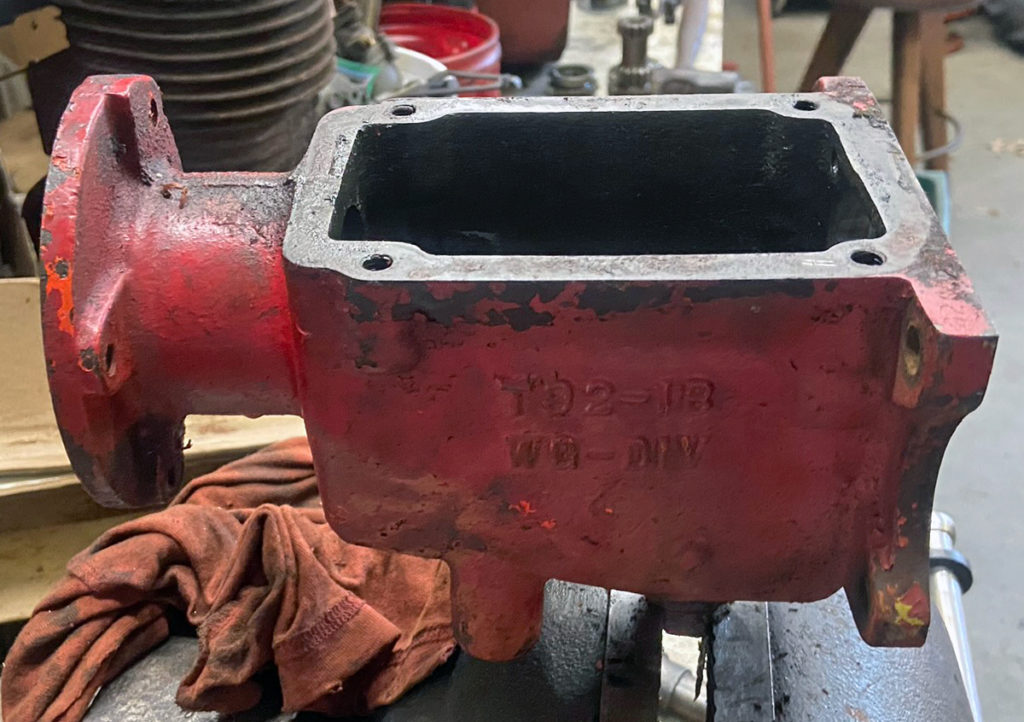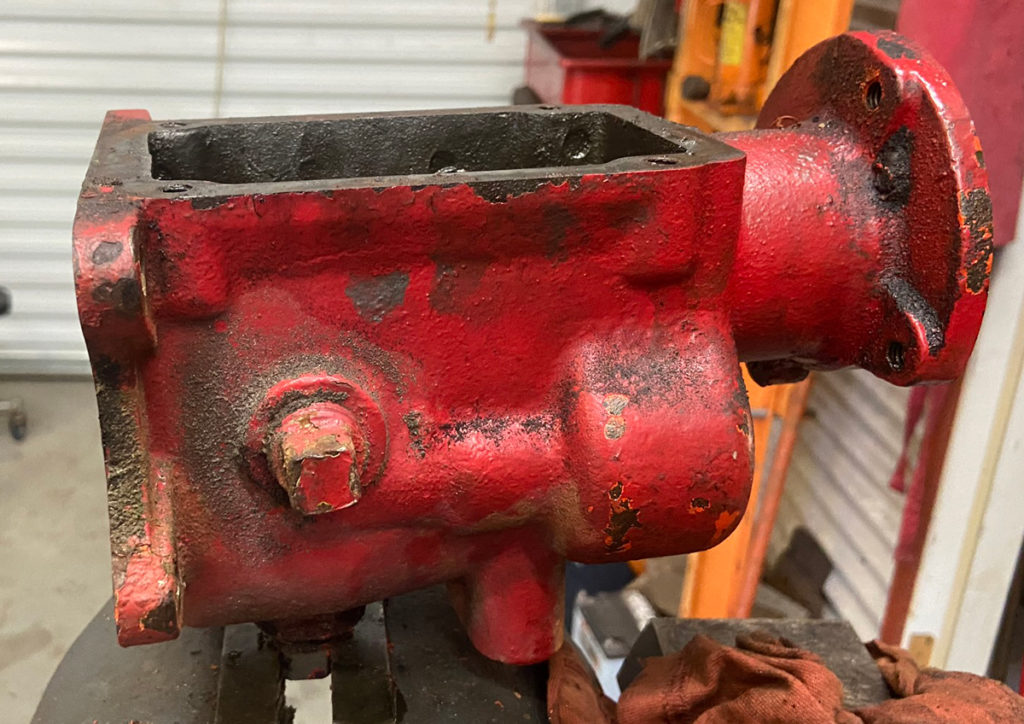
How to Remove the Shifter From an Economy Power King / Jim Dandy / Country Squire / Speedex / Crosley T92 Transmission

Shifter stuck on your Economy, Power king, or Jim Dandy tractor? You’re not alone — this happens all the time.

The bottom end of the shifter is usually the first thing to wear out on a T92 3-speed transmission, causing the transmission to become stuck in gear. The cure for that is to install a new or rebuilt shifter — and to do that, you need to take apart the transmission top or “tower.”

I advise you to read this all the way through before beginning this job.
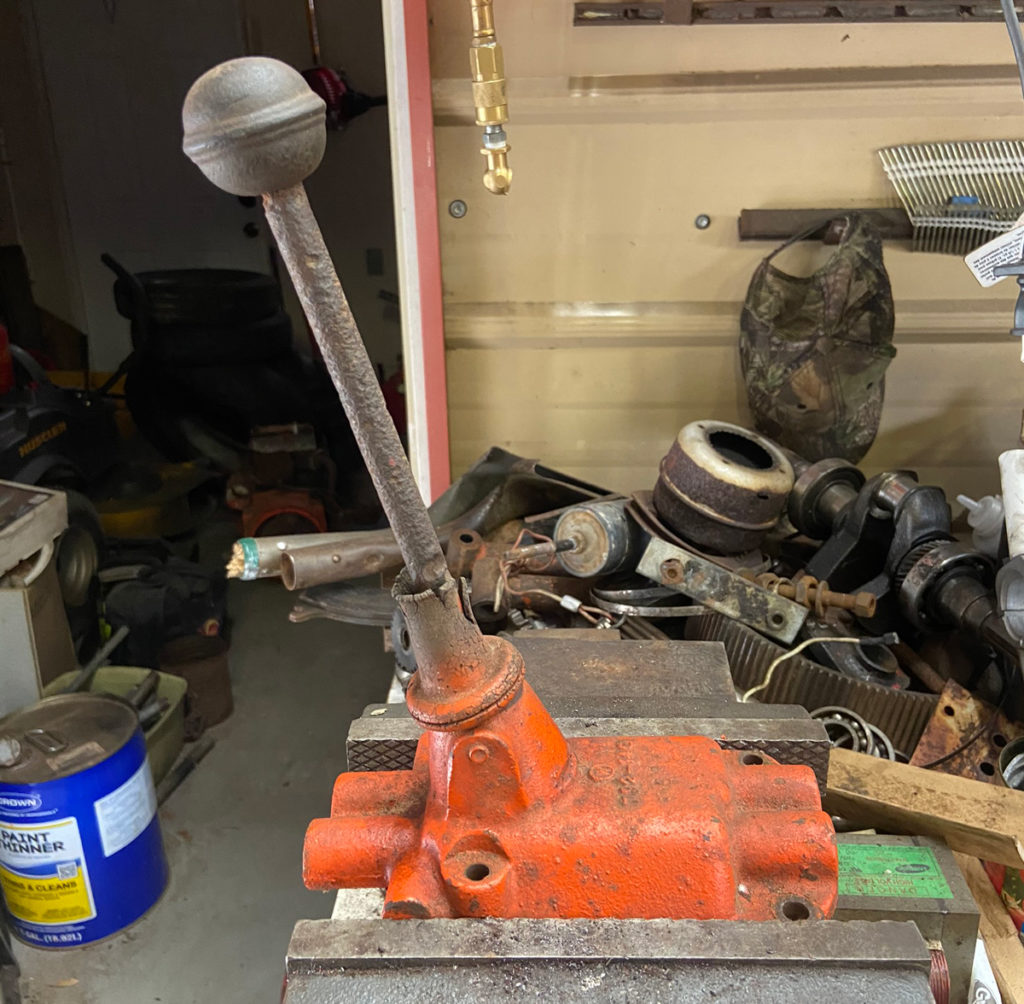
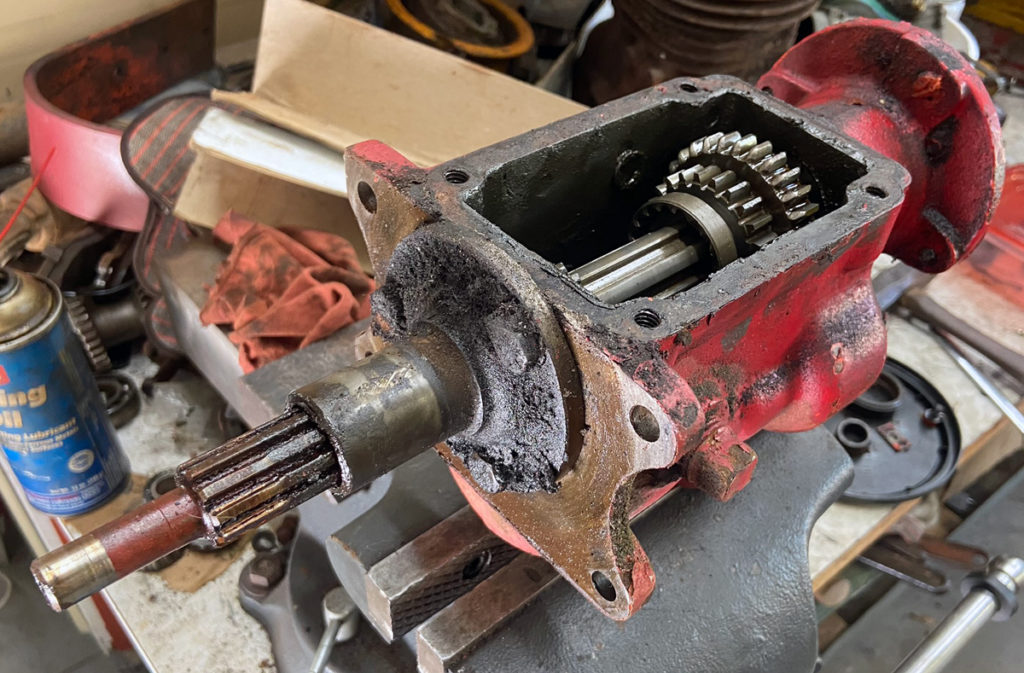
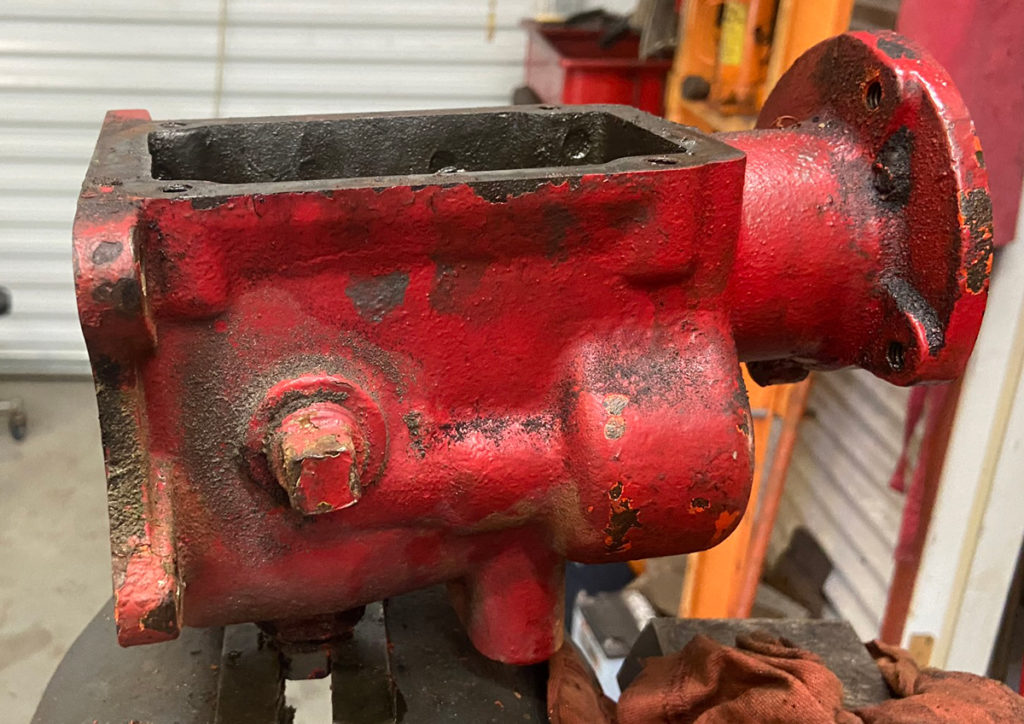
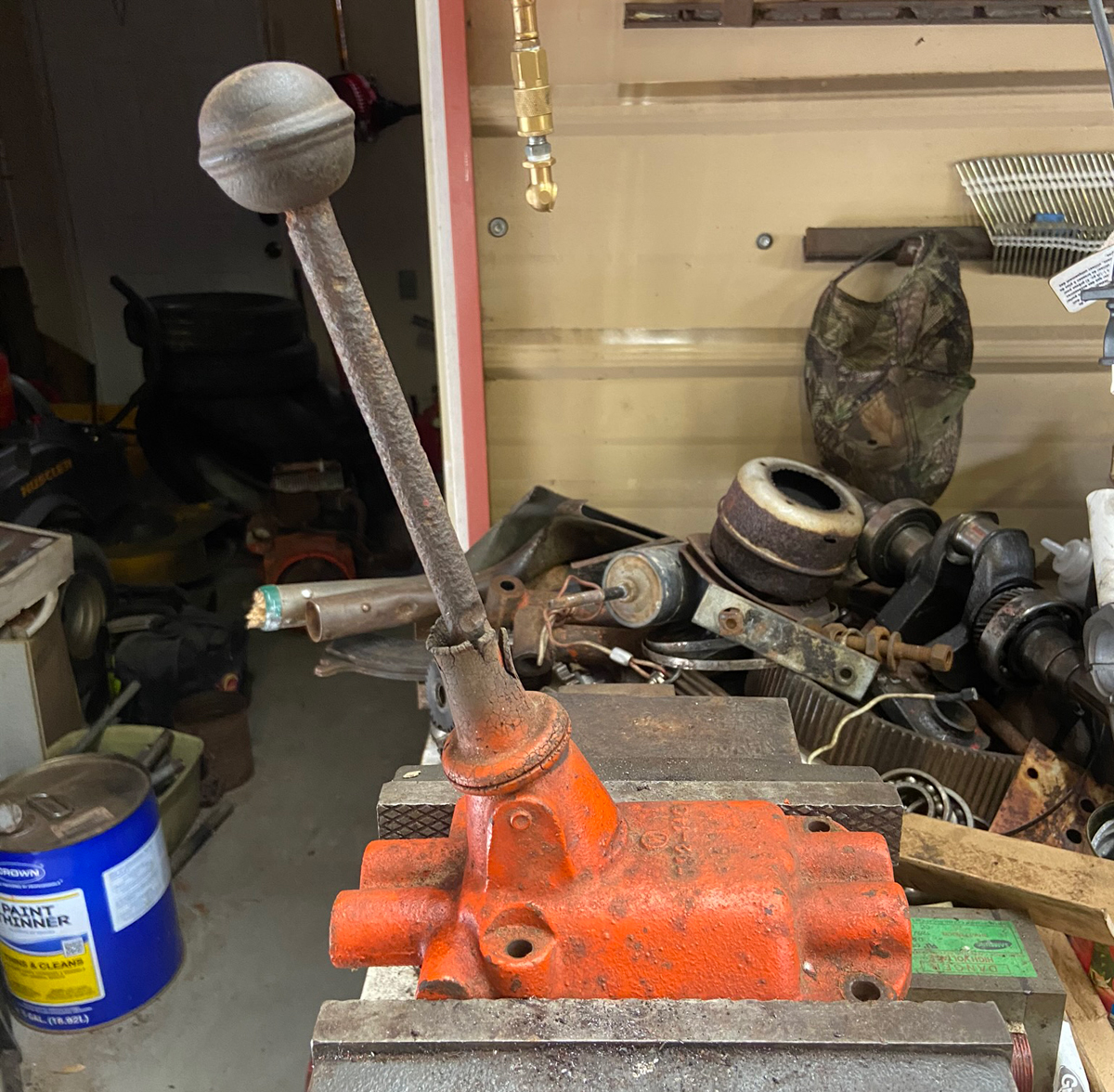
A T92 transmission top in the vise. First, remove the shifter ball. (Photo © Russ Chastain)

Hint: See that little pin just below the ragged rubber “boot?” Don’t try to remove it. More on that later…

The first thing to do is remove the shifter ball up top.
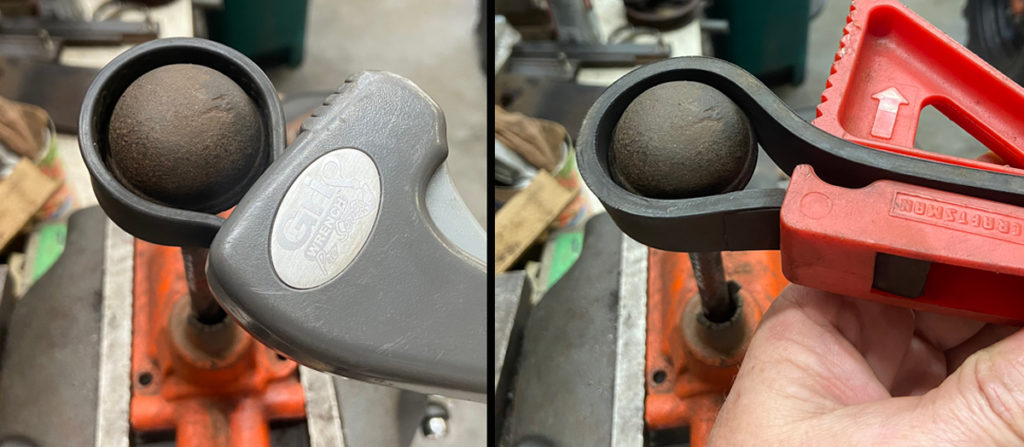
Most of the time you can use a strap wrench to avoid damage to the ball. (Photo © Russ Chastain)

Now is the best time to remove the shifter ball, because it will get much more difficult after the shifter is taken loose from the tower. The shifter ball is threaded on and is sometimes difficult to unscrew. It has normal right-hand threads, so “lefty loosey” is your friend. I always start with a strap wrench, to prevent damage to the ball.
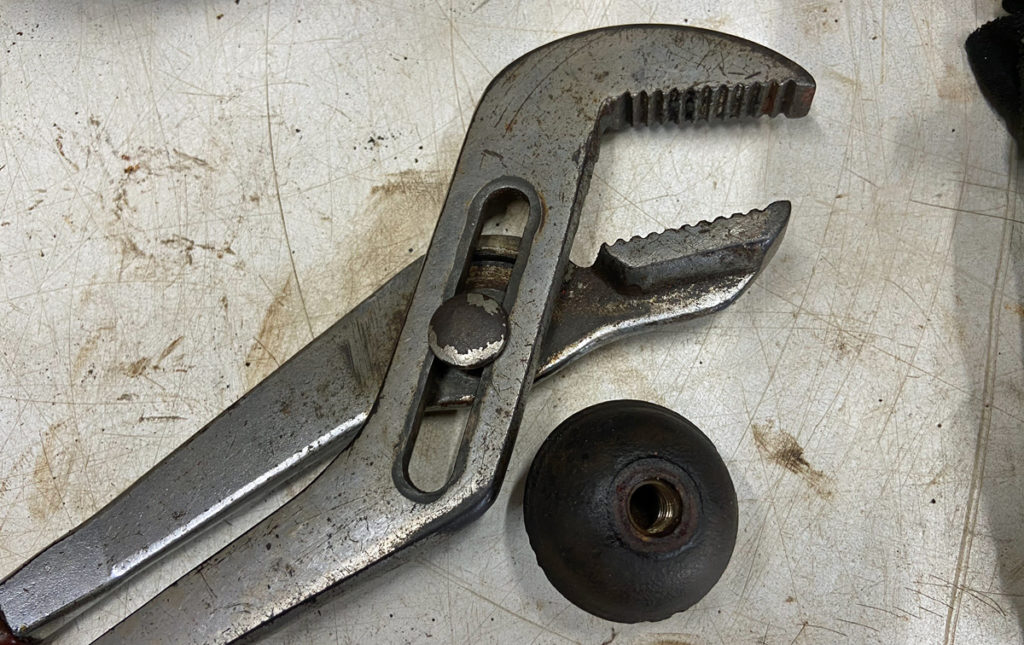
Sometimes you have to bring out the big tools, but that will leave marks on the shifter ball. (Photo © Russ Chastain)

More-stubborn balls require more-aggressive tools… when you put it back on, use some anti-seize on the threads.
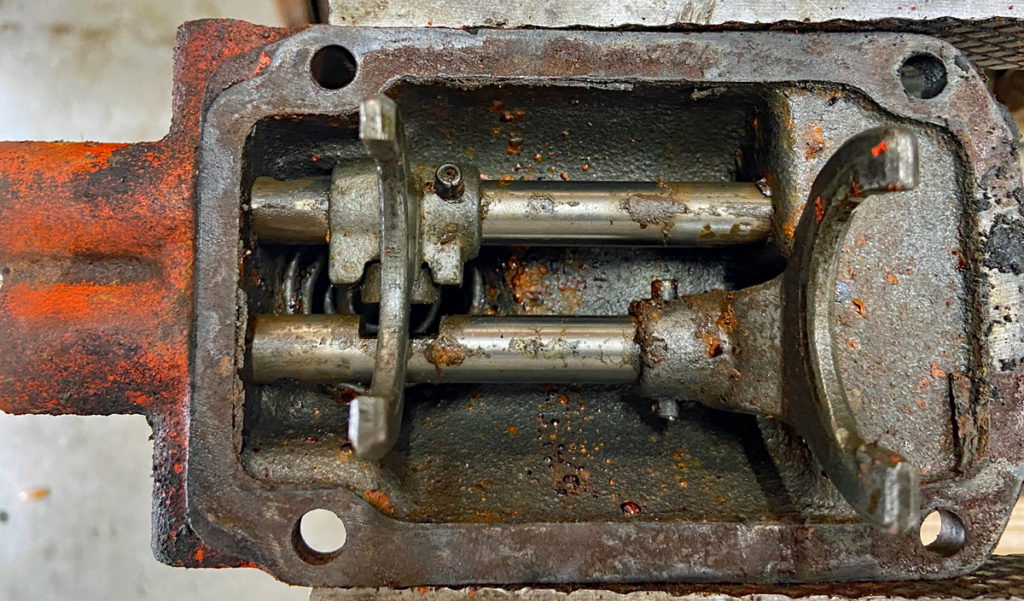
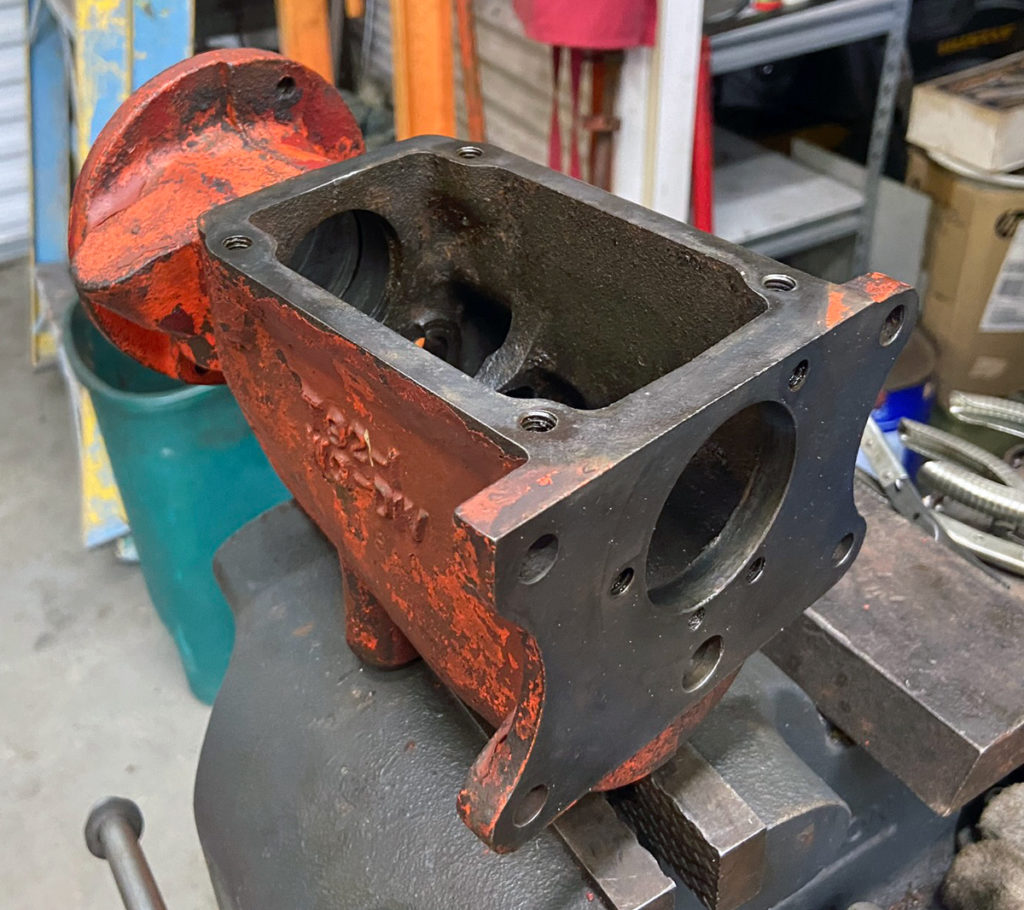
Clamp the top in a vise upside-down. This one is pretty clean. (Photo © Russ Chastain)

Then I like to clamp the trans top in a vise upside-down. Make sure the shifter is not in a bind and can move around a little.
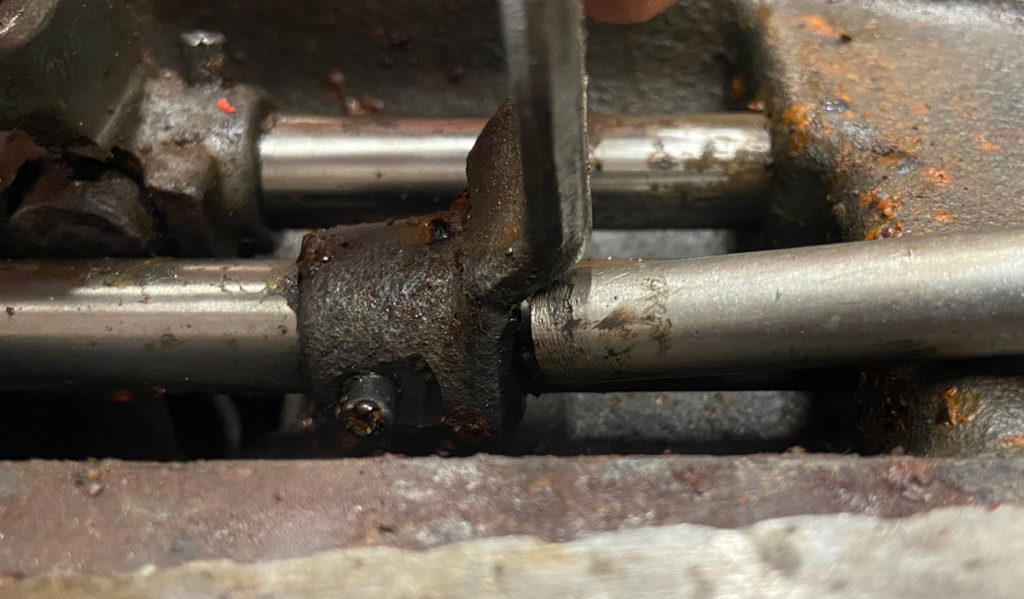
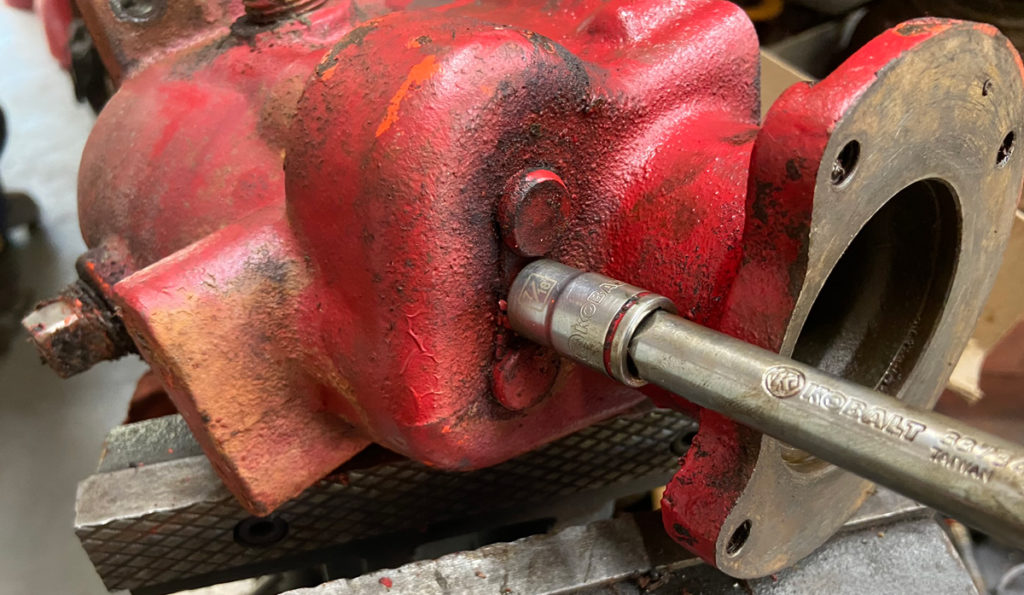
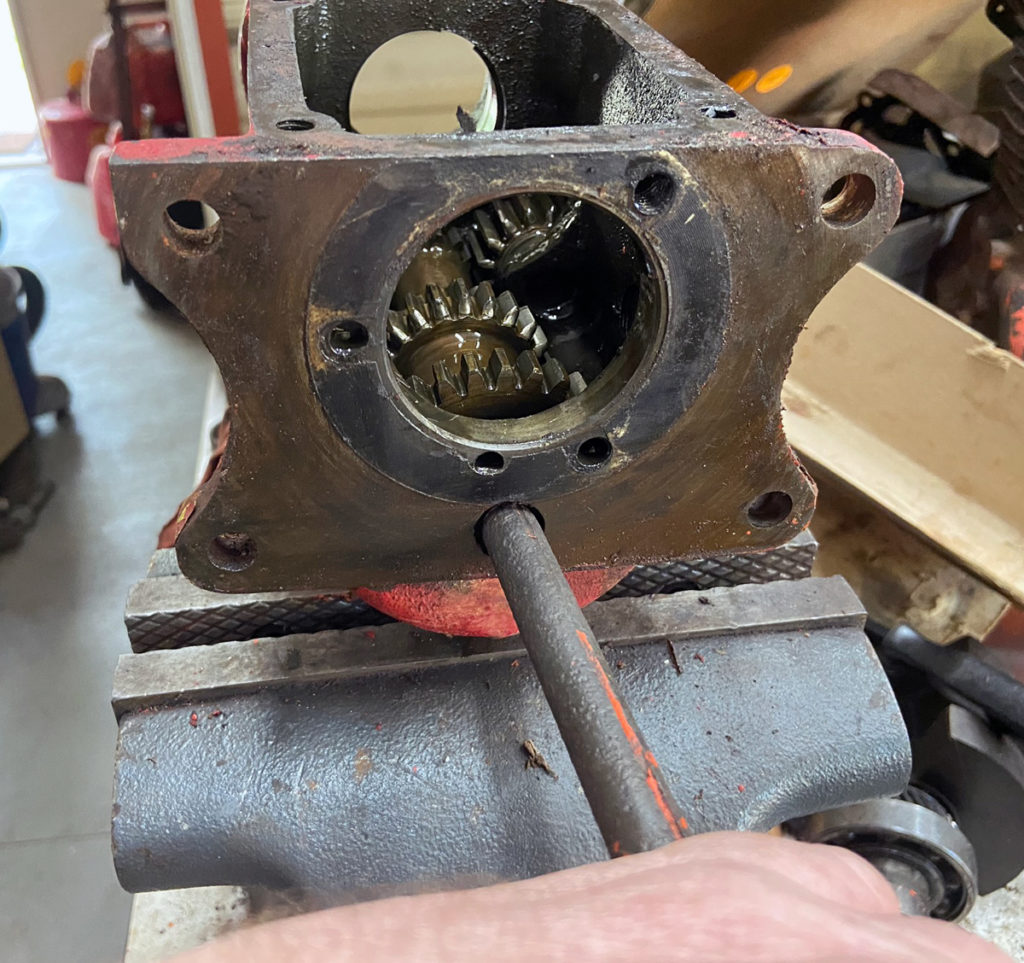
Use a punch against the base of the shift fork to avoid breaking the fork. (Photo © Russ Chastain)

The first step is to pop out one of the welch plugs by driving the shift rail into it from the inside. I use a punch placed on the base of the shift fork. NEVER hit the fork part or you’ll break it… don’t ask me how I know.
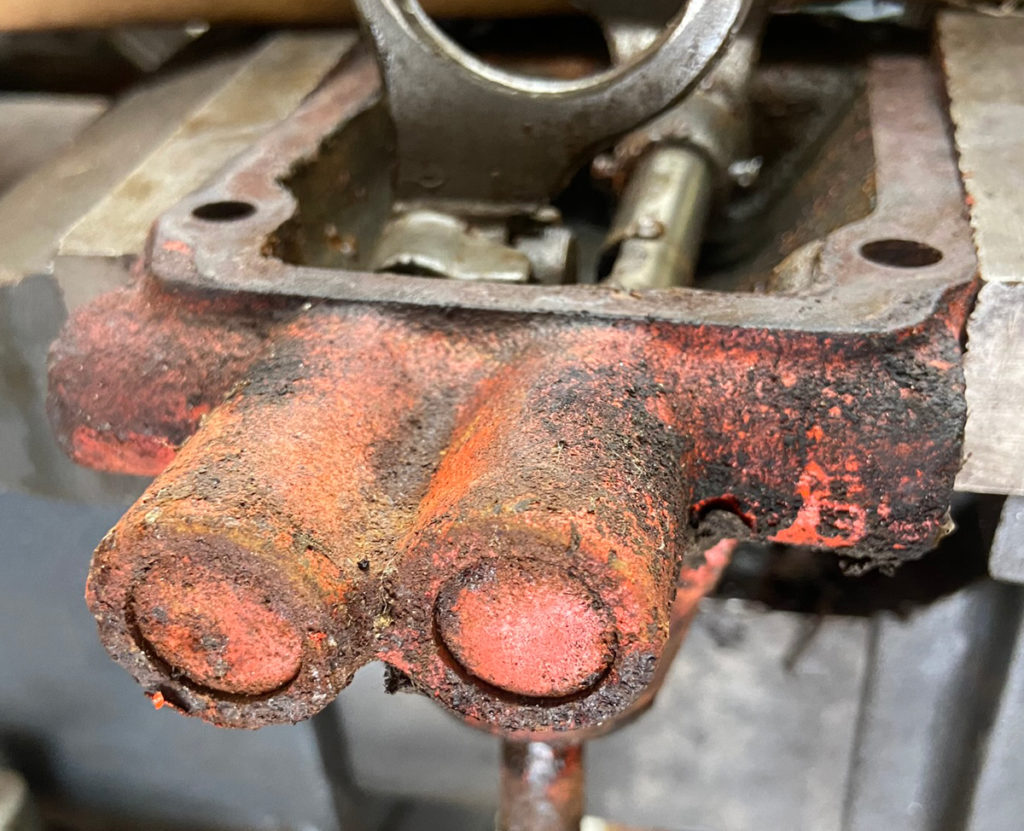
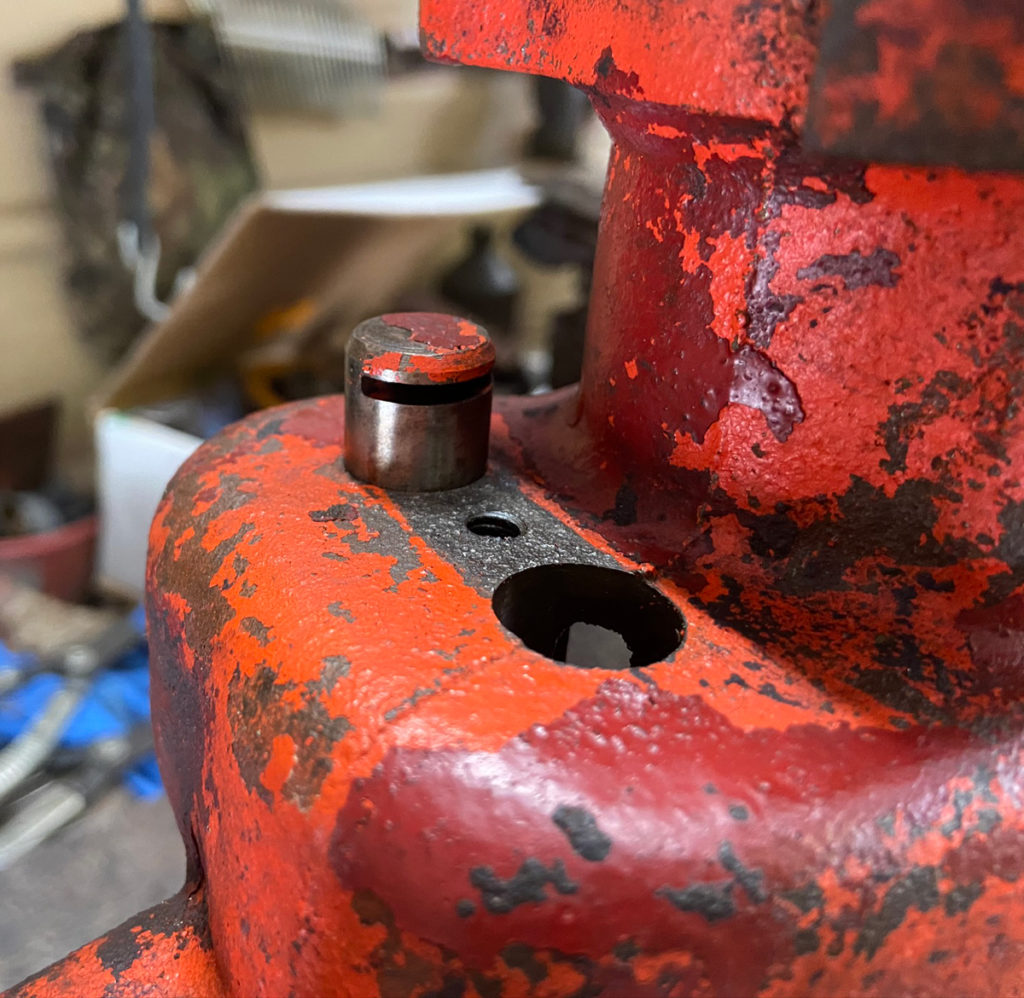
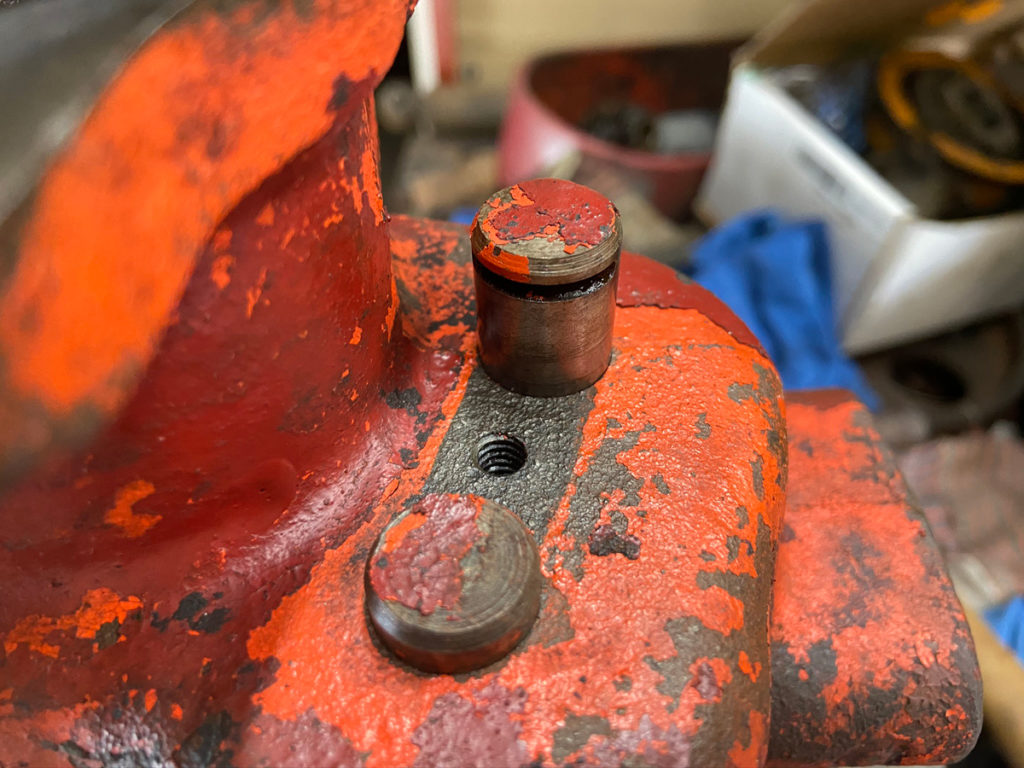
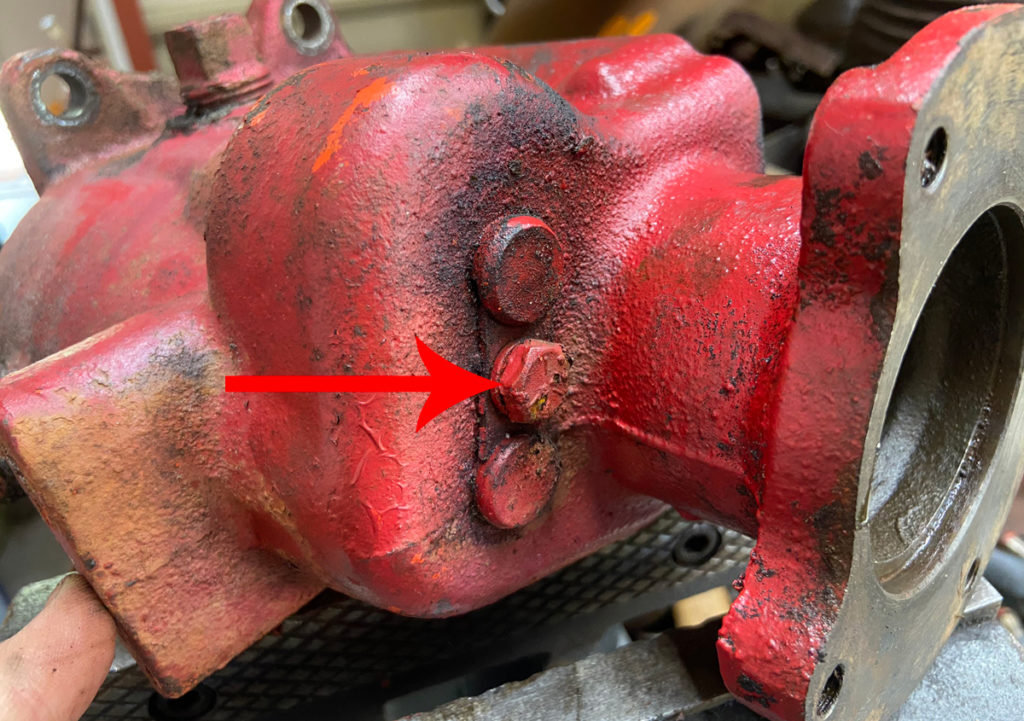
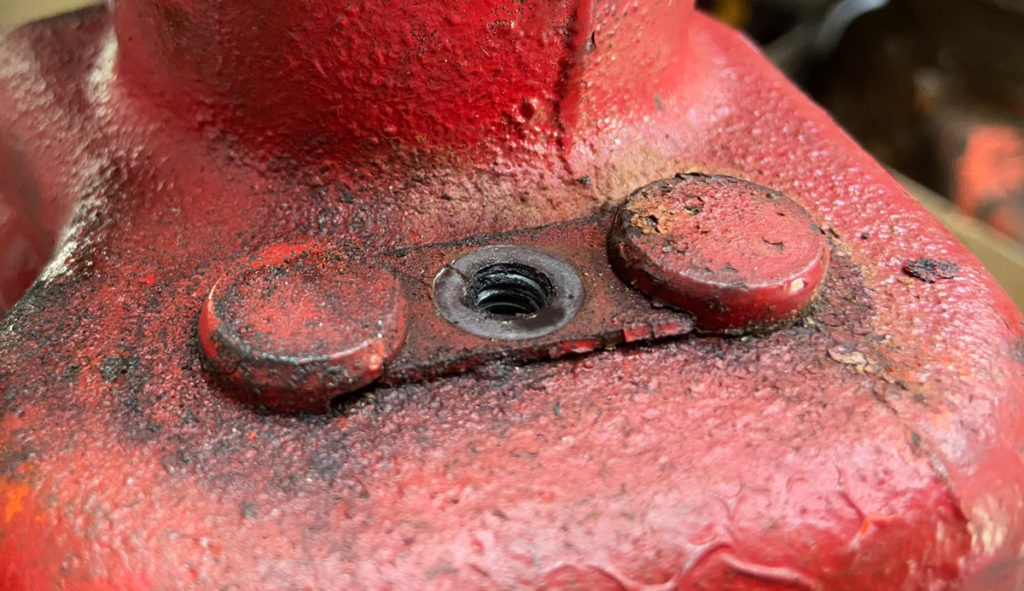
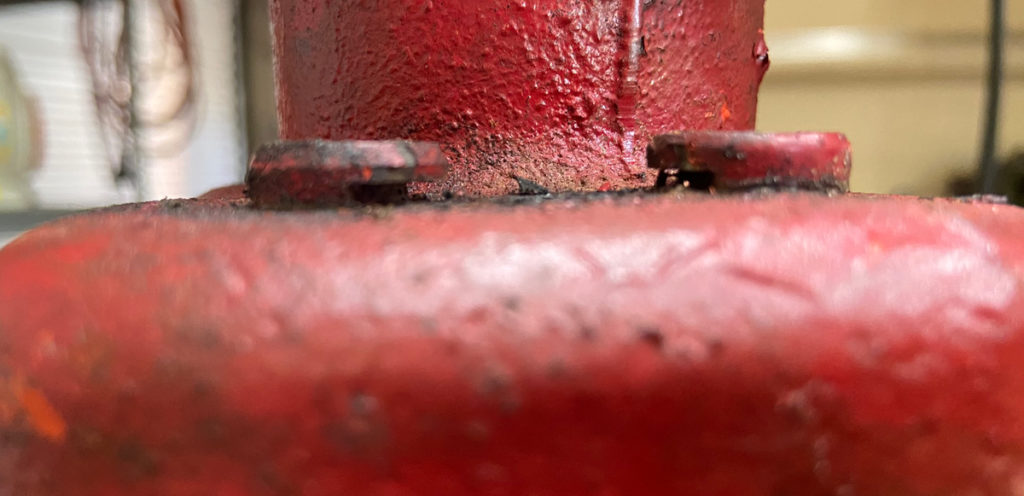
Pair of welch plugs on the end of the transmission cover. We are about to remove the one on the right. (Photo © Russ Chastain)

The round plug on the right in the photo above is our target. Be careful… sometimes they go flying when you pop them out.

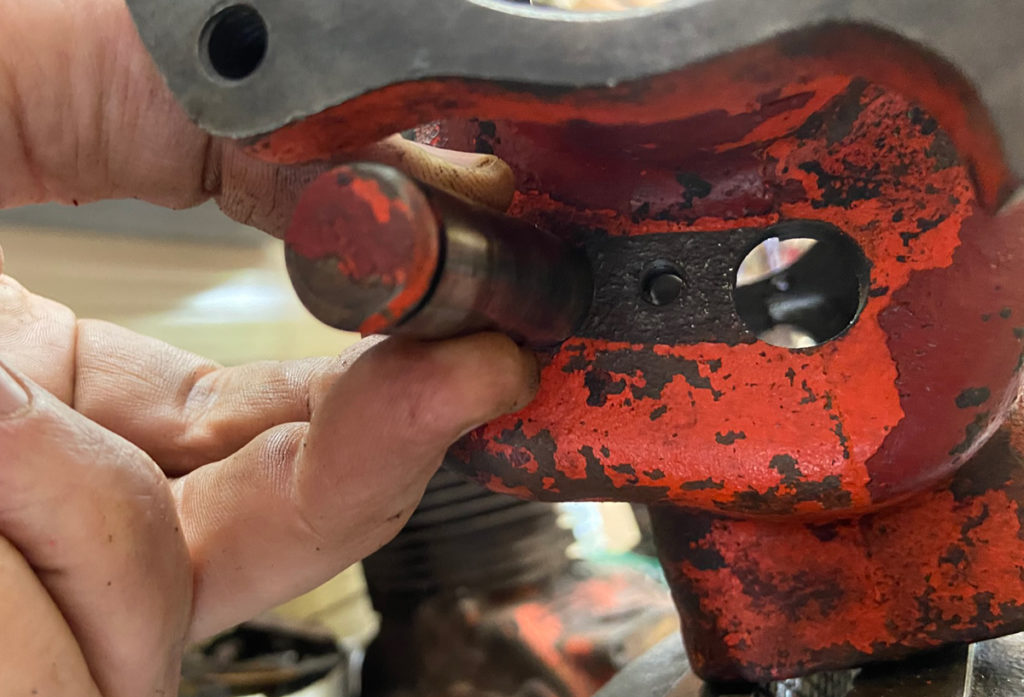
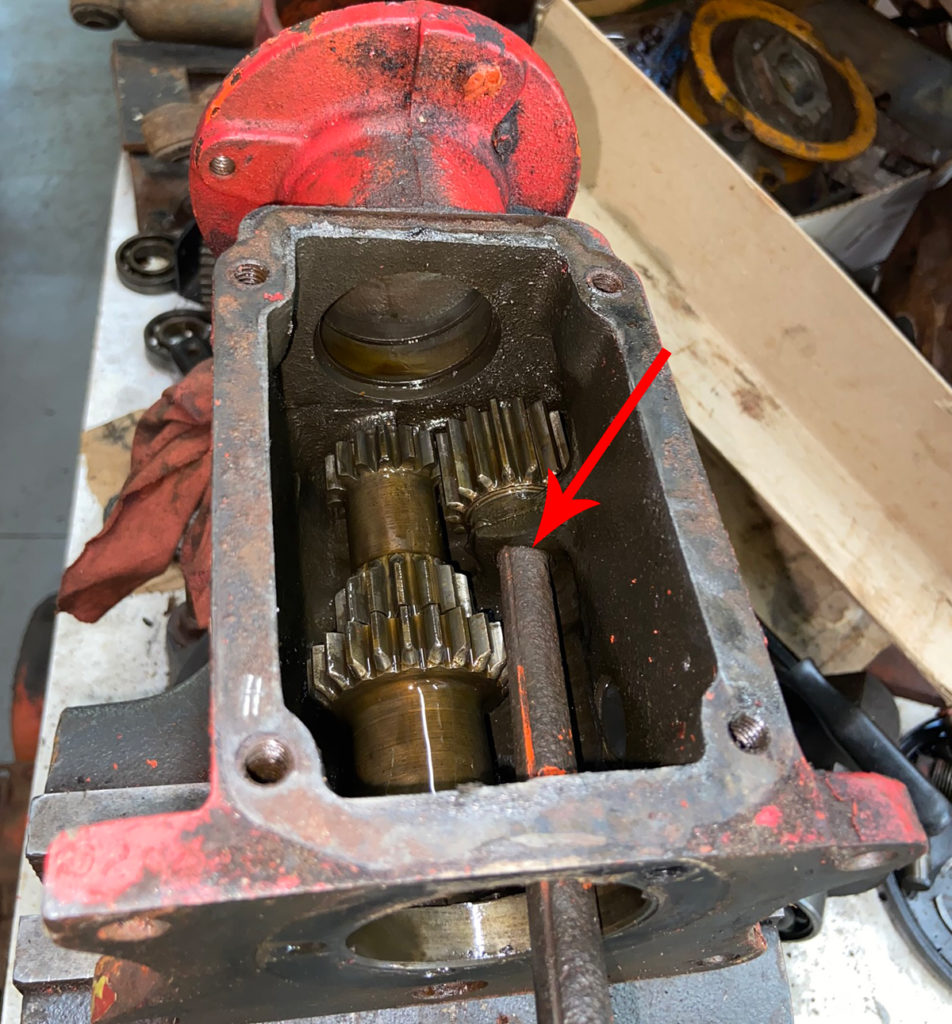
Welch plug removed by carefully driving the shift rail. (Photo © Russ Chastain)

And there’s the welch plug I just removed.
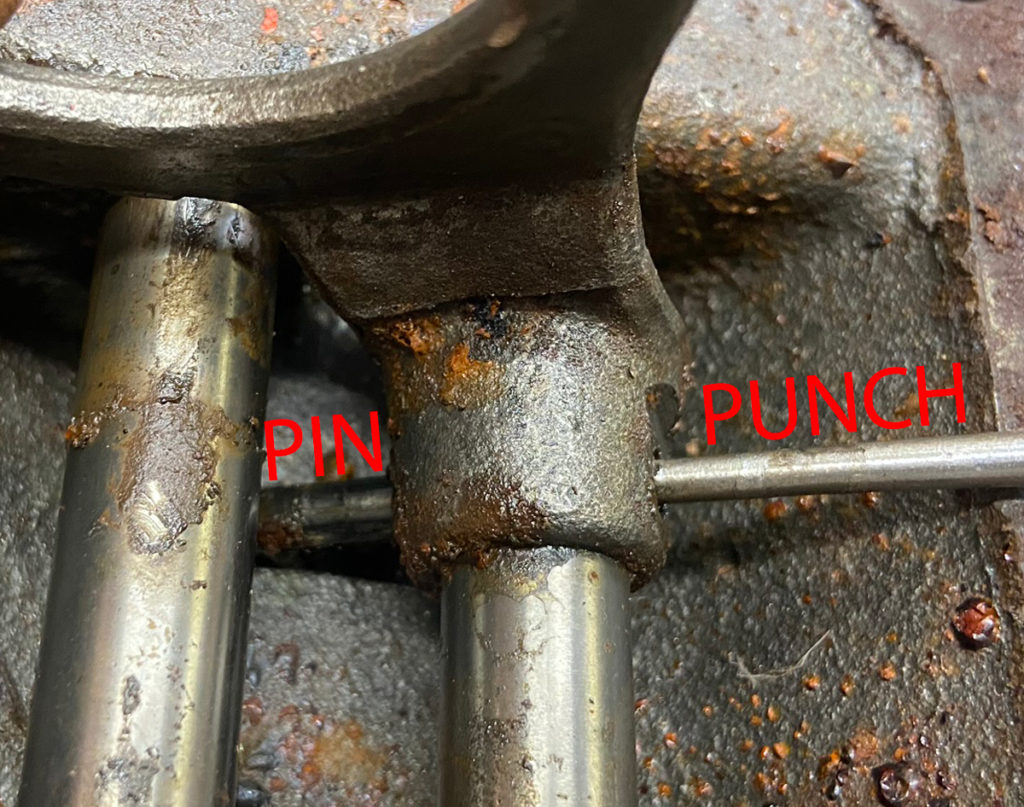
Now you can drive out the pin holding the fork to the rail. (Photo © Russ Chastain)

Use a punch that’s slightly smaller than the pin, to drive out the pin holding the fork to the shift rail. Make sure the shift rail is supported at each end when you do this.

Sometimes you’ll find rivets instead of roll pins — I’ve even found nuts & bolts in there — but either way the idea is the same: you need the shift rail to slide out of the fork, so the pin/rivet/bolt must be removed.

Once you do that, you can remove that shift rail entirely, or simply shove it out of your way towards the rear (meatier end) of the tower. Either way, you will have to move it past the detent assembly, so the other shift rail can move.
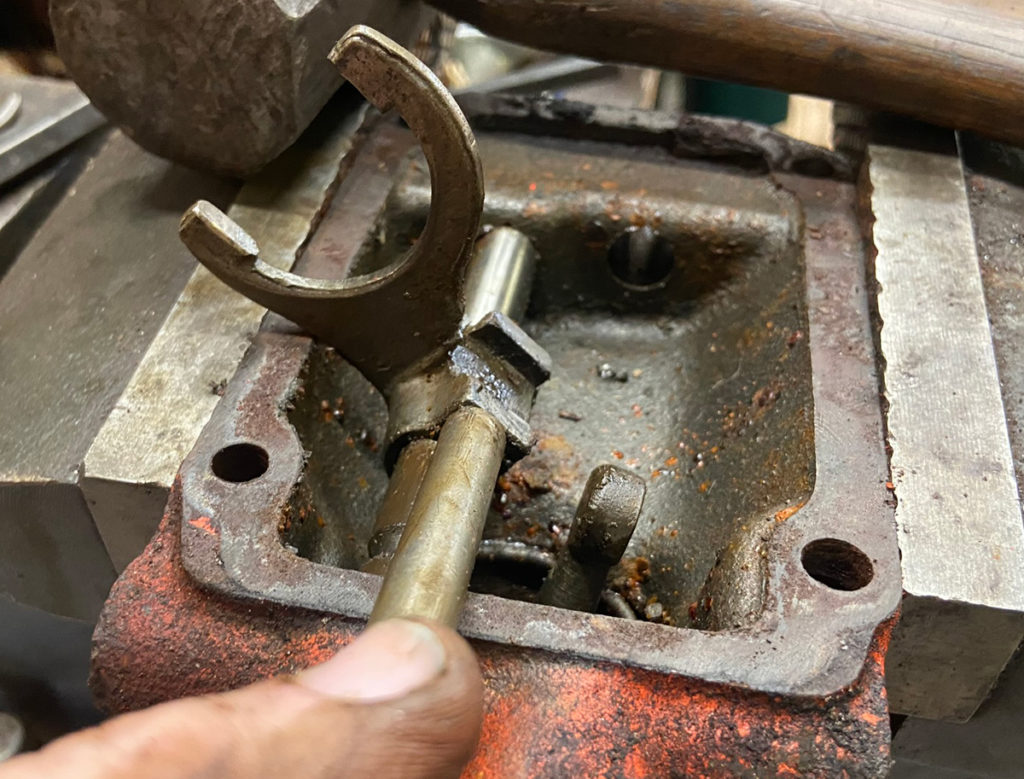
To drive the shift rail out of the way, rotate the rail and place a punch against the big part of the fork, then carefuly drive with hammer. (Photo © Russ Chastain)

On the other rail, drive it carefully in the other direction. This will pop out a welch plug; use care to prevent it flying off into the great wide open.
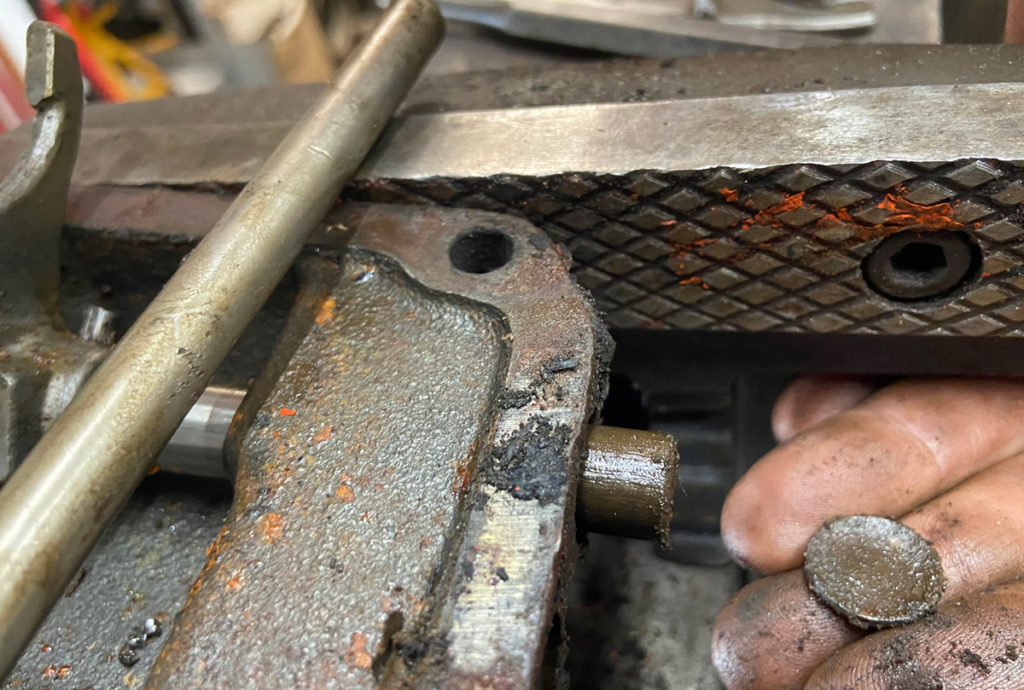
Welch plug removed. Don’t let it get away — it may go flying if you’re not paying attention. (Photo © Russ Chastain)

When the welch plug is out of the way, you can shove that other shift rail out of your way so you can get to the spring which secures the bottom of the shifter.

At this point, some small bits may fall out of the shift rail holes and down into the spring area… these are usually small steel balls. Don’t lose them.
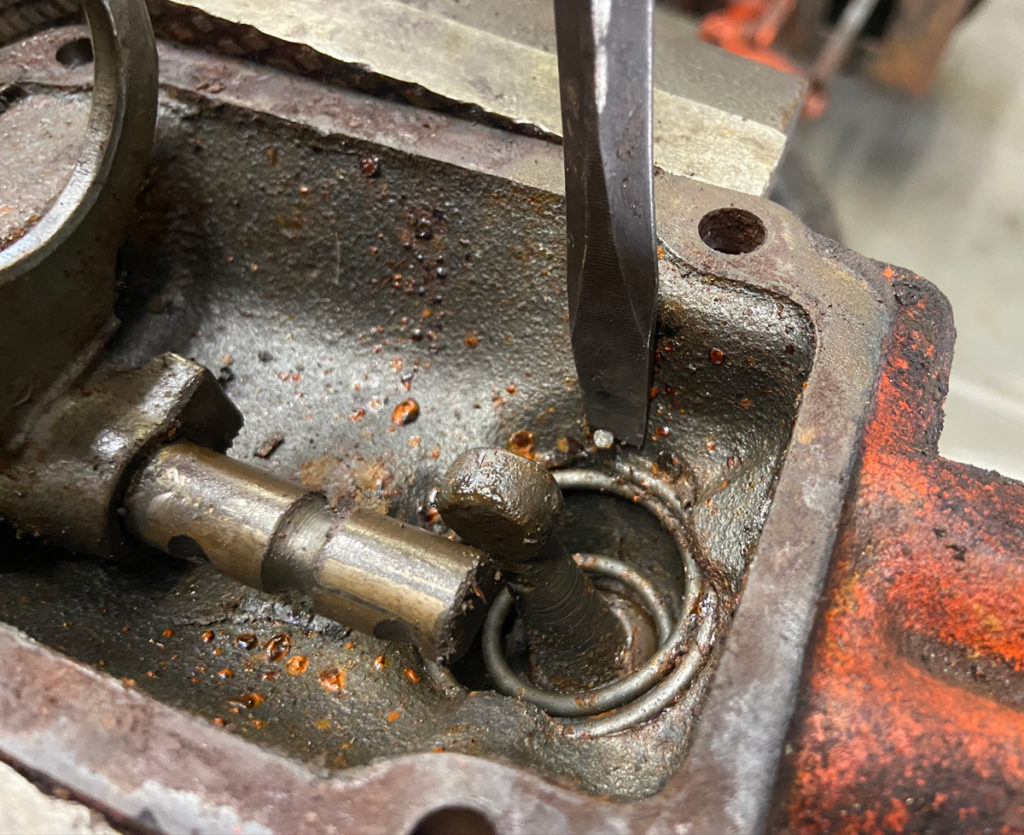
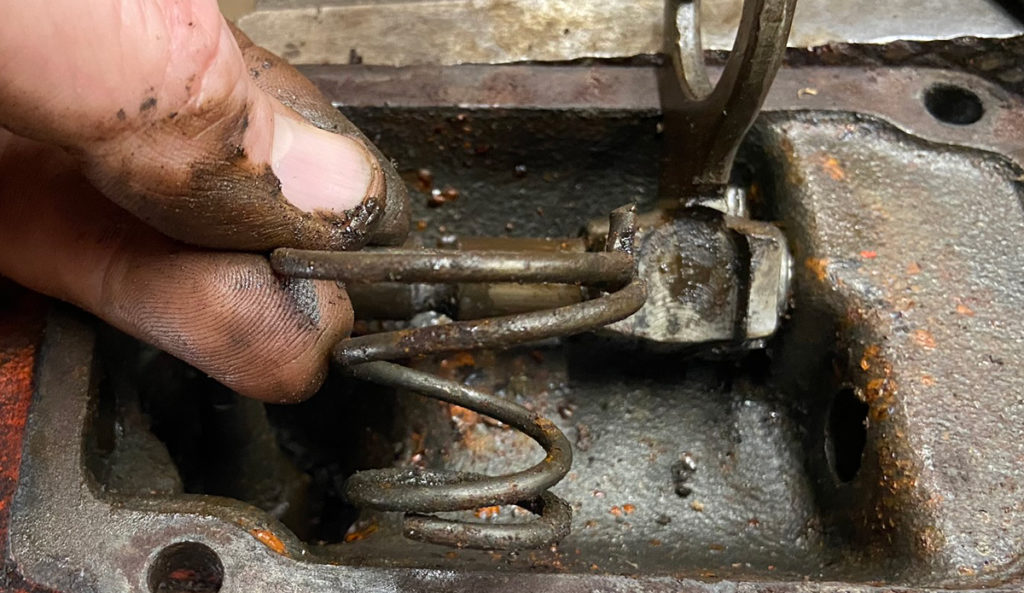
I use a big screwdriver to remove the spring that holds the shifter in place. (Photo © Russ Chastain)

A big screwdriver does the trick to work the big spring out of your way so you can remove the shifter.
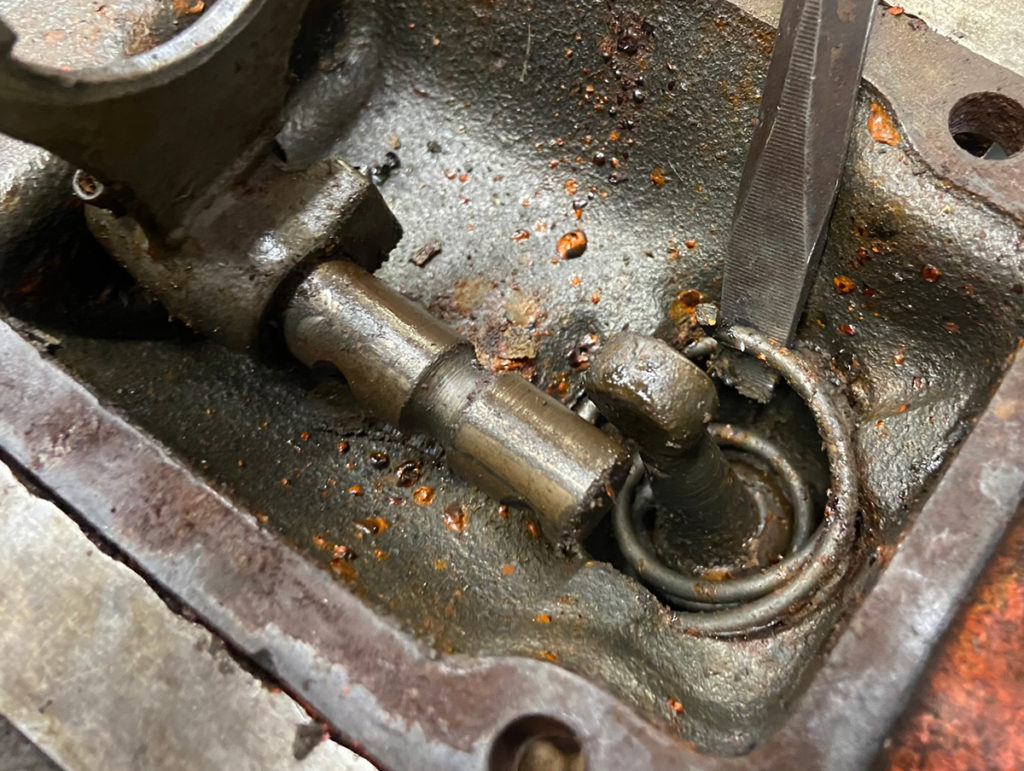
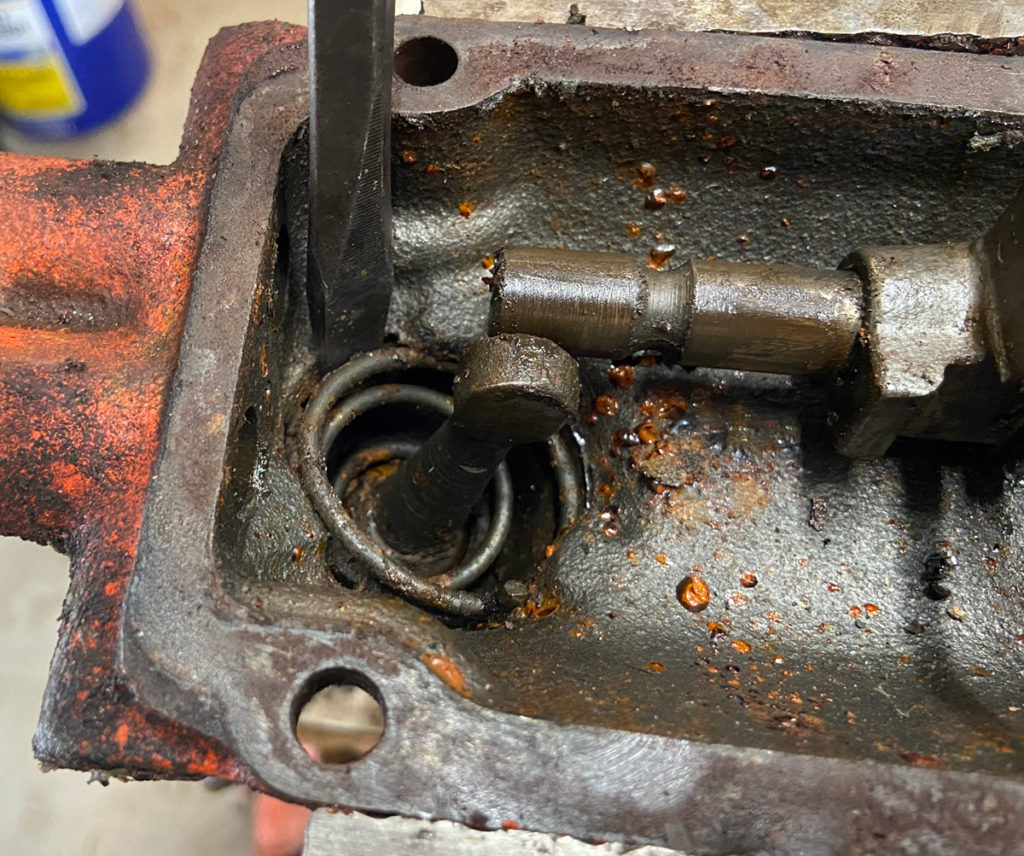
Just pop it loose of the cast iron tabs, one at a time. (Photo © Russ Chastain)
Work your way around the spring with the screwdriver. (Photo © Russ Chastain)
And there’s the spring. (Photo © Russ Chastain)

Success! Once the spring is out, the shifter just lifts right out.

I can repair your old shifter and return it to you, or you can weld & grind it back to spec yourself. If you’re interested in having me do it, feel free to contact me at pkjimdandy@gmail.com
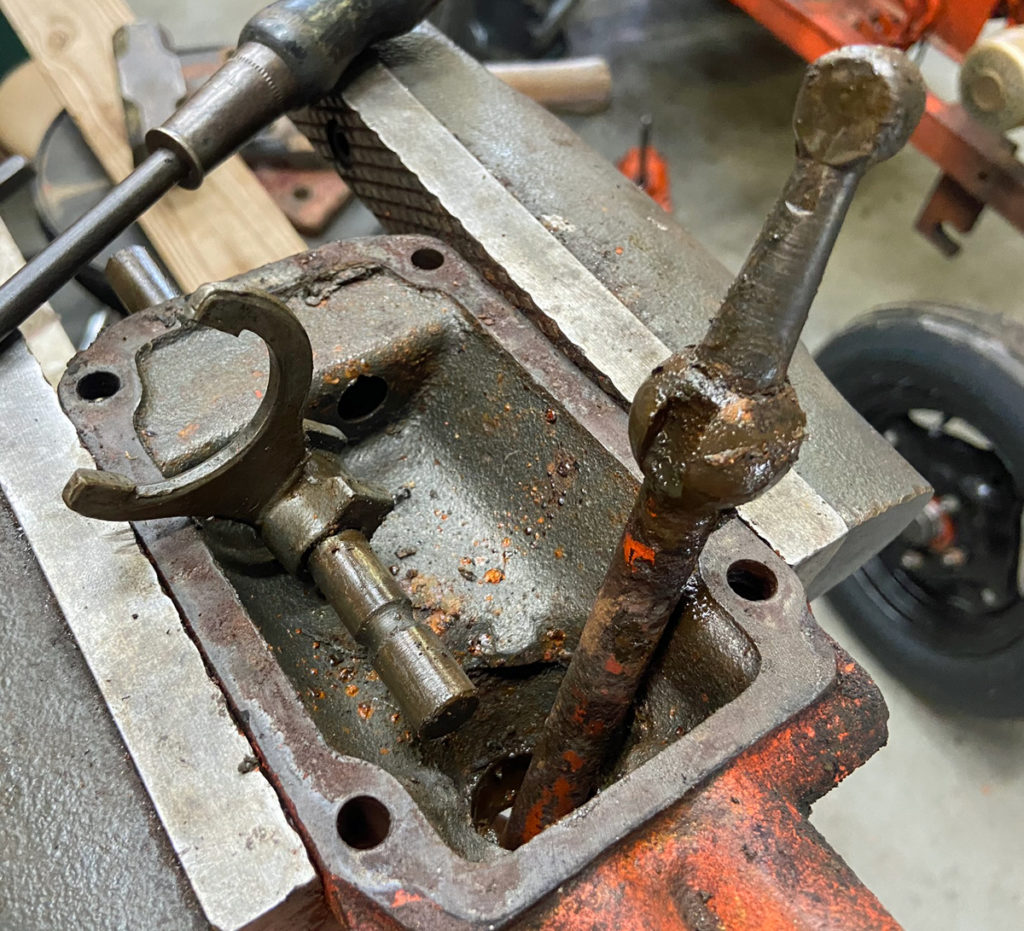
Remove the shifter through the bottom of the transmission top. (Photo © Russ Chastain)

Now you can install your new or overhauled shifter. The little pin I mentioned in the first paragraph above is used to index the shifter, like so. This is how you want it to look before you install the spring.
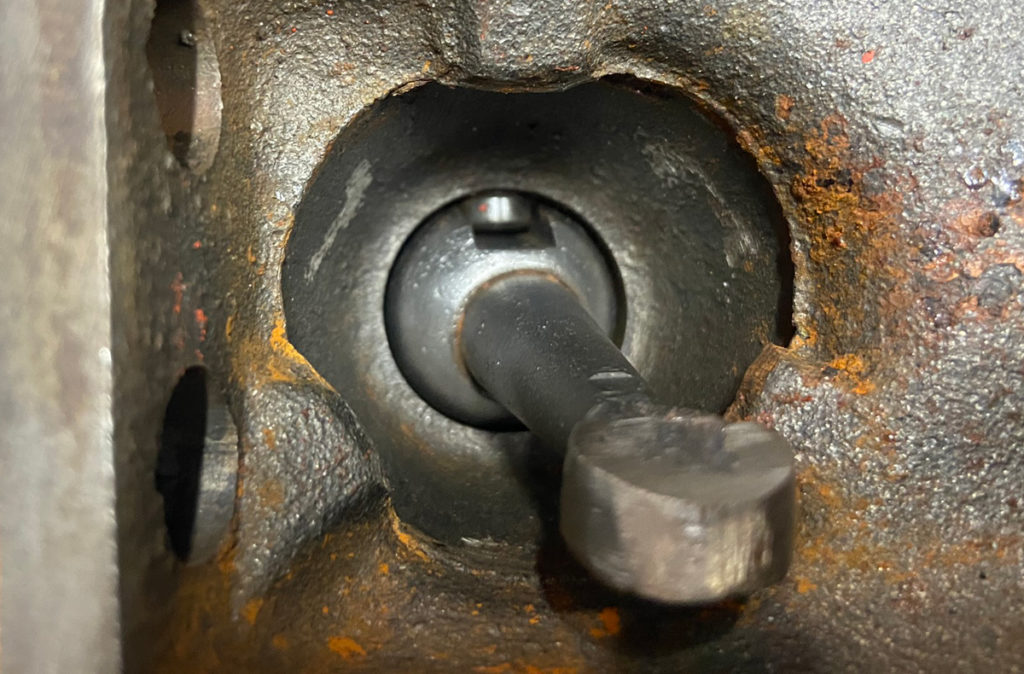
The slot in the shifter ball is indexed on the pin. (Photo © Russ Chastain)

Just pop the spring under its keeper tabs by working it in a little at a time using hammer & large screwdriver.
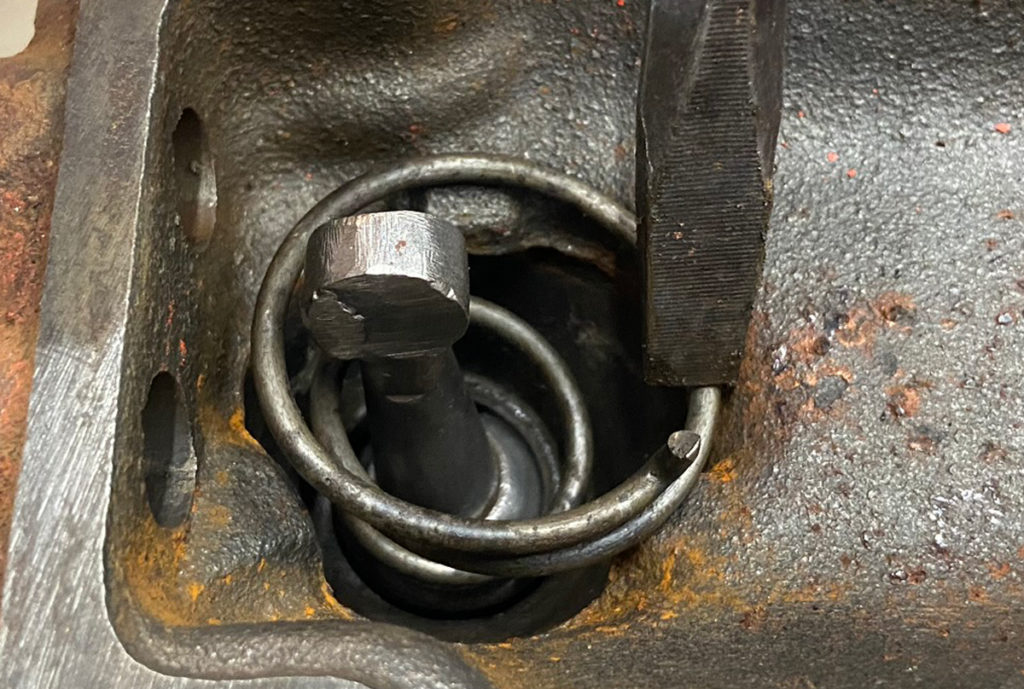
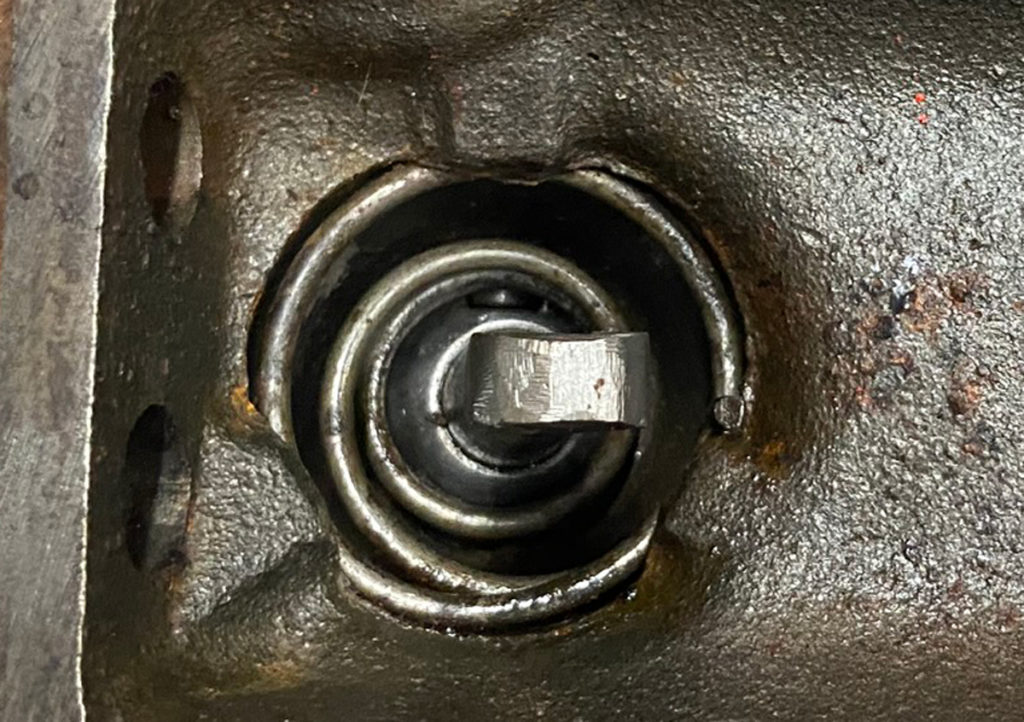
The easiest way to install the spring is to pop it in a little at a time. Hammer and screwdriver work well for this. (Photo © Russ Chastain)
Spring installed. (Photo © Russ Chastain)

Now you can re-pin the shift fork to the rail, if you removed that pin. LIne up the holes, but don’t drive the pin until both ends of the rail are in the cast iron top so they’re supported.

First shift rail & fork lined up and ready for the roll pin. (Photo © Russ Chastain)

Then you can drive the pin on in, ideally with the same amount sticking out on either end.
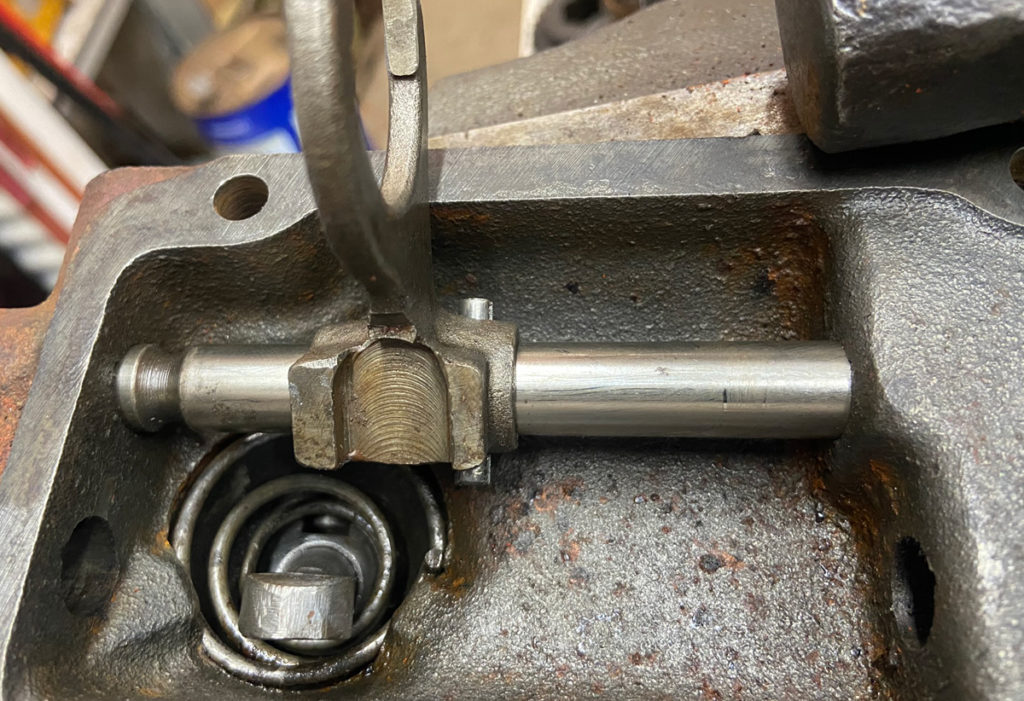
Roll pin installed. I like it to protrude evenly from each side. (Photo © Russ Chastain)

It helps to understand how the shifter detent system works. In the pic below, I set things in place but neglected to include the springs, so I drew those in with great artistry. This is how the parts are arranged inside of the “tower” when everything is assembled correctly.

This illustrates why you can only move one shift rail at a time… that center slug only lines up with the grooves on both rails when both rails are in the neutral position. At any other time, one rail is secured by the detent slug while the other rail is free to move.
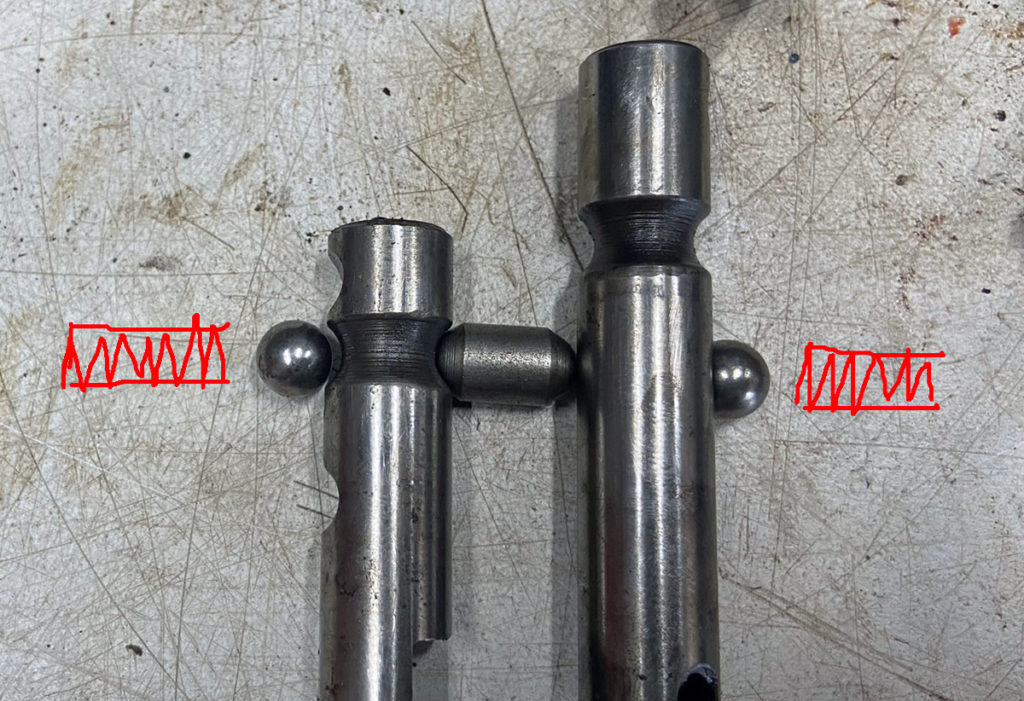
This is how the shifter detent parts are arranged. I had to draw in the springs because I didn’t have any handy. (Photo © Russ Chastain)

You need to get the parts in place progressively… in this case I would start by assembling the rail we just pinned the fork to (the right side in the photo below)… so I’d make sure the slug was out of the way as it is in the pic below, and the right ball in place over the spring. Then you can shove the right rail in there — making sure the ball stays in that hole with spring tension pushing against the rail.

What sometimes goes wrong here is the ball will come out and get ahead of the rail… then it’s time to back up, retrieve the ball, and try again.
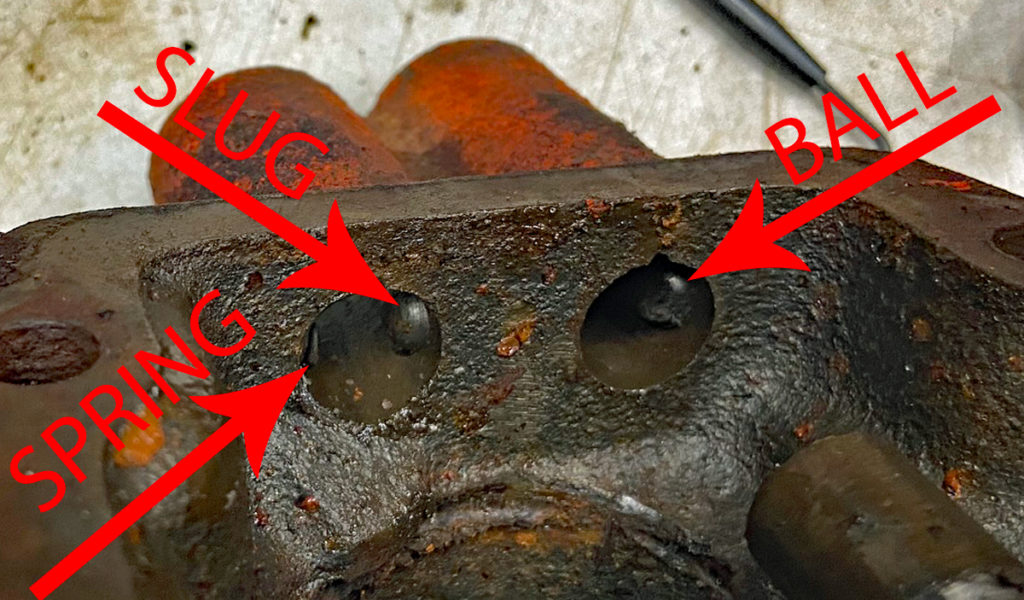
If your stuff looks like this, use caution! That spring needs to get shoved back in and a ball placed over the end before that shift rail (on the left in this photo) is installed. (Photo © Russ Chastain)

Next, move the newly-installed rail into the neutral position. You will know it because the ball will pop into the groove on the shift rail.

Use a little screwdriver to push the slug (indicated by arrow) off to the side, and make sure the spring & ball are in the hole opposite the slug. Place the end of the shifter into its notch in the shift fork, as in the photo below.

Inserting the rail from the outside of the tower, I use a small screwdriver to hold the ball back against its spring while I shove the rail in.
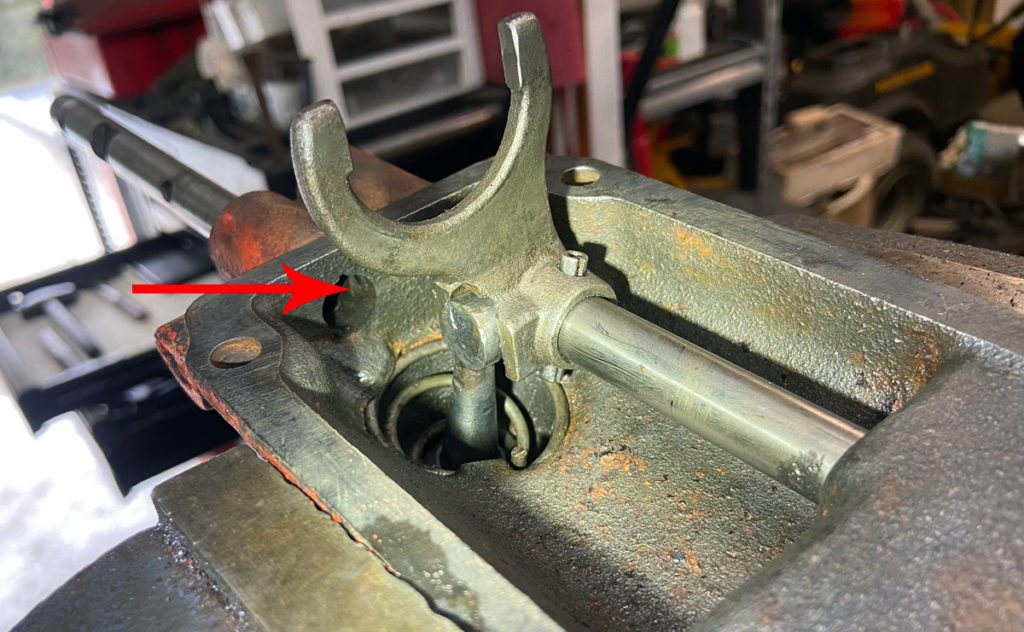
Before you insert the other rail, place everything in neutral with the shifter in its slot. Arrow shows the detent slug has been pushed out of the way. (Photo © Russ Chastain)

As you push the rail on in, it needs to go through the fork… make sure you don’t get the fork backwards. It should look like the pic below.

This is the way the fork should be. (Photo © Russ Chastain)

Align the holes in fork & rail, and drive in your roll pin.
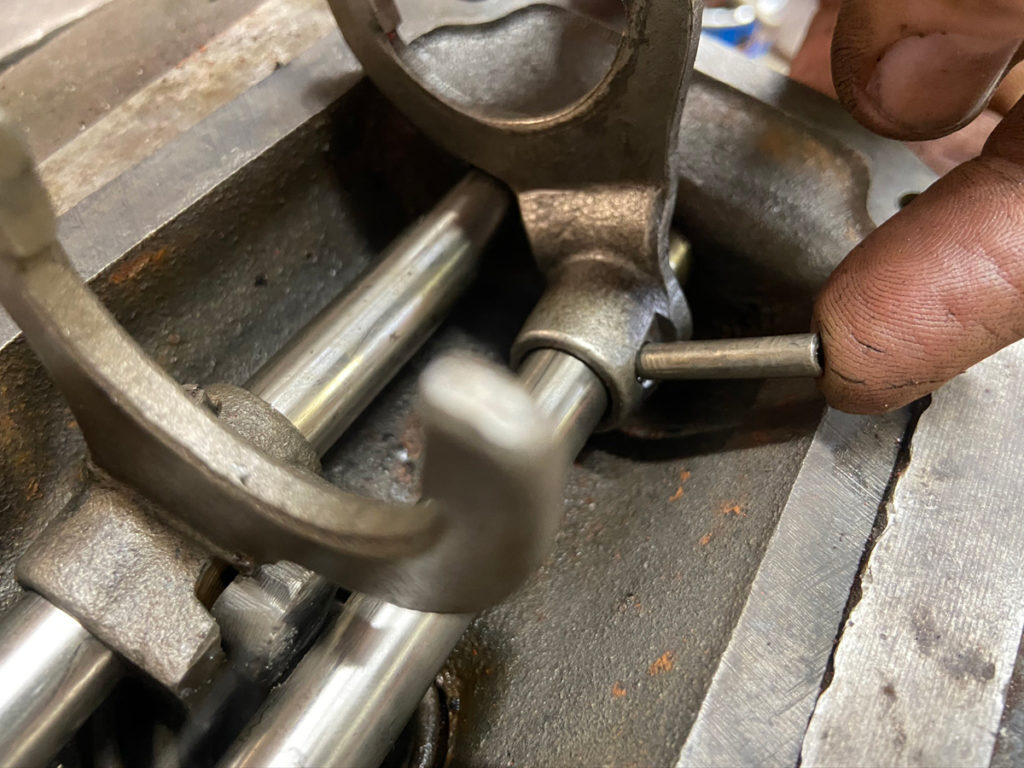
Ready to drive the roll pin home. (Photo © Russ Chastain)

Nice work! All done but the welch plugs. You can use new ones, but I usually clean up & re-form old ones so I can reuse them.
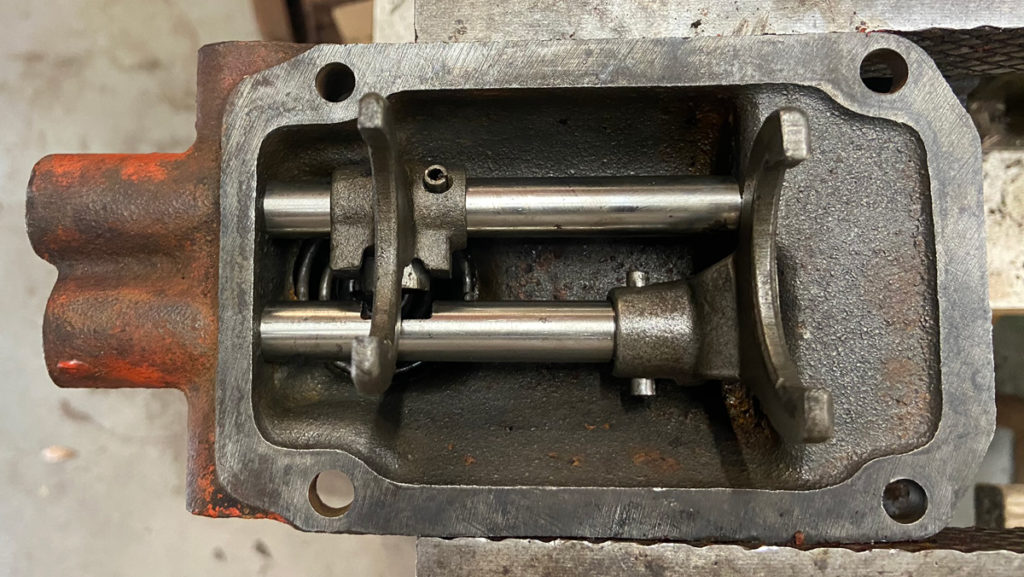
All done! Except for the welch plugs. (Photo © Russ Chastain)

When new, a welch plug is a small disk that’s been formed into a shallow dome. When it’s put in place, a punch against the dome expands it to fit its hole. So after removing these plugs, they must be re-domed. The two below are used and have been somewhat flattened by a punch. The left one is right-side-up and the right one is upside-down.
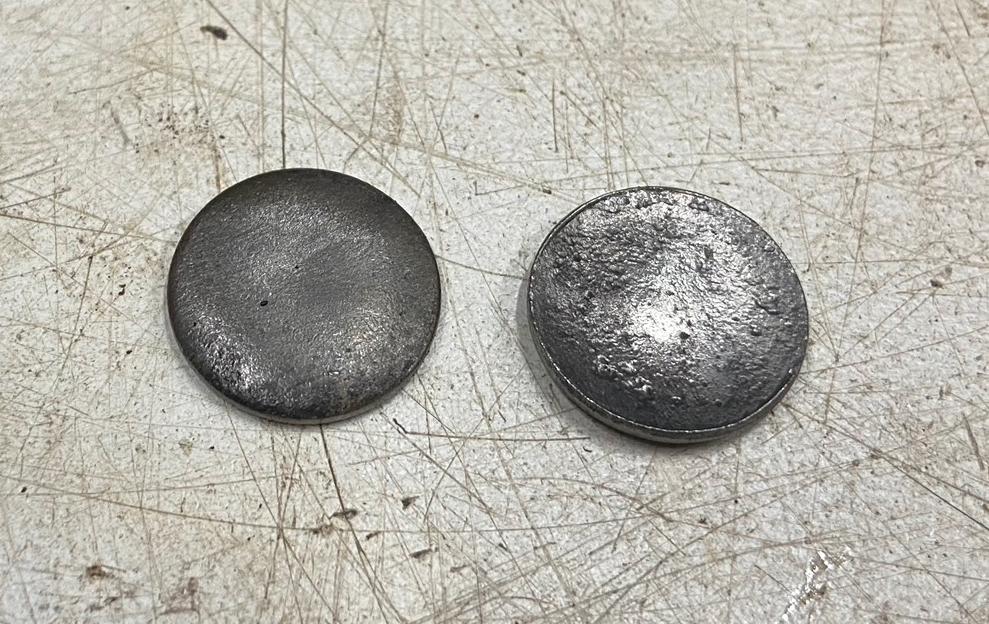
The old welch plugs can be reused. A wire wheel cleans them up, but they must be un-flattened (or re-domed) before they can be installed. (Photo © Russ Chastain)

These are the only tools you really need… anything to support the outer edges of the welch plug (a nut in this case) and a steel punch.
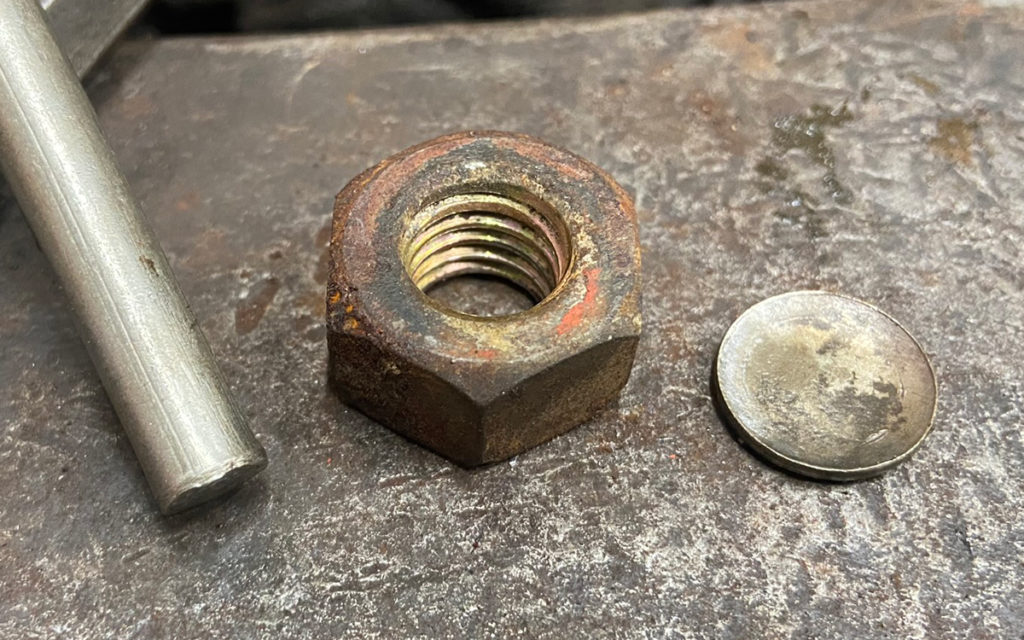
This is all you need to re-dome a welch plug. And it doesn’t have to be a nut; anything that supports the edges of the disk will do. (Photo © Russ Chastain)

Place the plug upside-down on the nut (or whatever), and smack the punch with a hammer.
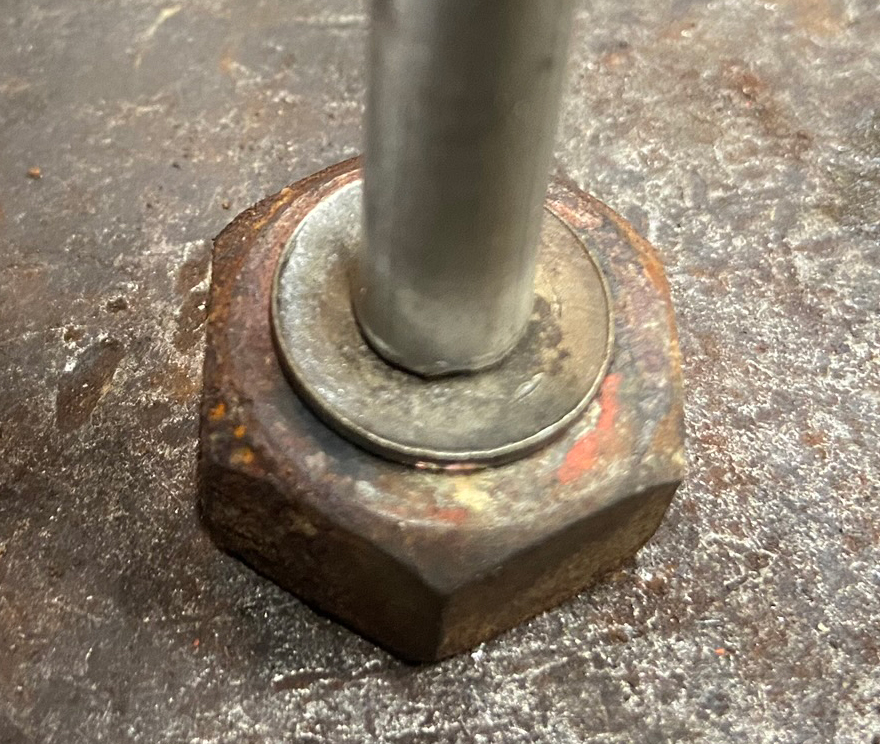
Place a punch about this size in the middle of the plug and swat it with a hammer. (Photo © Russ Chastain)

The two plugs below are nice and clean, re-shaped and ready to be used again.
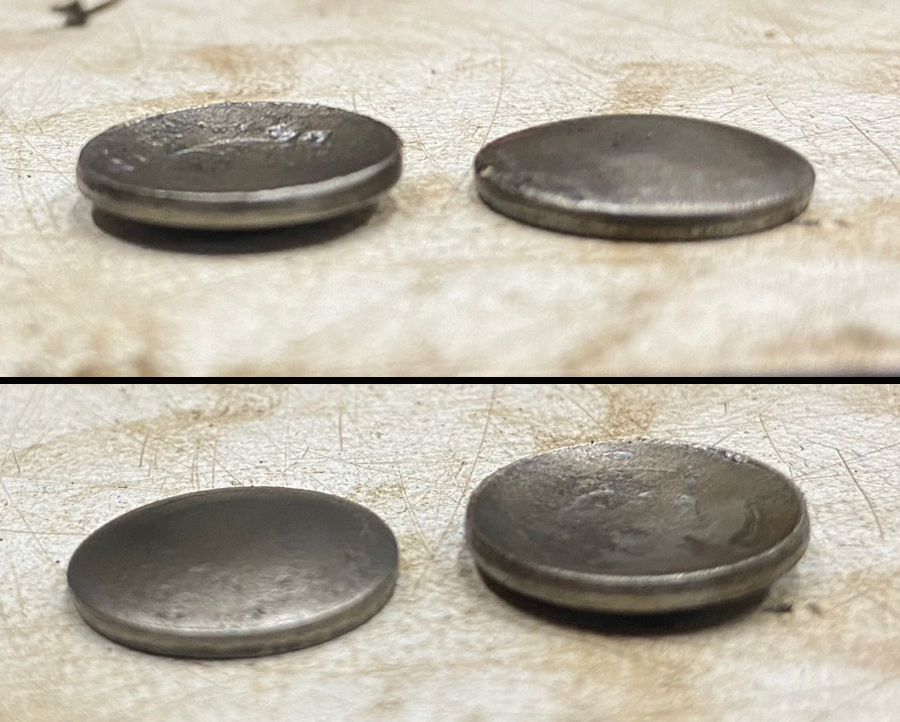
The reconditioned welch plugs are ready to be installed. (Photo © Russ Chastain)

Make sure the hole is nice and clean, then insert the welch plug with the dome towards the outside.

Make sure the welch plug is seated all the way in, like this, before you use a punch on it. (Photo © Russ Chastain)

Place a punch against the center of the dome and give it a swat to flatten/expand the plug.
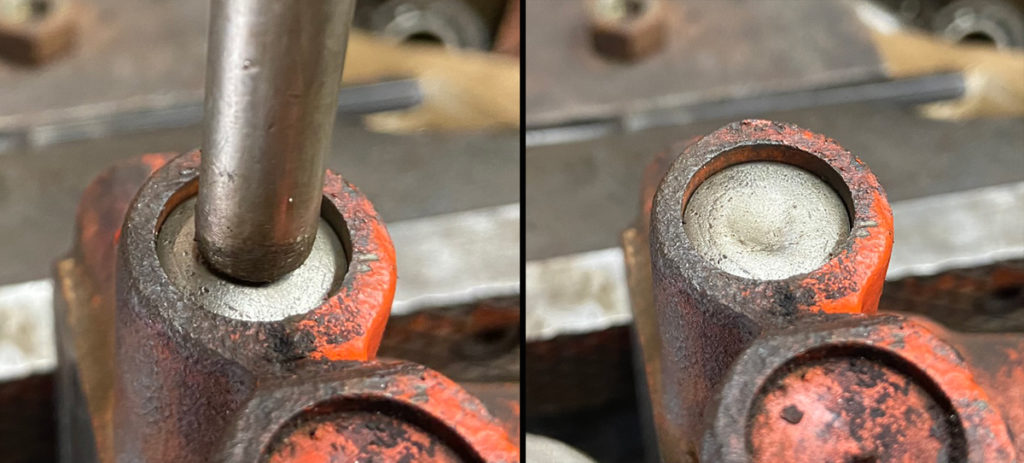
A swat with a hammer & punch will expand the welch plug. Done! (Photo © Russ Chastain)

You’re done! Nice work. Tell your friends. 🙂
Power King T92 3-Speed Transmission Rebuild Overhaul, Part 3 — Assembling the T92 Transmission

Previously in this series of articles, we have covered the teardown of a T92 transmission for rebuild in Part 1, and removed & installed front and rear ball bearings in Part 2.

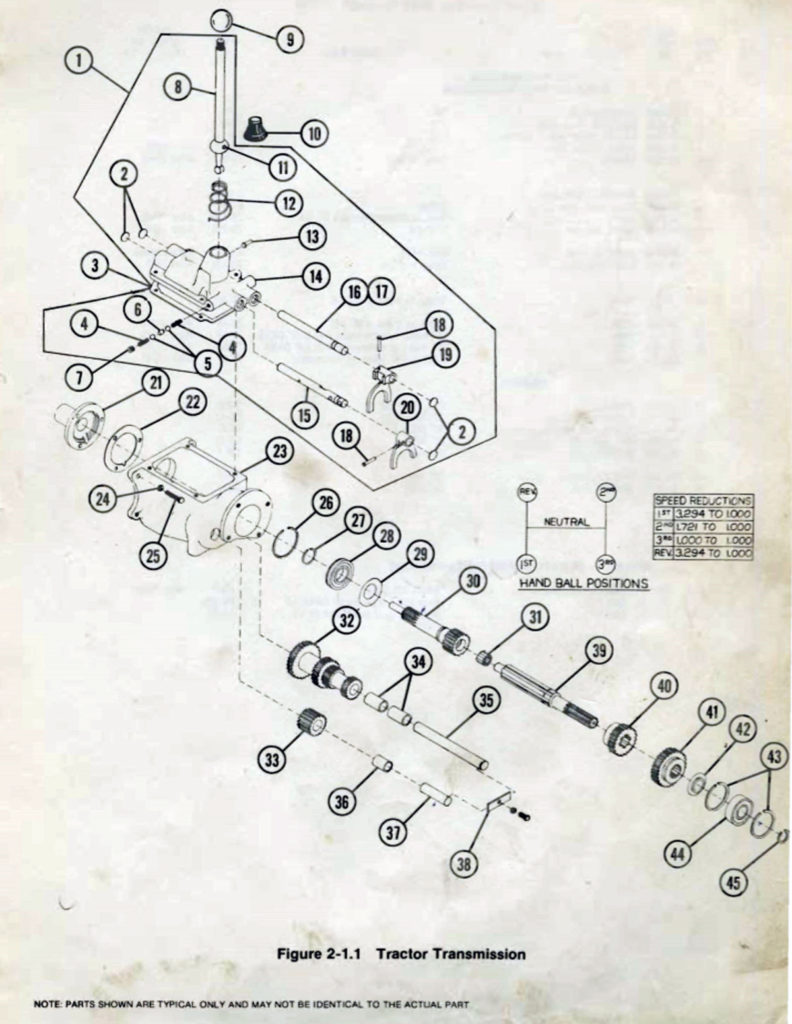
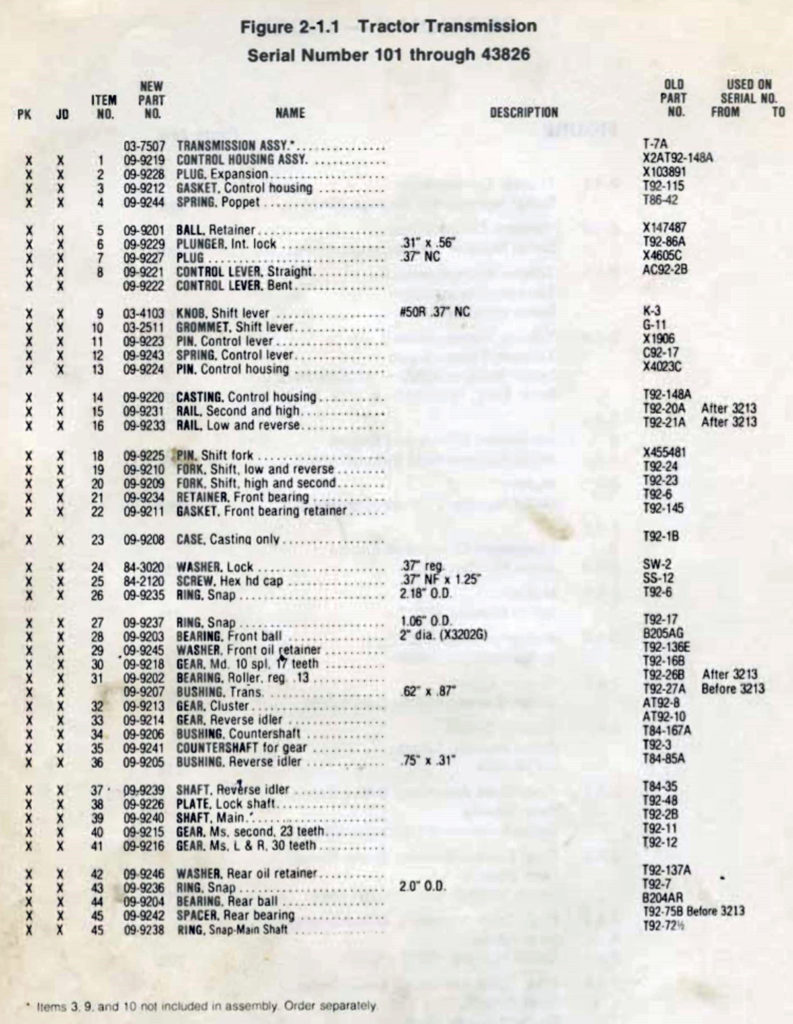
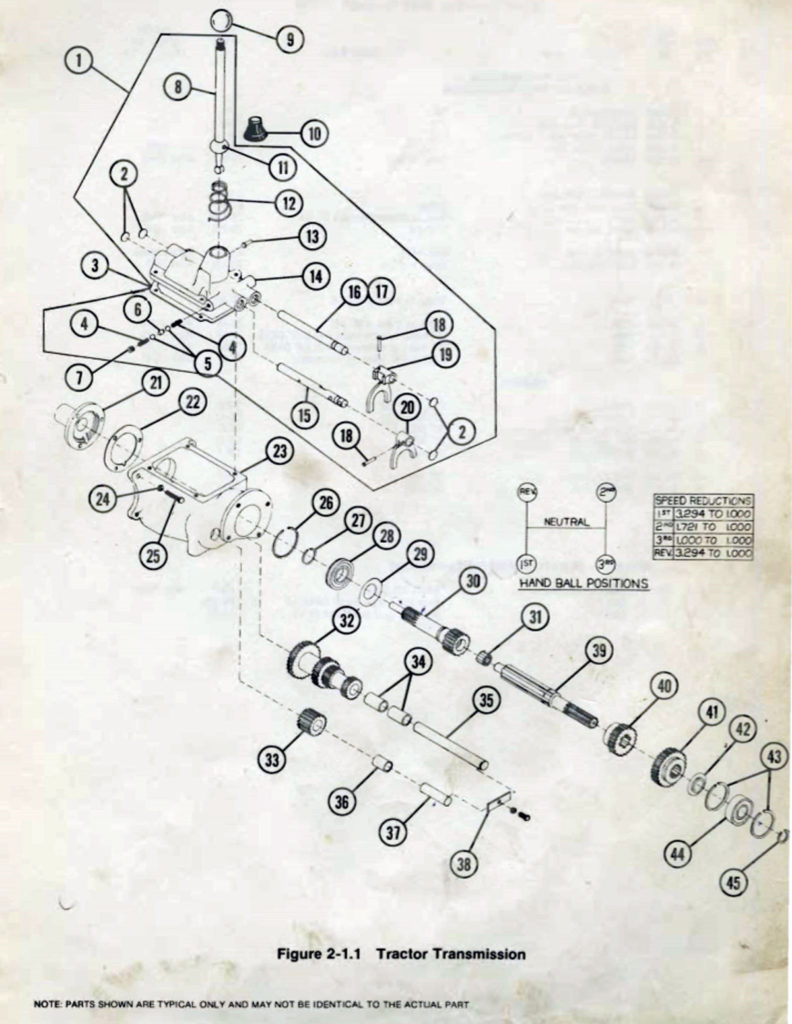
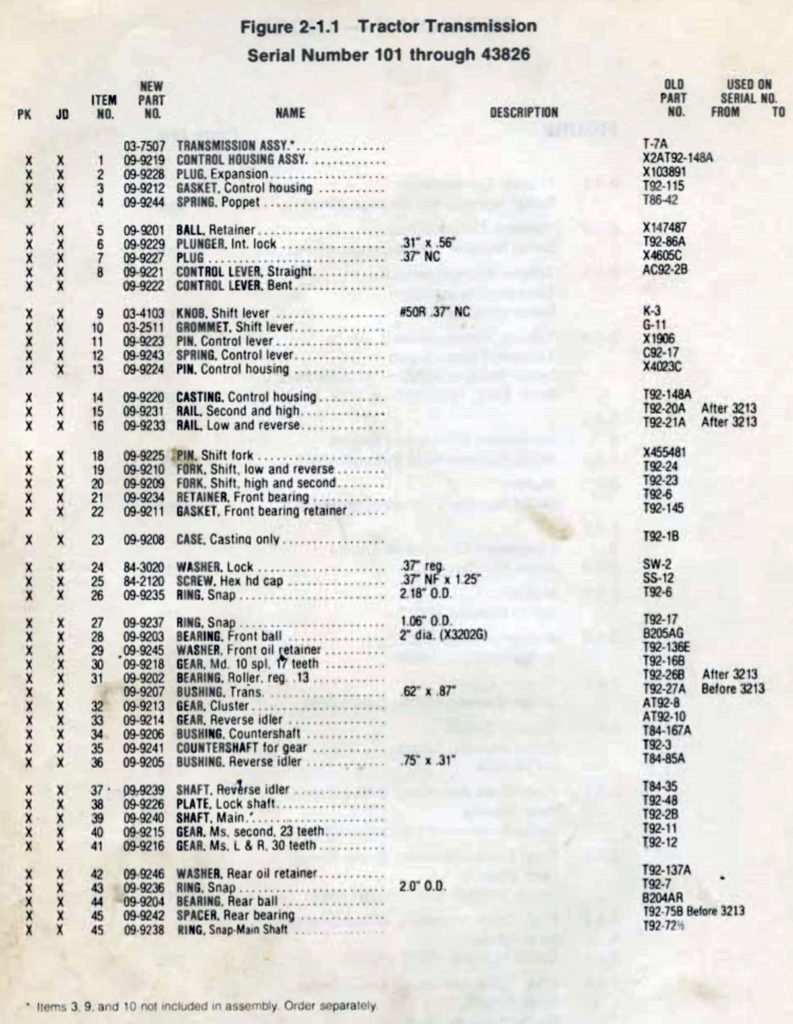
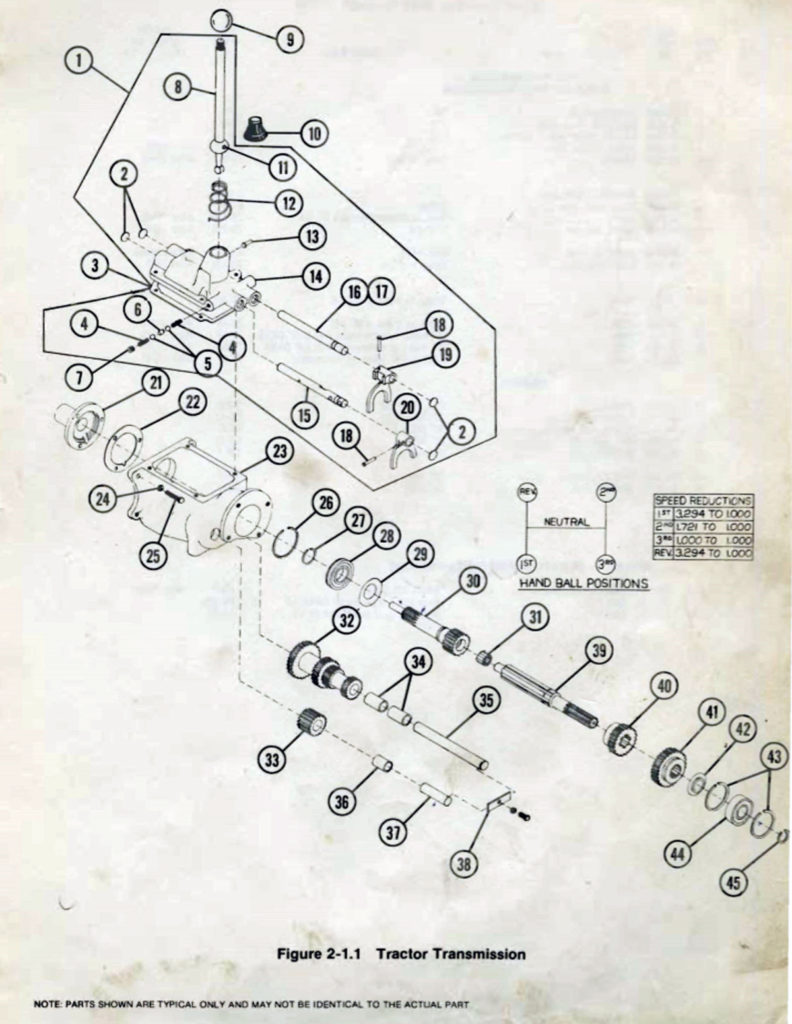
This is Part 3, covering assembly of the T92 transmission gearbox. Let’s get to it. First, here’s an exploded view and illustrated parts list (IPL).

I’m assuming you have a nice clean transmission case, and all your parts are ready to go. There should already be a snap ring inside the rear of the case, for the front of the rear bearing to butt up against.

Empty T92 Borg-Warner transmission case.
(Photo © Russ Chastain)

Start with the reverse idler gear and it shaft. The front of the gear will probably be tapered slightly from wear; that’s okay.

Reverse idler gear and its shaft.
(Photo © Russ Chastain)

Place the gear where it belongs, and insert the shaft from the back side of the case — making sure the retainer slot is positioned correctly.

This is where the reverse idler gear belongs.
(Photo © Russ Chastain)

When you start the shaft, make sure the slot is facing towards the other shaft so the retainer will fit into it.

Reverse idler shaft goes into this hole.
(Photo © Russ Chastain)

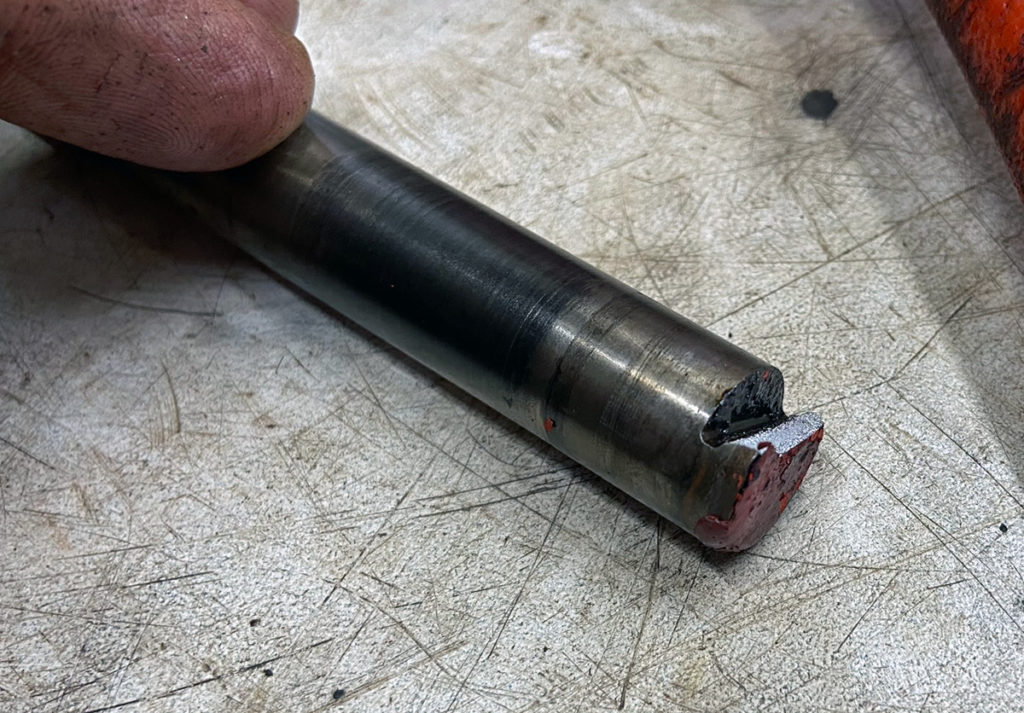
When you drive it in, make sure your punch is not above the slot. That will break the shaft, as you will see below.

Slot faces the retainer.
(Photo © Russ Chastain)

Next, place the cluster gear where it belongs. This one has more wear than I’d like to see; this is caused by grinding gears when shifting. The good news is, there’s still a lot of life left in it.

Cluster gear in place.
(Photo © Russ Chastain)

Run the shaft through the cluster gear, again making sure the slot is facing the correct direction.

Installing the cluster gear countershaft.
(Photo © Russ Chastain)

When you hit the shaft in the wrong place due to carelessness, you break it. If this was the reverse idler shaft, I’d have to trash it — or more likely, cut another slot 180 degrees from the old one. But the front bearing retainer will prevent this shaft from “walking” out the front, and the retainer will keep it from moving backwards. So I’ll just live with it.

Broken shaft retainer slot.
(Photo © Russ Chastain)

My usual practice is to use a cutoff wheel to cut new retainer slots into these shafts opposite the original slots, to allow the bushings inside the gears to ride on unworn portions of the shaft. I chose not to do that this time, because I was trying to retain the original tractor’s patina. And then I got stupid & broke the shaft! Derp.

With shafts in place, slide the retainer (“lock shaft plate” in IPL) in place and start the 5/16″ cap screw with lock washer.

Retainer in place, screw ready to be tightened.
(Photo © Russ Chastain)

Tighten the retainer screw and you’re done with those lower shafts.

Tighten with a 1/2″ socket & extension.
(Photo © Russ Chastain)

Now for the main shaft. Don’t get hasty; you will need the main shaft with good bearing installed, both the sliding gears, and a snap ring.

Again — Make sure the inside snap ring is installed in the rear of the case. This will secure the front side of the rear bearing.

When you slide the main shaft into the transmission case, you’ll need to slide it through the sliding gears as you go.

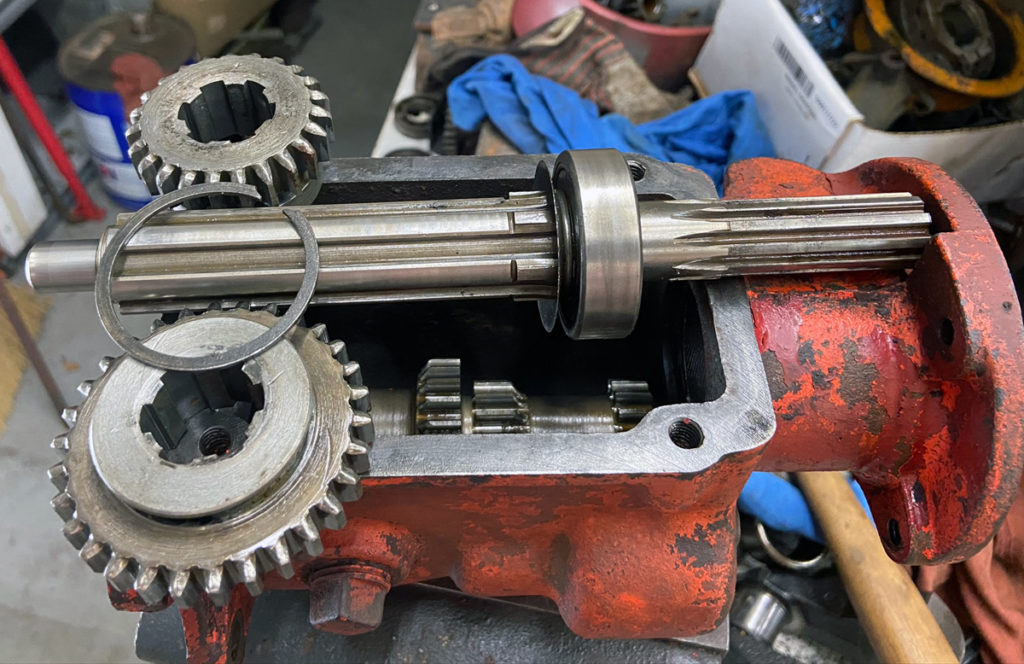
You’ll need these parts to install the T92’s main shaft.
(Photo © Russ Chastain)

Hold the larger sliding gear in place with the shift fork slot towards the rear of the case, and slip the shaft into the case and through the gear.

Then slide the main shaft through the smaller sliding gear, keeping its shift fork slot towards the front of the case.

This photo shows how the gears should be arranged:

Main shaft in place with sliding gears.
(Photo © Russ Chastain)

Make sure the rear bearing gets started straight in the case.

Rear bearing started nice and straight.
(Photo © Russ Chastain)

Use a tool, such as this old hunk of a Power King tie rod, to tap around the perimeter of the bearing to move it into place in the gear case.

Tap gently and keep moving the tool around the perimeter. The bearing will stop against the aforementioned front snap ring.

Keep an eye on the sliding gears while you do this, making sure they don’t slide too far forward on the shaft or get bound up somehow.

Use a tool to tap the bearing into place, moving the tool often.
(Photo © Russ Chastain)

Once the bearing is in place, check the sliding gears to make sure they are not binding anywhere and they can slide back & forth freely on the shaft.

Check to make sure the sliding gears are still free.
(Photo © Russ Chastain)

You want to be certain everything is good before you install the snap ring to secure the rear bearing.

Sliding gears should move freely on the shaft.
(Photo © Russ Chastain)

You know the bearing is properly positioned when the snap ring groove in the case is fully visible, as shown below.

Arrow indicates snap ring groove.
(Photo © Russ Chastain)

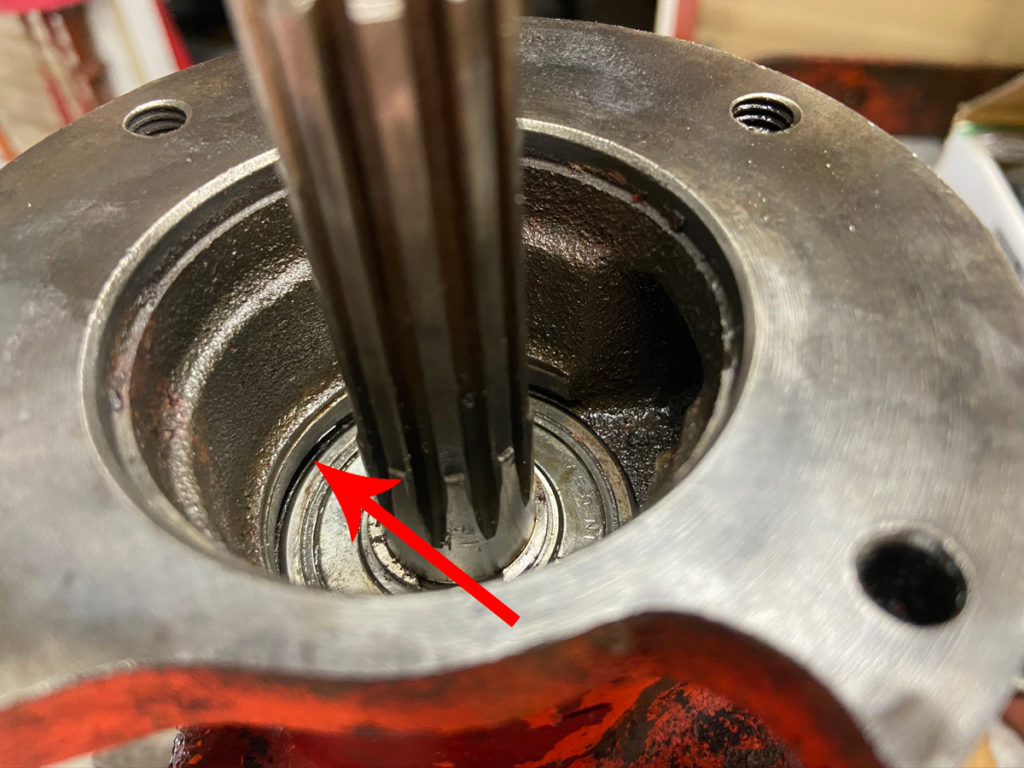
Now put the snap ring into the bore. It should be pretty easy to get it most of the way in there, keeping it pretty much parallel with the face of the bearing.

Snap ring partially in place.
(Photo © Russ Chastain)

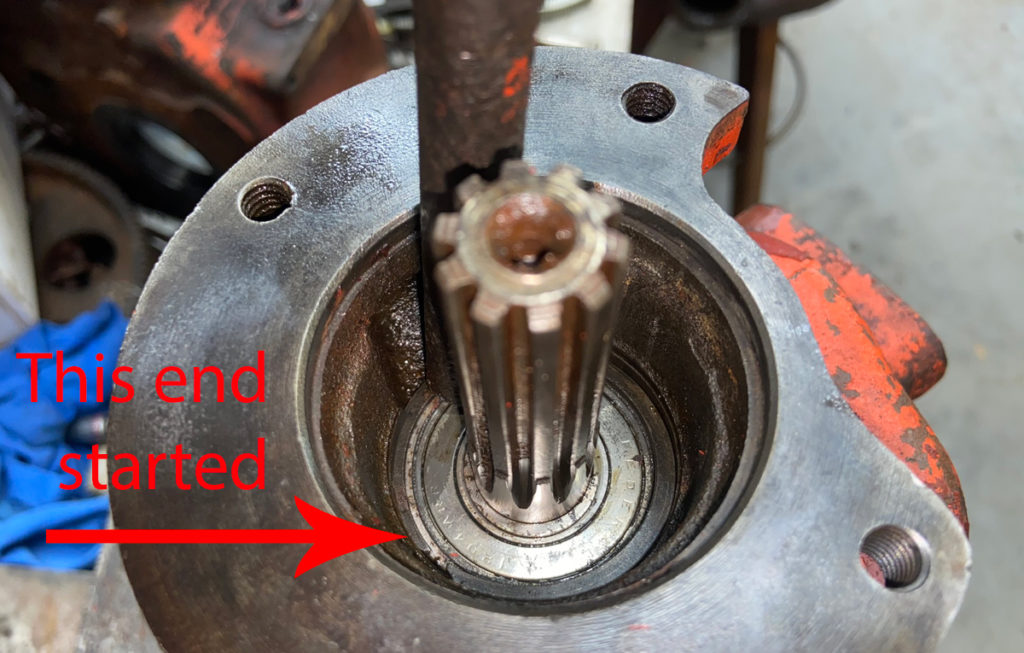
Push one end of the snap ring down so it goes into the groove in the case. Then work a tool around the snap ring, moving the ring down a little at a time, “feeding” it into the groove.

One end of snap ring started in groove.
(Photo © Russ Chastain)

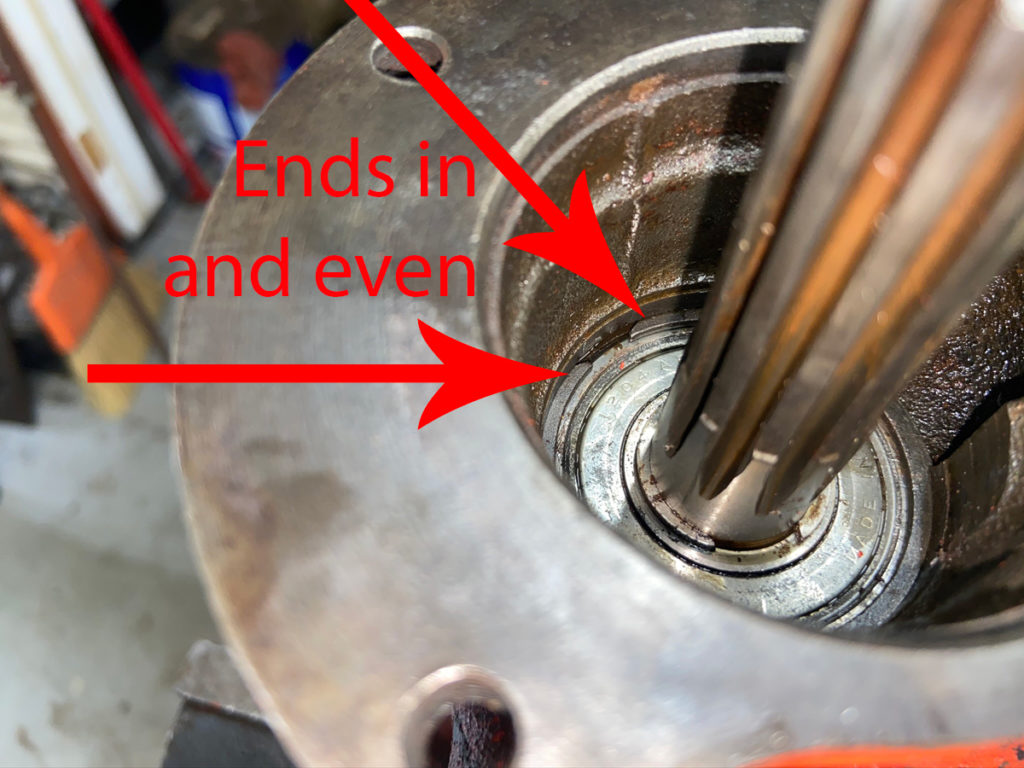
Work it on down until the entire snap ring is lying against the bearing and is properly fitted into the groove.

When you’re done, the snap ring will lie against the bearing all the way around, with both ends in the groove and even.
(Photo © Russ Chastain)

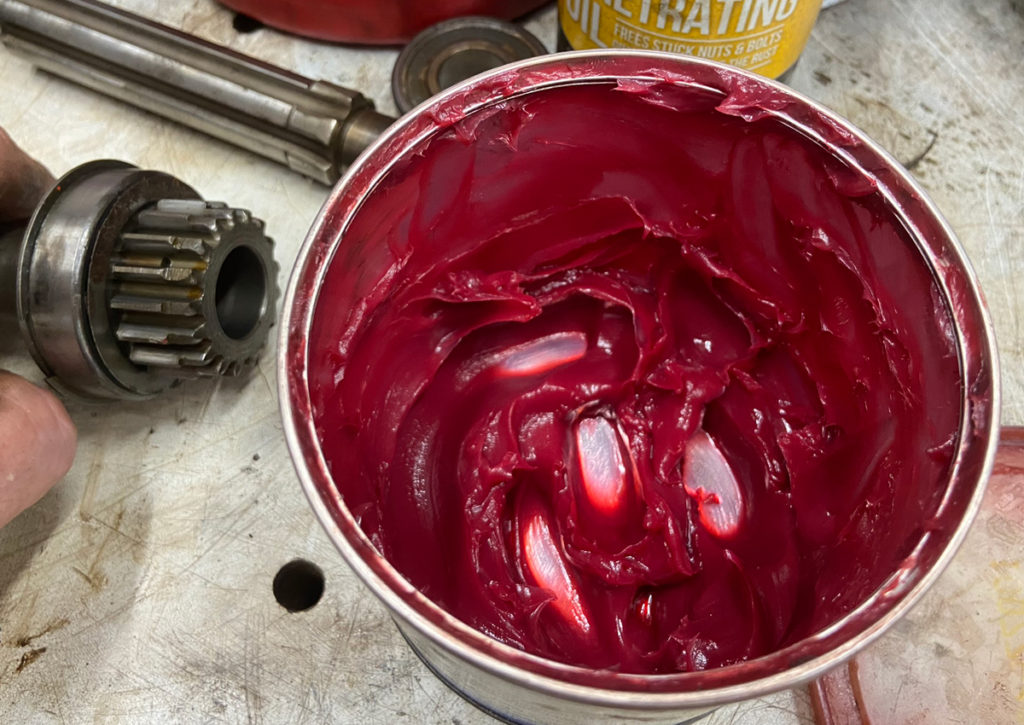
Time for the input shaft. Remember those 13 loose needle bearings from Part 1? It’s time to deal with those. The easiest way to do that is to stick them into the rear of the input shaft with some grease.

Grease!
(Photo © Russ Chastain)
Add a dab o’ grease, then a needle, repeat until you’re done.
(Photo © Russ Chastain)

Once you have the needle bearings safely secured, slip the rear end of the input shaft through the front of the gear case and over the front end of the main shaft.

Slipping the input shaft over the main shaft.
(Photo © Russ Chastain)

Your job here is to make sure all the needle bearings stay in place. The front bearing should slide into the gear case easily.

Input shaft properly assembled.
(Photo © Russ Chastain)

The snap ring on the outside of the front bearing should lie against the front of the transmission case like so:

Front bearing against front of transmission case.
(Photo © Russ Chastain)

To secure the front bearing, the bearing retainer must be installed. If this is the rear transmission on a dual-trans setup for a Power King / Jim Dandy / Economy tractor, it won’t have a bearing retainer; the center torque tube will do this job.

If the bearing retainer has a “divot” inside to help circulate oil, it must be installed over the oil hole in the gear case.

That hole in the gear case lines up with this divot in the bearing retainer.
(Photo © Russ Chastain)

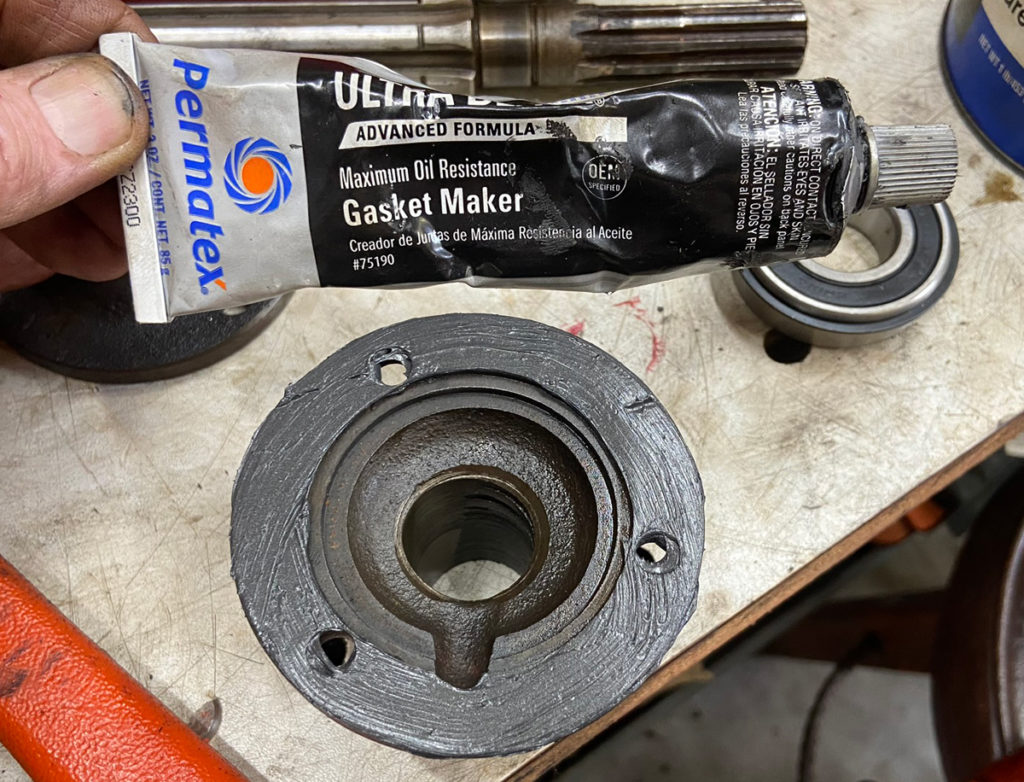
Originally these transmissions used paper gaskets, but I assemble using Permatex silicone gasket maker. Just follow the directions: Tighten the bolts just barely snug, wait at least an hour, then tighten them fully.

I use Permatex gasket maker instead of a paper gasket.
(Photo © Russ Chastain)

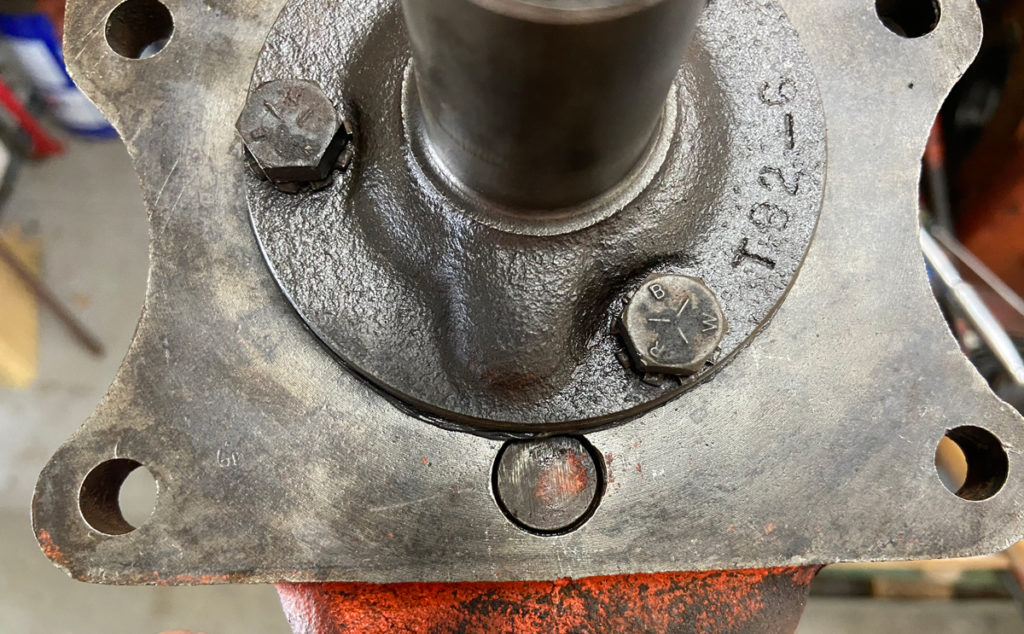
Once installed, the bearing retainer should look like the photo below. Note the position of the oil passage — and that the bearing retainer will also prevent the main countershaft from coming out the front of the gear case.

Bearing retainer installed on t92 transmission.
(Photo © Russ Chastain)

You are just about done, my friend. All that’s left is to install the top shifter assembly. When you do, make sure the shift forks slip into the slots in the sliding gears.

Use a paper gasket or gasket maker to ensure a good seal — but if you’re going to use gasket maker, wait until after you’ve added 8 ounces (no more!) of gear lube. I prefer 85w-140w gear oil.

It’s true that you can always add the lube through the fill hole on the side of the gear case, but it’s much easier to fill from the top while the shifter assembly is off.

Installing the top on a T92 3-speed transmission.
(Photo © Russ Chastain)

Install your four 5/16″ cap screws (bolts) with lock washers, and you’re done. The longer of the 4 bolts goes into the hole at right rear.

All that’s left is to install bolts in these holes.
(Photo © Russ Chastain)

It’s easy to see why a longer bolt is needed in that location.

Arrow points to the hole where the longer bolt goes.
(Photo © Russ Chastain)

Well, that’s how to rebuild a T-92 transmission gearbox. I hope you found this useful and informative.

— Russ

Power King T92 3-Speed Transmission Rebuild Overhaul, Part 2 — Changing front & rear bearings

In part one of this series, I walked you through general teardown of the Borg-Warner T92 3-speed transmission used on Power King and Jim Dandy tractors (among others) as well as Crosley automobiles. In this installment we will replace the front and rear bearings on the input and output shafts.

For reference, here’s an IPL, or illustrated parts list.

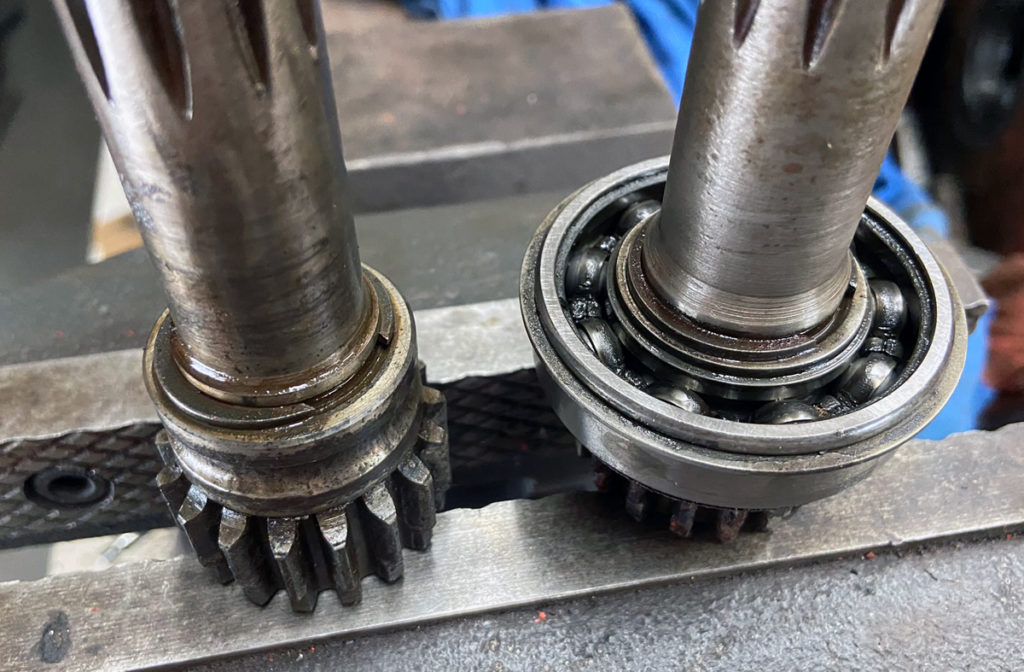
Let’s start with the input shaft, which is the front shaft. This is the bearing that gets the most wear. The photo below shows two input shafts; the one on the right has an open ball bearing, which is the original type. The shaft on the left has only the inner race of the bearing remaining, because the bearing failed and went to pieces inside the transmission.

Two different input shafts… the one on the left has only the inner bearing race remaining, due to complete bearing failure.
(Photo © Russ Chastain)

WARNING: Do not damage the snap ring around the outer race of the bearing! You will probably need to reuse it (more on that later in this article). And if you plan to use open bearings rather than sealed bearings, you will need to preserve the thin “oil slinger” washer if it’s still intact (more on that below).

I’ll demonstrate using the worst of the two shafts. The procedure is the same when you’re removing the entire bearing. The first thing you do is remove the snap ring holding the bearing onto the shaft. Spread the ends and gently move it away from the bearing and out of its groove. WEAR EYE PROTECTION.

Removing the snap ring to remove a T92 front transmission bearing.
(Photo © Russ Chastain)

Getting it out of its groove is the hard part. Try not to bend or over-stretch it.

Input shaft snap ring out of its groove.
(Photo © Russ Chastain)

Once you have the snap ring out of its groove, slide it off of the shaft. Try to keep it “even” as you do this, so you don’t bend or otherwise distort it.

Input shaft snap ring out of its groove.
(Photo © Russ Chastain)

The inside of the bearing fits tightly on the shaft, so it will take some force to remove it. Normally, you can support the outer race of the bearing while you drive or press the shaft out of the bearing. If your bearing is not intact, or if it comes apart while you’re removing it from the shaft, you will need to secure the inner race somehow while you remove the shaft.

Securing the inner race in a vise so I can drive the shaft out.
(Photo © Russ Chastain)

NEVER strike the shaft with a steel hammer! Shafts are expensive, and a steel hammer can damage it. Use a hammer of non-marring material such as brass, or use a piece of brass between the hammer and shaft to cushion the blows.

The vise is gripping the race, but not touching the gear teeth.
(Photo © Russ Chastain)

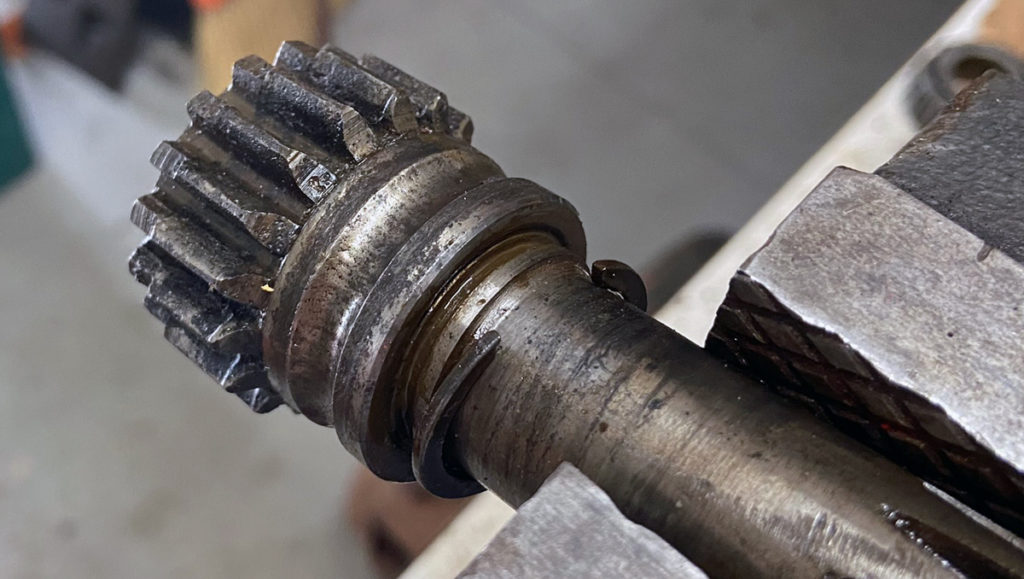
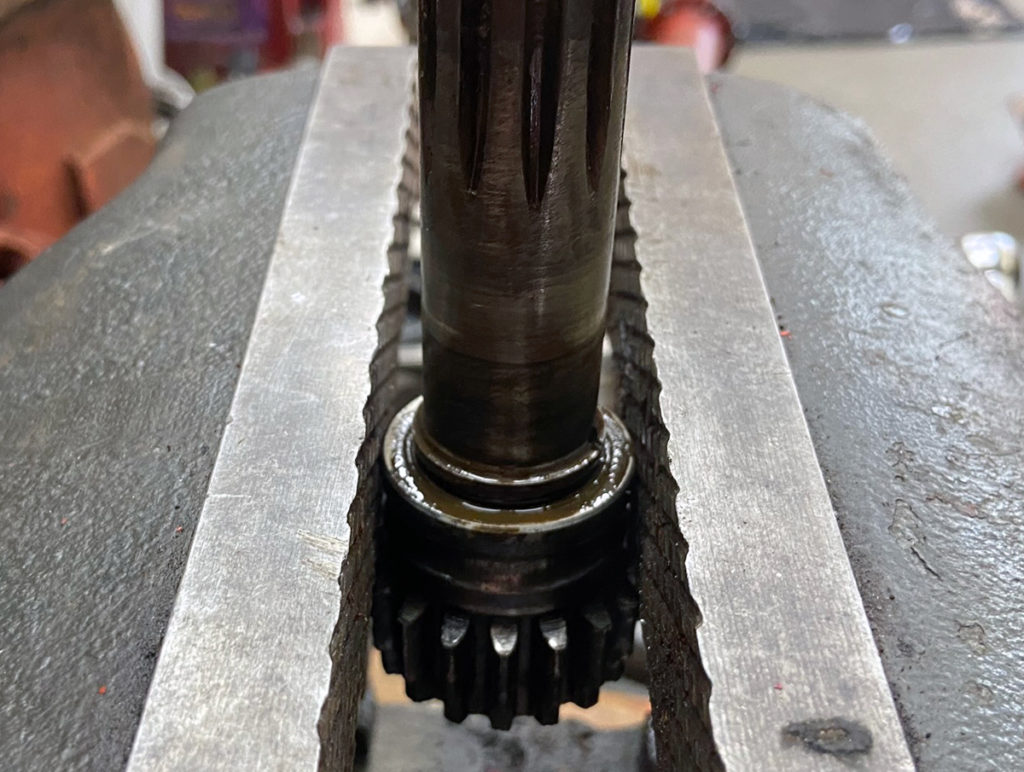
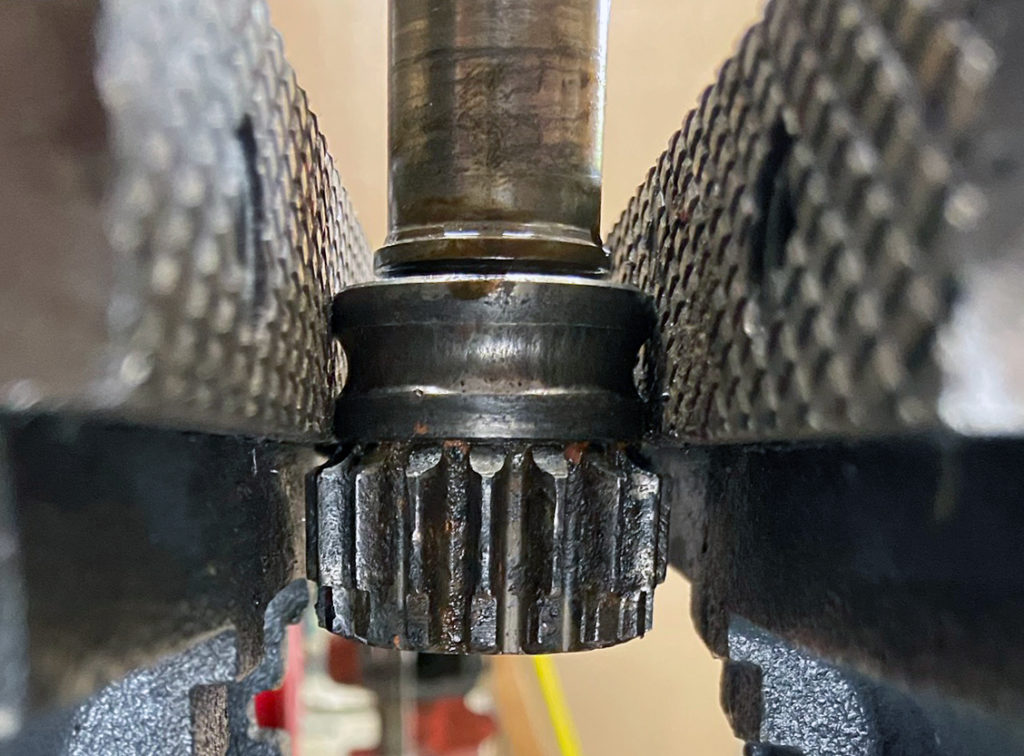
Be sure you don’t grab the gear teeth with your vise, or otherwise damage them.

If you are using a vise in this manner, pay attention to where the race is in the jaws. With each strike of the hammer, the race will probably slip down a little. You may need to reposition it in the vise a few times before the race comes off.

A pair of “naked” input shafts.
(Photo © Russ Chastain)

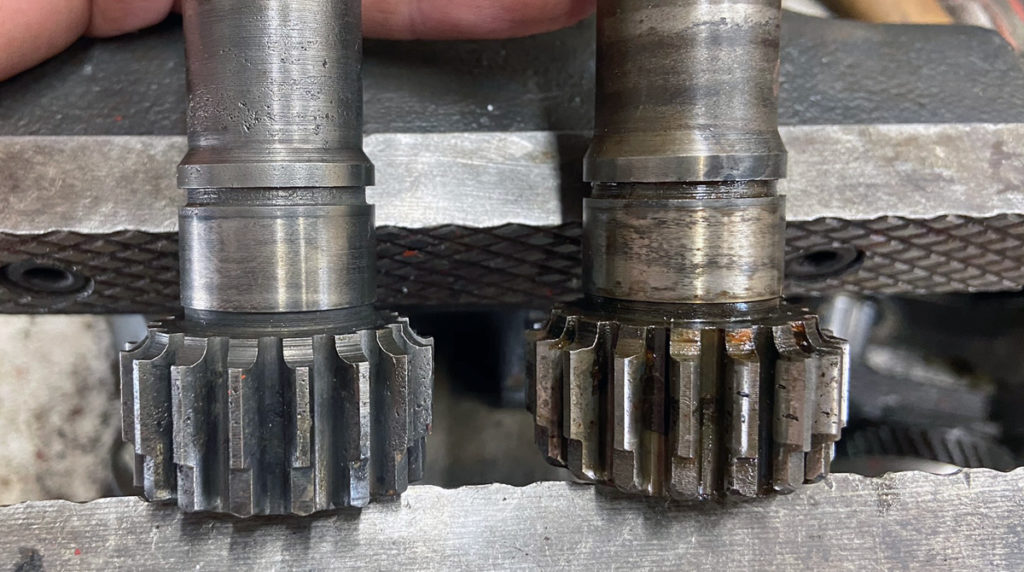
Once the bearing is off, your input shaft should look like this. I wish I could combine these shafts; one has better gear teeth, while the other is in better shape up front.

Rear ends of two T92 transmission input shafts.
(Photo © Russ Chastain)

The new sealed front bearing part number is 6205 2RS NR, and you need to be sure to get one with the snap ring, because you’re going to need the snap ring groove. You can buy one by clicking here, if you like. (If you do, I might make a few pennies.)

Chances are good that your new front bearing will have the wrong size snap ring. Thankfully, it’s easy to swap them out.

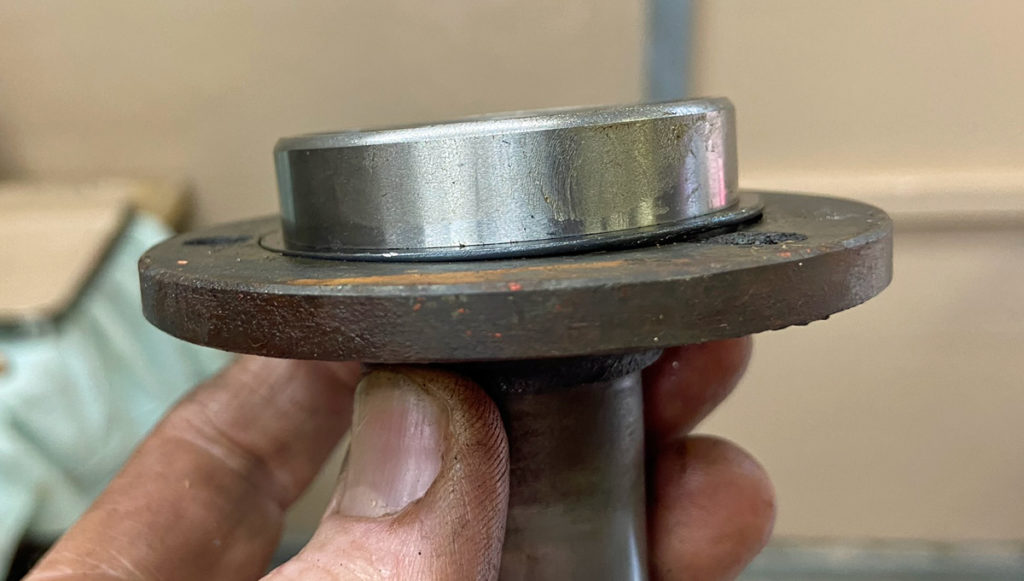
Old (left) and new front bearings for T92 transmission. New bearing is sealed, and has the wrong size snap ring.
(Photo © Russ Chastain)

All of the new snap rings I’ve found on these bearings are too large to properly fit into the bearing retainer. The diameter is simply too great, and as you can see the new snap ring can’t fit correctly. So, just remove the snap ring from the new bearing and install the old snap ring on the new bearing.

This is probably the easiest snap ring procedure of the entire process. Enjoy!

New bearing’s snap ring doesn’t fit into the bearing retainer.
(Photo © Russ Chastain)

A note about “oil slingers:” Originally, this transmission had open bearings with sheet metal parts commonly known as slingers, which the IPL above calls “oil retainer washers.” These are often damaged and are not easily replaced — and are unnecessary if you use sealed bearings.

If you are going to use one of these, you’ll want to slip it onto the shaft BEFORE you install the bearing, and then take care not to damage it during installation.

Arrows indicate the sheet metal oil slinger.
(Photo © Russ Chastain)

To install the new front bearing, position it with the snap ring towards the front of the shaft and press or drive the input shaft into the bearing. Then reinstall the shaft snap ring which retains the bearing on the input shaft. When you’re done it should look like the one on the right in the pic below (if you used a sealed bearing, you won’t be able to see the balls inside).

Two different input shafts… the one on the left has only the inner bearing race remaining, due to complete bearing failure.
(Photo © Russ Chastain)

The Rear Shaft

Now let’s work on the rear shaft, also known as the output shaft or the main shaft.

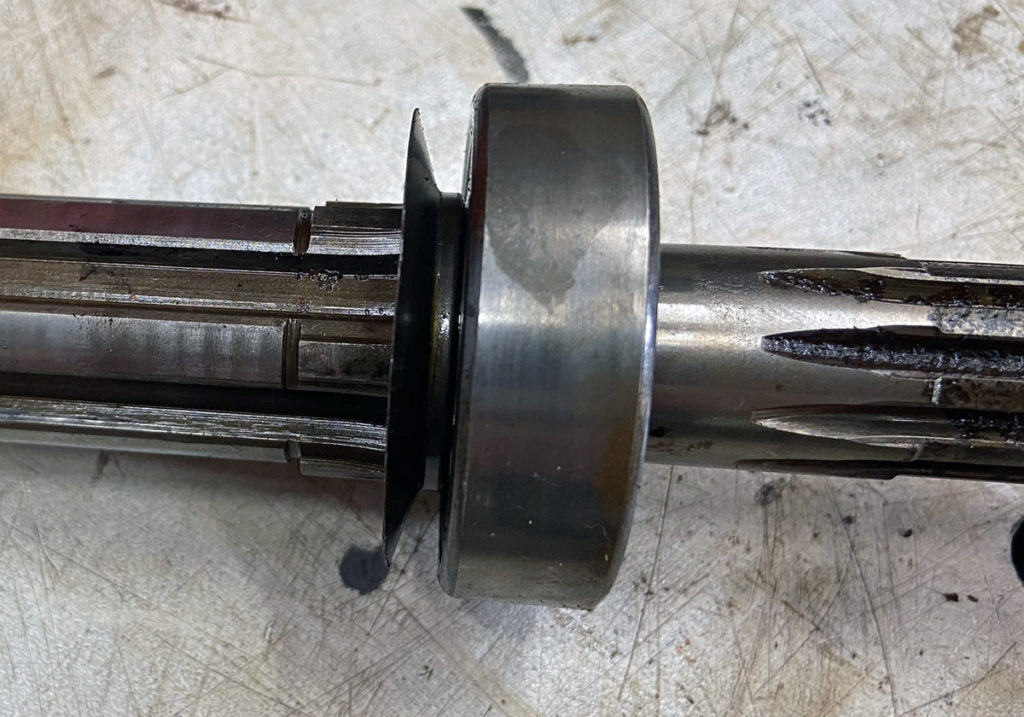
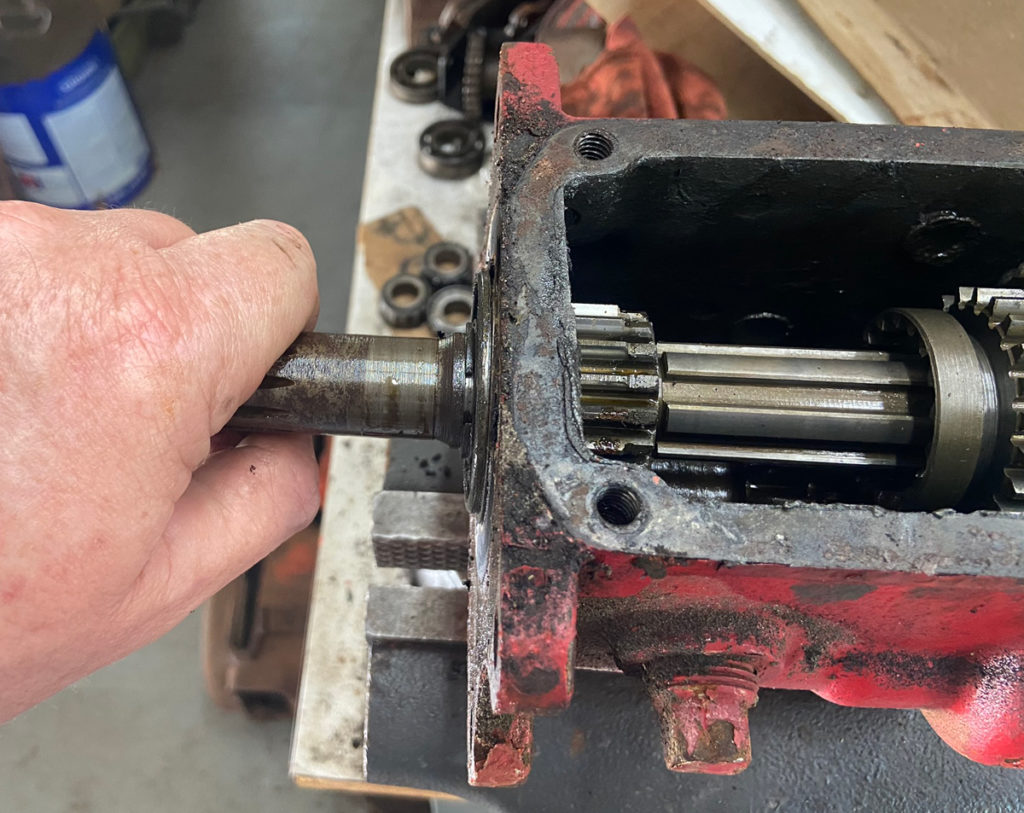
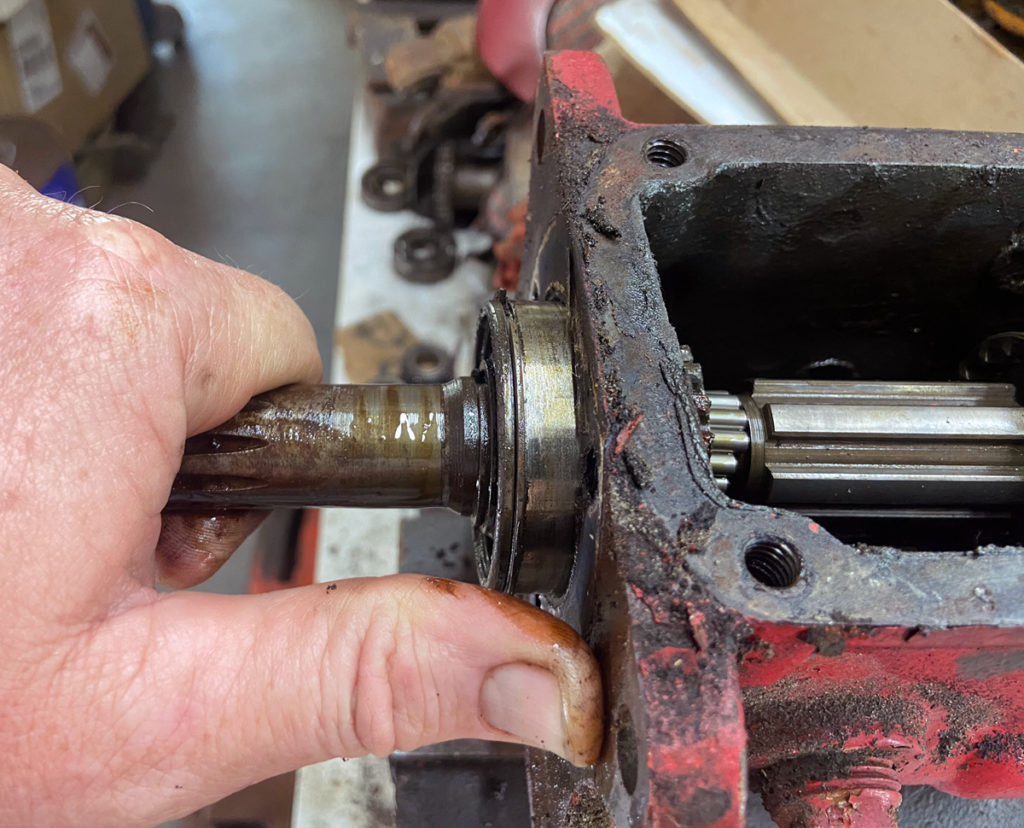
I’ve noticed two different types of rear shafts in T92 transmissions. One type has a spacer between the snap ring and the rear bearing. The pic below shows this type of shaft with and without the bearing installed.

One type of rear T92 transmission shaft uses a spacer between snap ring and bearing. The oil slinger is unnecessary in this photo, because the bearing is sealed.
(Photo © Russ Chastain)

Another type of shaft has no spacer, and the snap ring is placed right next to the bearing.

This type of rear shaft doesn’t use a spacer between snap ring and bearing. Top shaft has slinger in place, although it’s not necessary with this sealed bearing. Another old sealed bearing is lying in the background.

Both of these shafts take the same sort of bearing, and unlike the front bearing, it’s not directional (there’s no front or back).

The part number for a new rear sealed bearing is 6204 2RS, and you can buy one by clicking here. (If you do, I might make a few pennies.)

To remove the old bearing, the procedure is the same as for the front (input) shaft: Remove snap ring, then remove bearing (and slinger, if present).

If you are using an unsealed bearing, install the slinger/oil retainer like this.
(Photo © Russ Chastain)

Installation is even simpler than the front bearing because there’s no external snap ring to worry about. Install slinger (if using an unsealed bearing), then bearing, then spacer if applicable, then snap ring. Done!

Next, we will assemble the parts to make up a good T92 transmission; that’s part 3 of this T92 Transmission Overhaul series.

Power King T92 3-Speed Transmission Rebuild Overhaul, Part 1 — General teardown of the T92 transmission for overhaul.

An old grubby T92 transmission, sans top, ready to be overhauled. (Photo © Russ Chastain)

So you have a Borg-Warner 3-speed transmission to overhaul or rebuild? Okey dokey, let’s get started.

Here’s an IPL, or illustrated parts list from the EPCO Master Parts Manual.

Drain the lube out by removing the square-head drain plug on the bottom and allowing the gunk (um, I mean “old lube”) to drain, then stabilize the transmission for the work. The best way I’ve found to hold the case is to replace the drain plug and clamp the plug in a bench vise. Larry Goss taught that trick to anyone who would listen.

Clamping the drain plug in a bench vise is about the best way to hold it while working.
(Photo © Russ Chastain)

Use a 1/2″ socket to remove the four cap screws holding the top (shifter assembly) on, and remove the top.

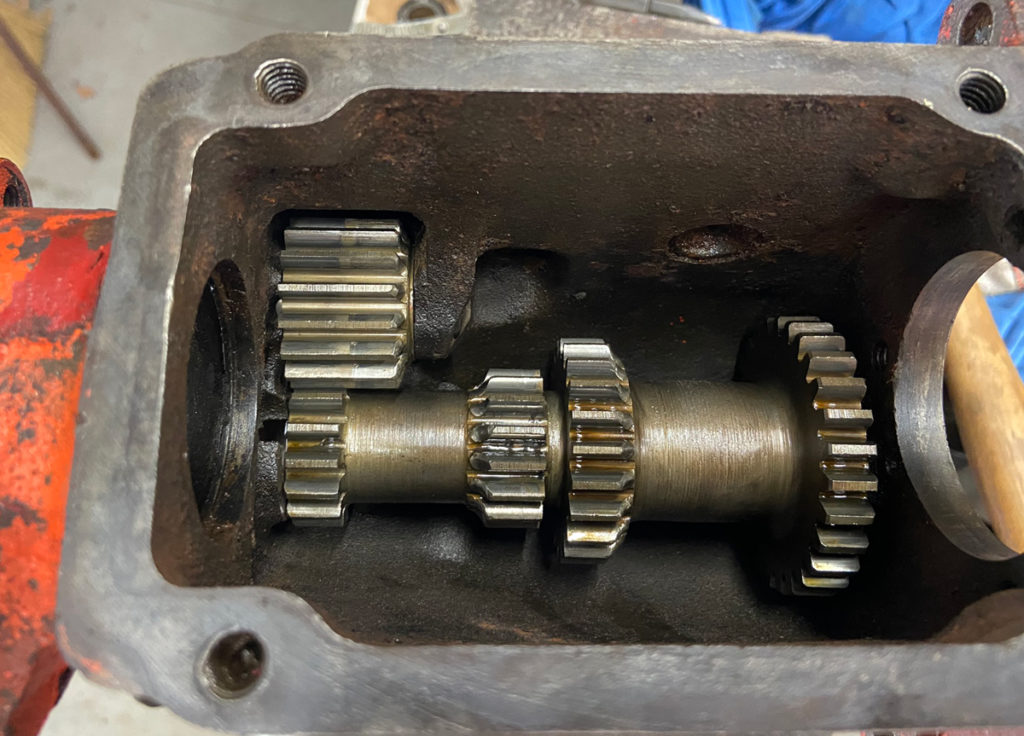
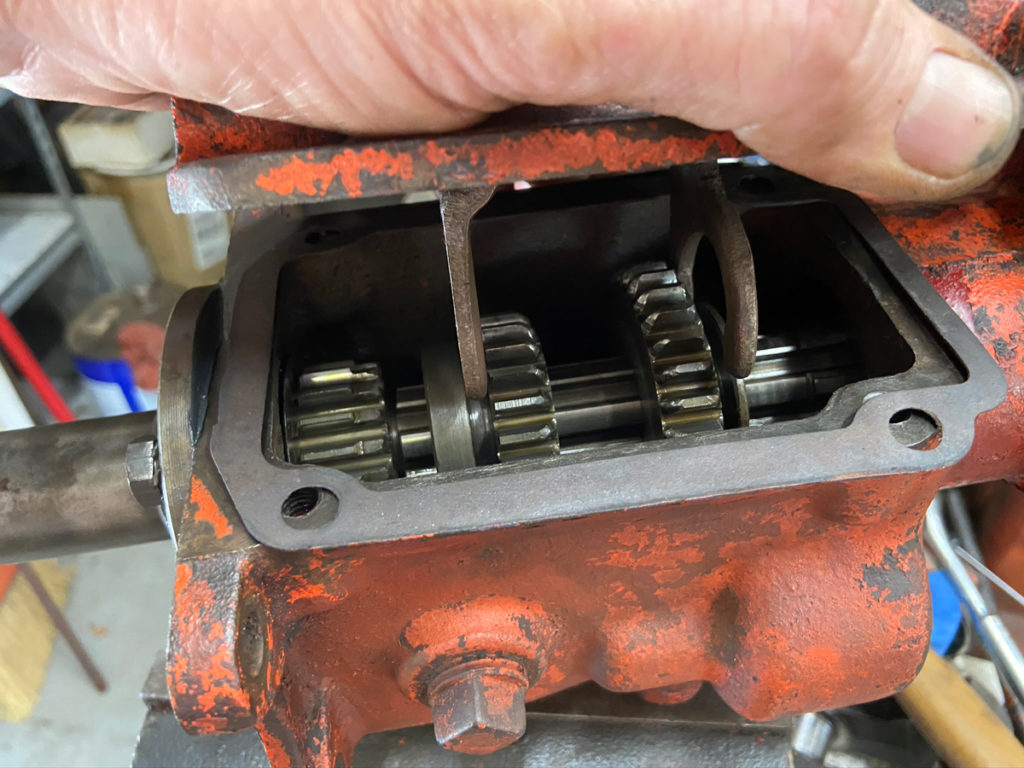
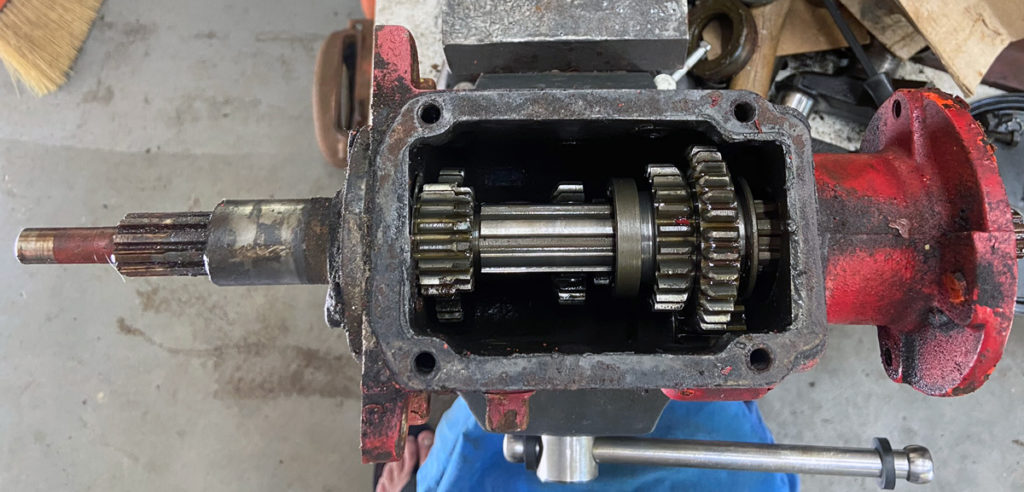
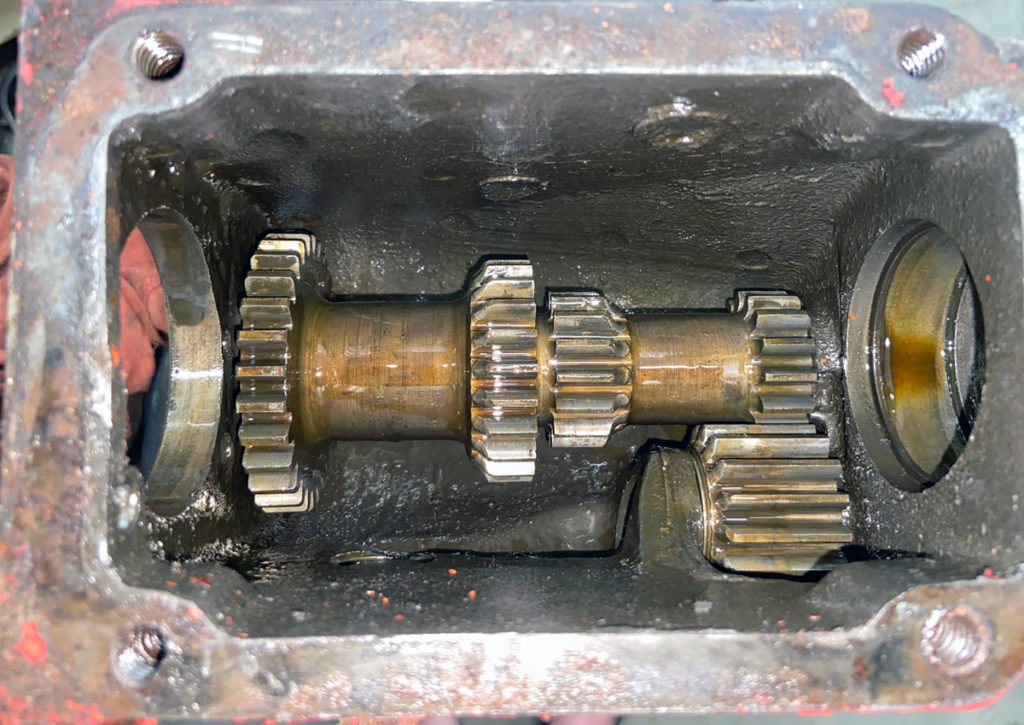
This is what it should look like inside, although the sliding gears will likely be in different positions.


Top view of T92 3-speed Power King tractor transmission.
(Photo © Russ Chastain)

Once that’s done, remove the bearing retainer from the front. It’s held on by three 5/16″ cap screws; a 1/2″ socket works well to remove them.

The bearing retainer must be removed. 1/2″ 6-point socket works well for this.
(Photo © Russ Chastain)

Plenty of gunk on this one. I’ll toss it into some fuel oil or diesel to soak.

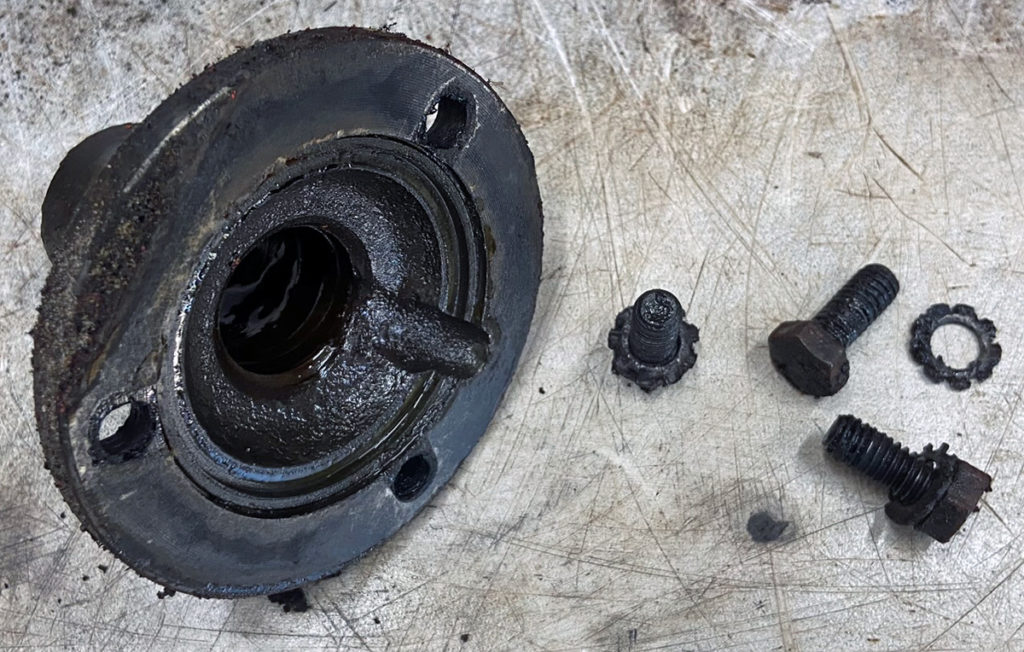
Bearing retainer and its three 5/16″ cap screws with star lock washers.
(Photo © Russ Chastain)

At this point, the input shaft and its bearing are only held in place by a bit of friction.

Bearing retainer removed from Borg-Warner T92 transmission.
(Photo © Russ Chastain)

You can grab the input shaft to pull it out… do this slowly.

Removing input shaft from T92 transmission.
(Photo © Russ Chastain)

Go slow and easy, and stop when you get more or less to this point.

She’s a-comin’
(Photo © Russ Chastain)

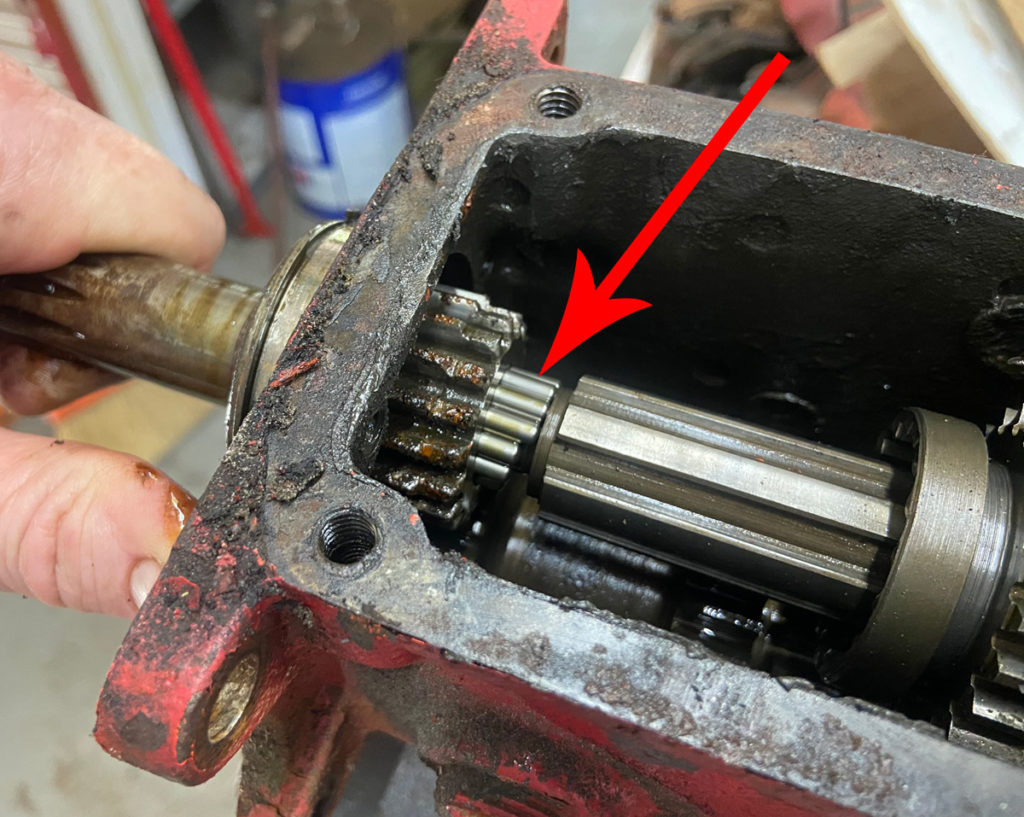
There are 13 roller/needle bearings that go between the input and output shafts. They are loose and if you’re not careful they will fall down inside the transmission — and if you are doomed, they will fall onto the ground and disappear.

This is a good time to slide them forward into the input shaft before you pull that shaft out any farther.

These needle bearings will try to get away from you.
(Photo © Russ Chastain)

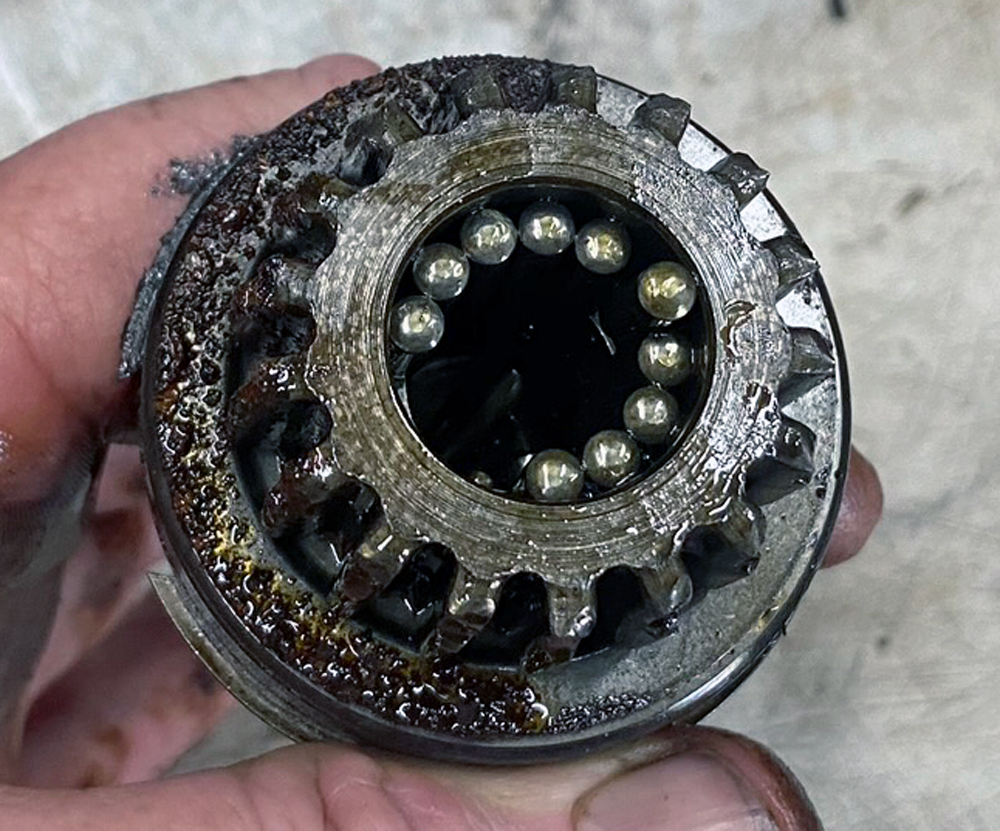
Because I remembered to push the bearings up into the shaft, I didn’t lose any of them into the transmission. They all stayed with the input shaft (the other 3 are down inside there).

It’s also a good idea to loosen the vise so you can tip the transmission forward, angling the input shaft towards the ground. This way, gravity can be your friend by encouraging the needles to remain inside the input shaft.

The other 3 are down inside there.
(Photo © Russ Chastain)

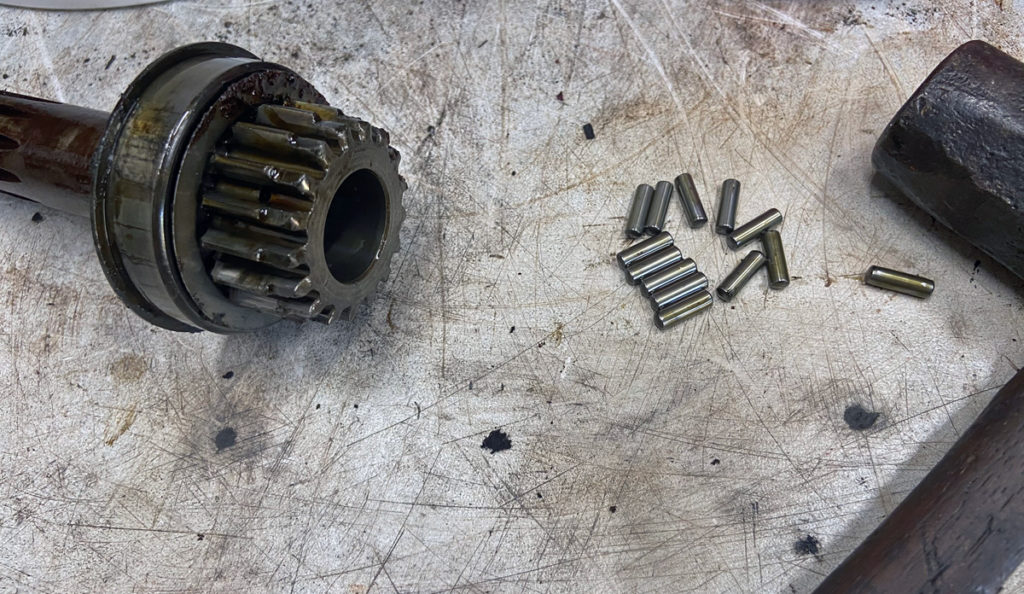
These needle bearings are precious, so don’t lose them! They are not widely available, and they are far from cheap.


Keep track of the 13 needles, they are precious!
(Photo © Russ Chastain)

Time for snap rings. Argh! Make sure you wear eye protection.

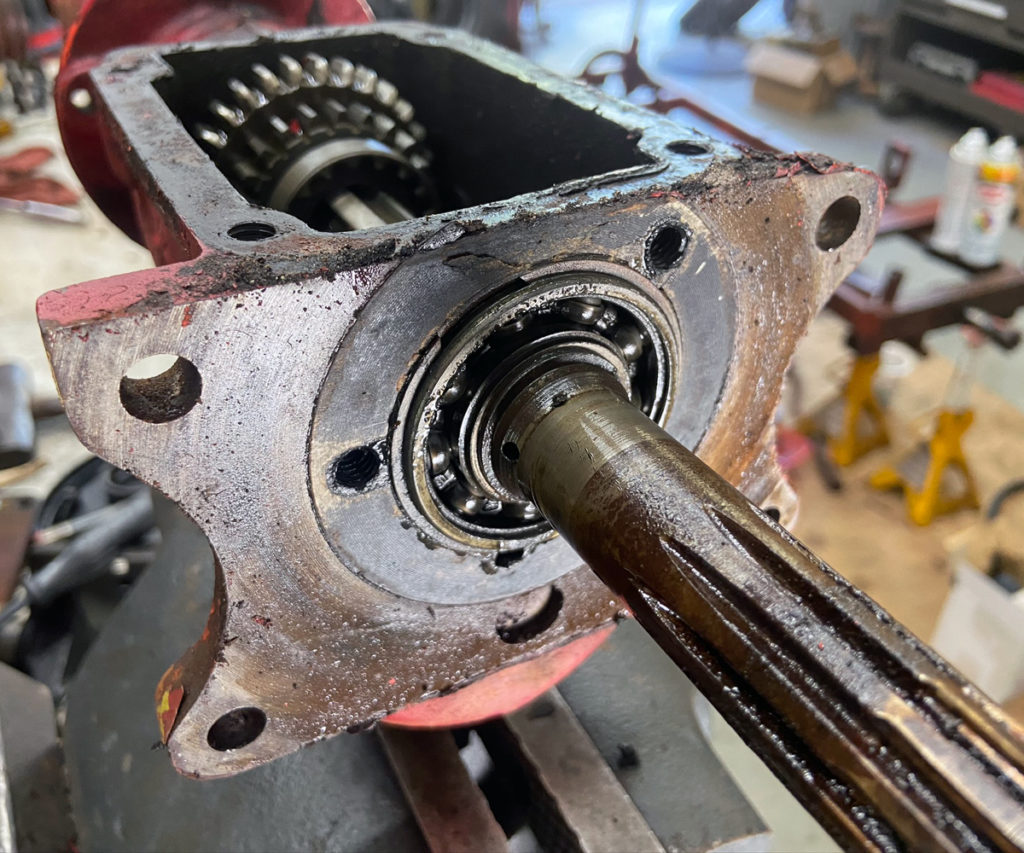
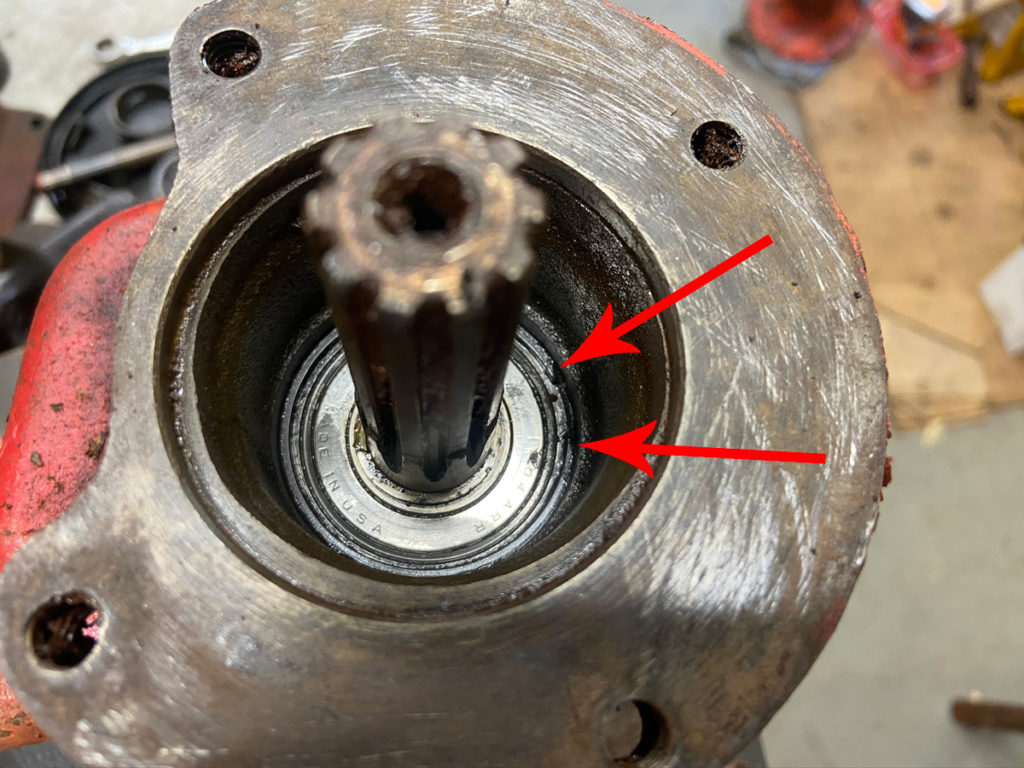
Secure the transmission with its rear end pointing up, and clean out the decades’ worth of goop so you can see the snap ring that holds the rear bearing in place.


Arrows indicate the two ends of the rear bearing snap ring.
(Photo © Russ Chastain)

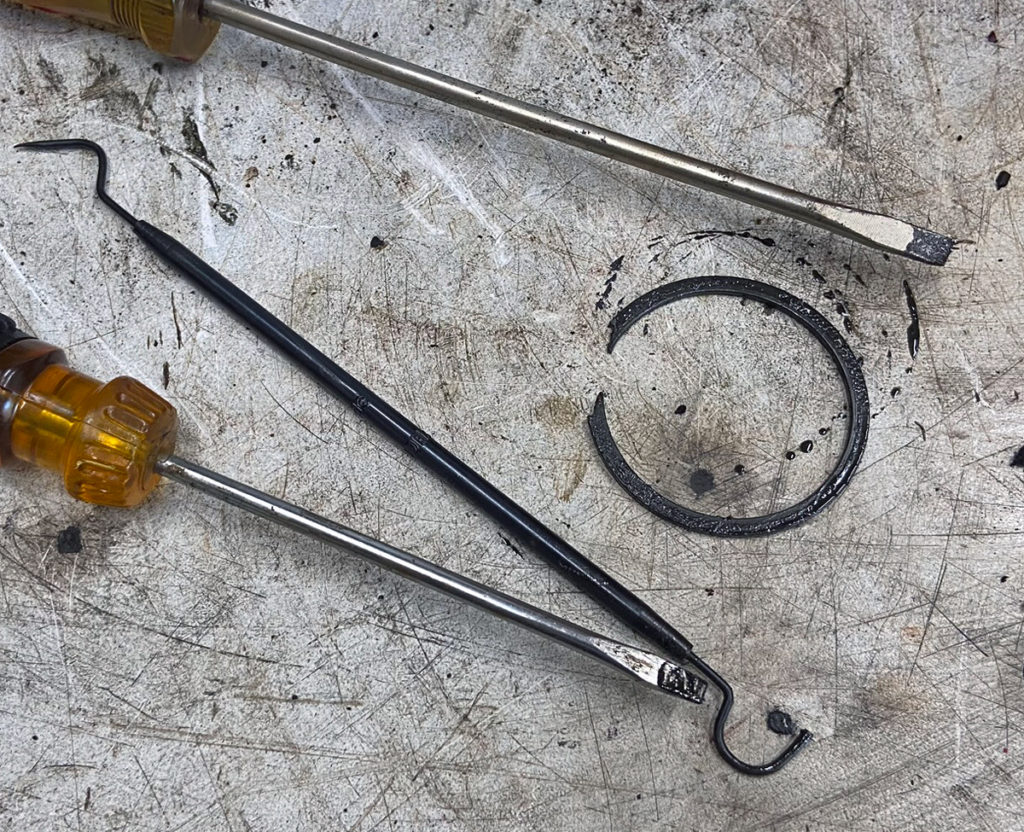
Snap rings are about as fun as a case of the cla-… um, never mind. Anyhow, they are aggravating even when you’re not trying to photograph them. This picture shows a screwdriver prying one end of the snap ring out of its groove.


Use a screwdriver or similar tool to pry out one end of the snap ring.
(Photo © Russ Chastain)

You need to lift the snap ring while it’s pried out… a small pick is useful for that. Now we have one end of the snap ring out where we can work on it.


Lift the snap ring to prevent it from slipping back into the groove.
(Photo © Russ Chastain)

Use a couple screwdrivers to pry it out while you lift with the pick or whatever tool works for you. Be prepared to say a few naughty words when it gets away from you…

Biggest thing to remember here is: Don’t force it! A bent snap ring is an even bigger pain than a non-bent one.


Screwdrivers work snap ring out of groove, pick lifts it.
(Photo © Russ Chastain)

Finally got the pick behind the ring so it can’t get away. Next is a combination of prying and lifting until it comes up out of the groove entirely.


Hooking the pick like this helps keep the snap ring from getting away from you.
(Photo © Russ Chastain)

Mwahahaha!


Snap ring removed!
(Photo © Russ Chastain)

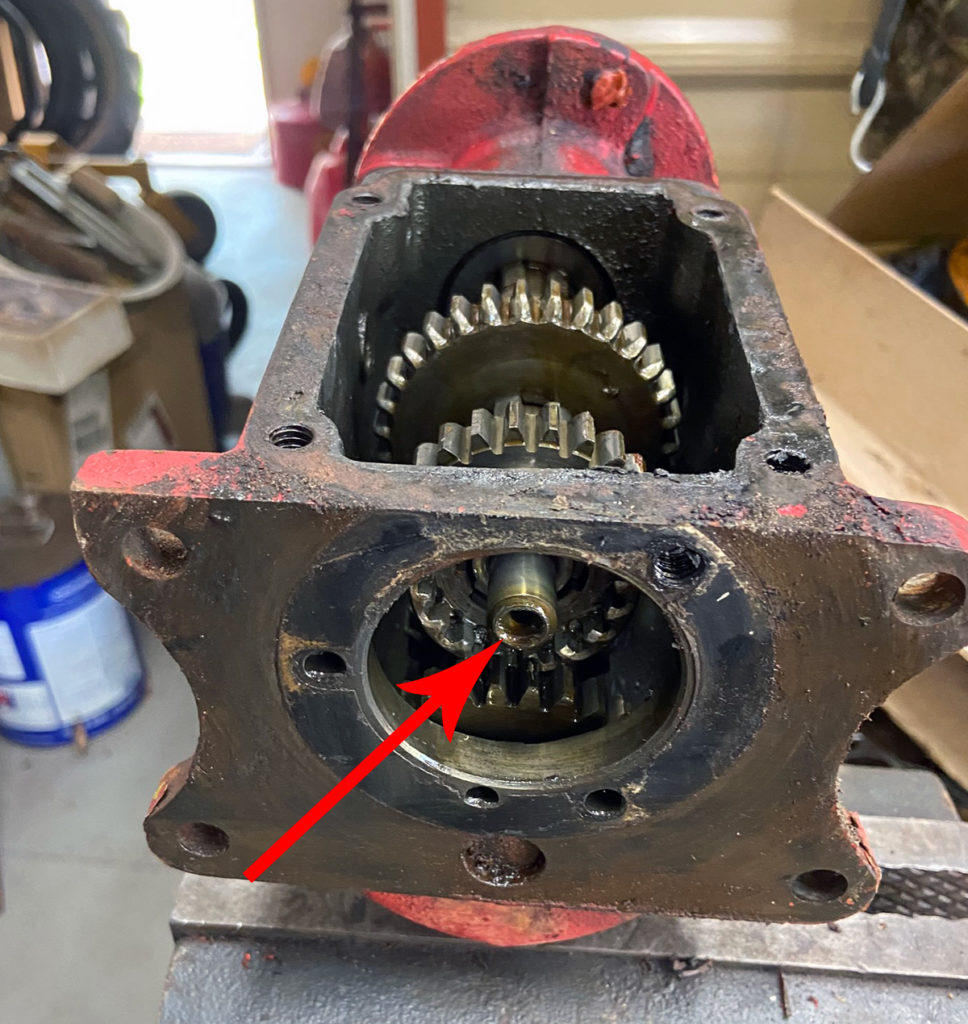
Next, remove the output shaft (indicated by arrow). It shouldn’t be difficult to move, but a hammer helps… just don’t hit the shaft with anything harder than brass. Don’t want to mar or deform it!


Arrow indicates shaft to be removed by pushing it towards the rear of the case.
(Photo © Russ Chastain)

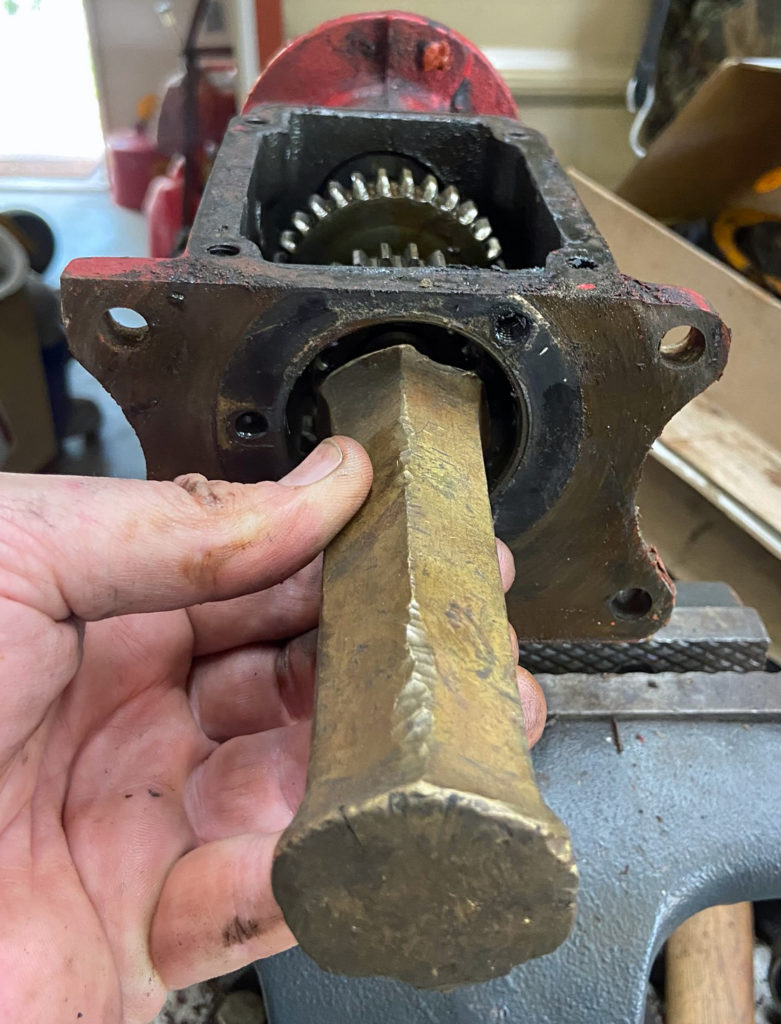
I happen to have a big honking piece of brass for just such occasions. I’ll swat this with a hammer a couple times.


This big brass punch will prevent damage to the shaft.
(Photo © Russ Chastain)

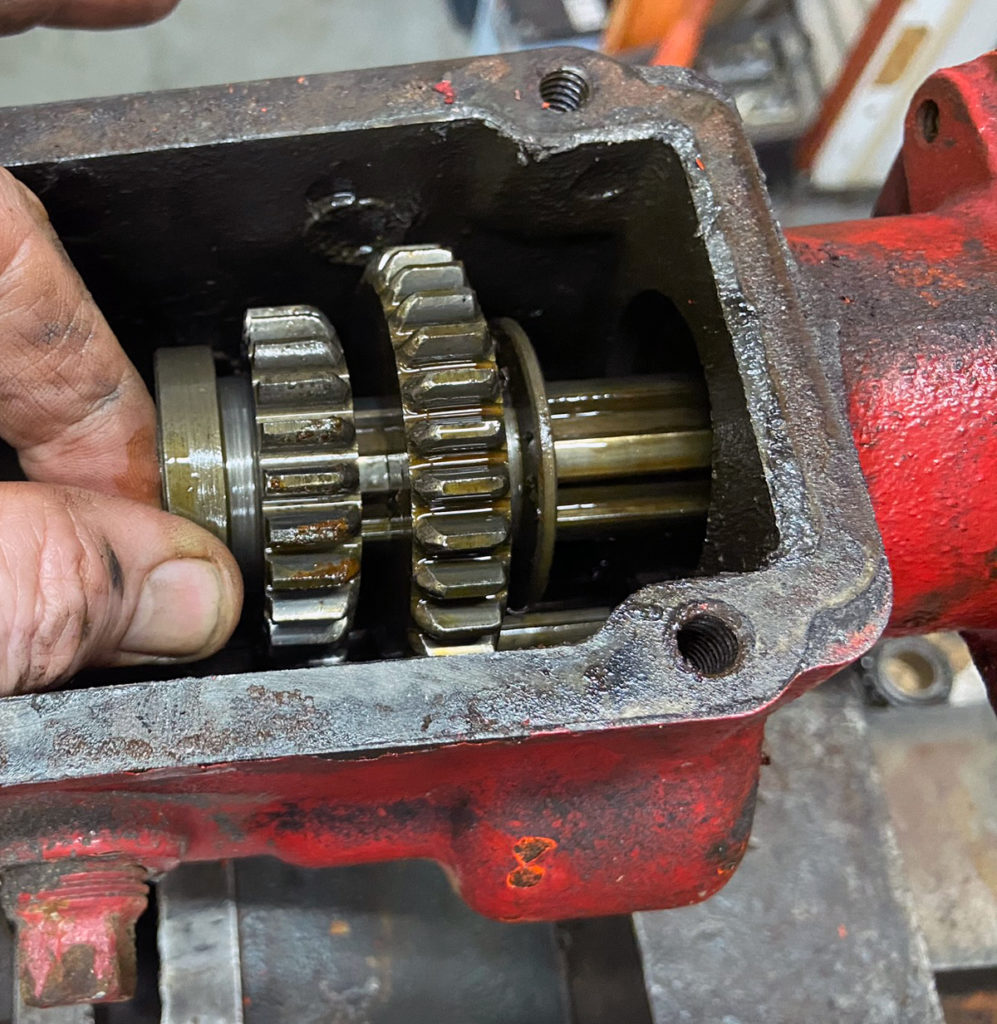
As the shaft slides rearward, a couple sliding gears will come off of it.


The shaft will slide out of these gears.
(Photo © Russ Chastain)

One gear removed, one to go.
(Photo © Russ Chastain)

Another gear removed. Shaft & bearing are now free to be removed.
(Photo © Russ Chastain)

Hooray and all!


Output shaft & gears.
(Photo © Russ Chastain)

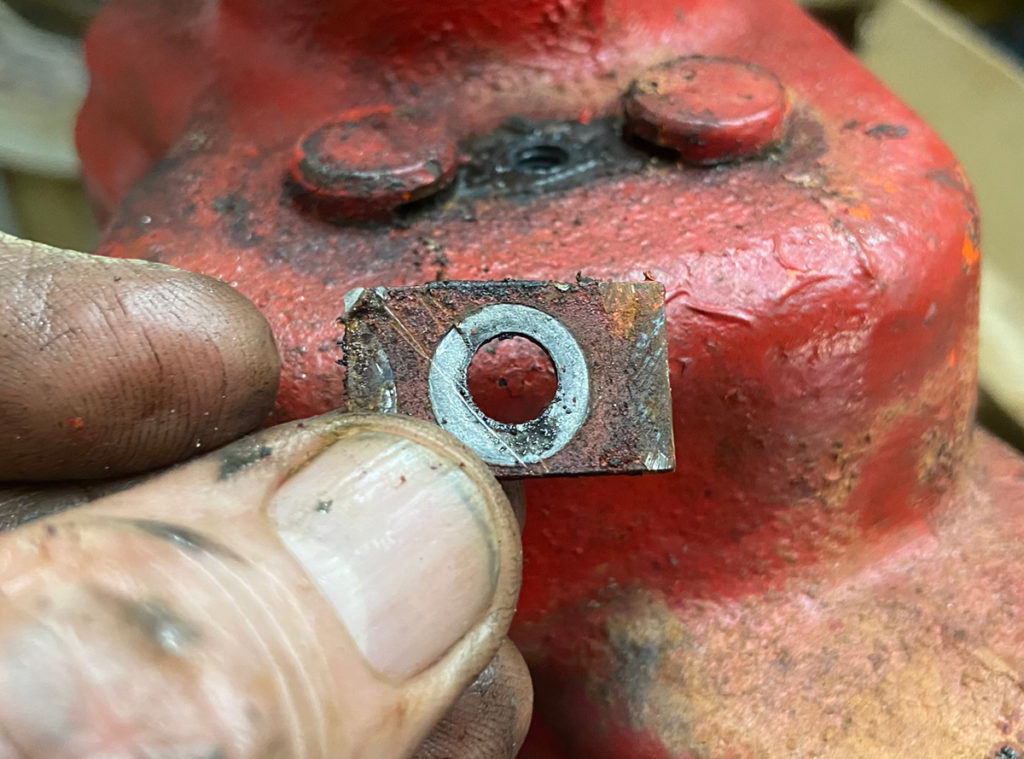
Not done yet… we still have the big ol’ cluster gear and reverse idler gear in there. These ride on steel shafts, which are held in place by a little hunk of sheet metal called a lock plate.


Cluster gear and reverse idler gear.
(Photo © Russ Chastain)

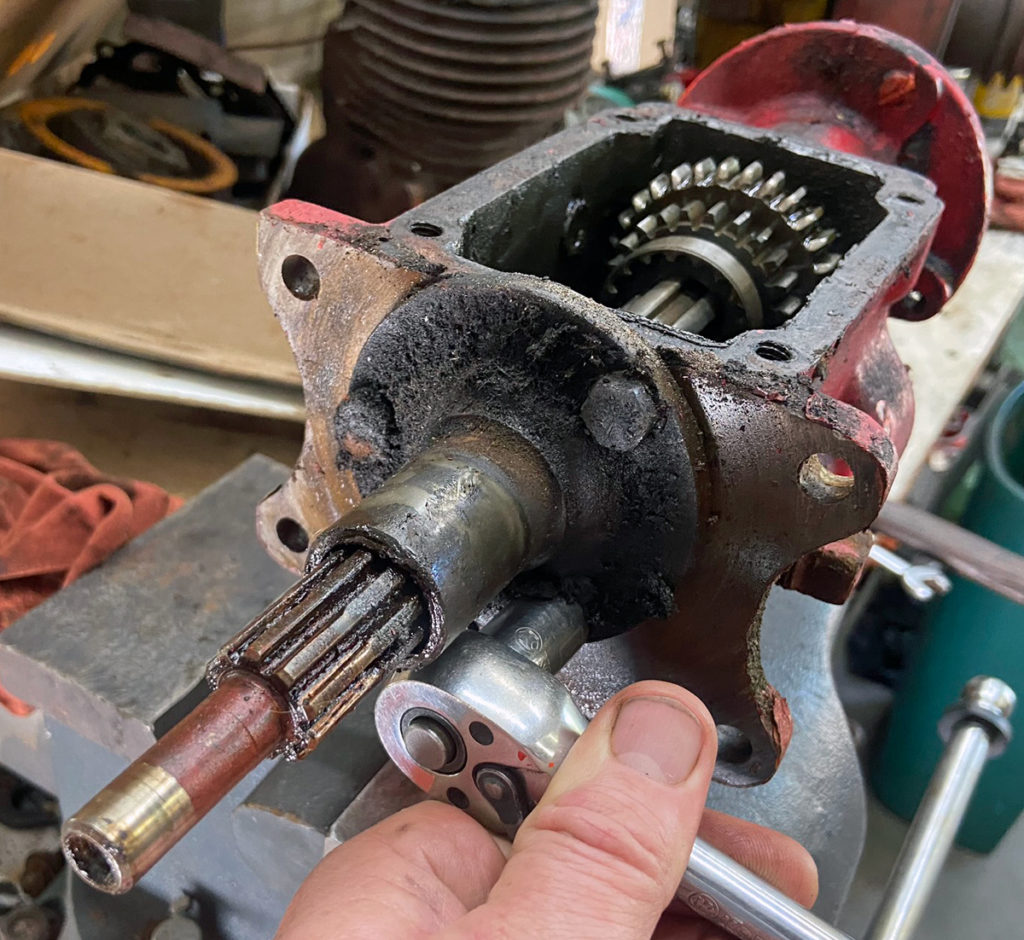
The lock plate is held by a single 1/4″ cap screw… use a 7/16″ socket & extension to remove it.


Remove this retaining screw.
(Photo © Russ Chastain)

A 7/16″ socket with extension will do the job well.
(Photo © Russ Chastain)

Usually, paint and other crud will keep the lock plate from coming free. To loosen it, use a punch to smack the ends of the shafts. Here’s me using a steel punch when I should be using a brass one to whack the end of the cluster gear countershaft.

(My “punch” is actually a hunk of an old Power King tie rod that rusted in two.)


Give the cluster gear shaft a swat with a punch from the front end just to budge it a little.
(Photo © Russ Chastain)

The inside end of the reverse idler gear shaft can be accessed like so; all you need to do is move it juuuuuust a tad to loosen the lock plate.


Also swat the reverse idler a bit. Arrows shows punch covering end of shaft.
(Photo © Russ Chastain)

We’ve loosened it up and now it can be removed.


Usually, this little lock plate is loose after you swatted the shafts. Slide it out of the grooves.
(Photo © Russ Chastain)

And there it is.


Lock plate removed.
(Photo © Russ Chastain)

Grooves in shafts where the lock plate lives.


The lock plate engages with those grooves.
(Photo © Russ Chastain)

Remember when you smacked the shafts to loosen the lock plate? Well go back to that and drive out the shafts towards the rear of the transmission case. Be careful! There are bushings inside the gears and you don’t want to damage them.


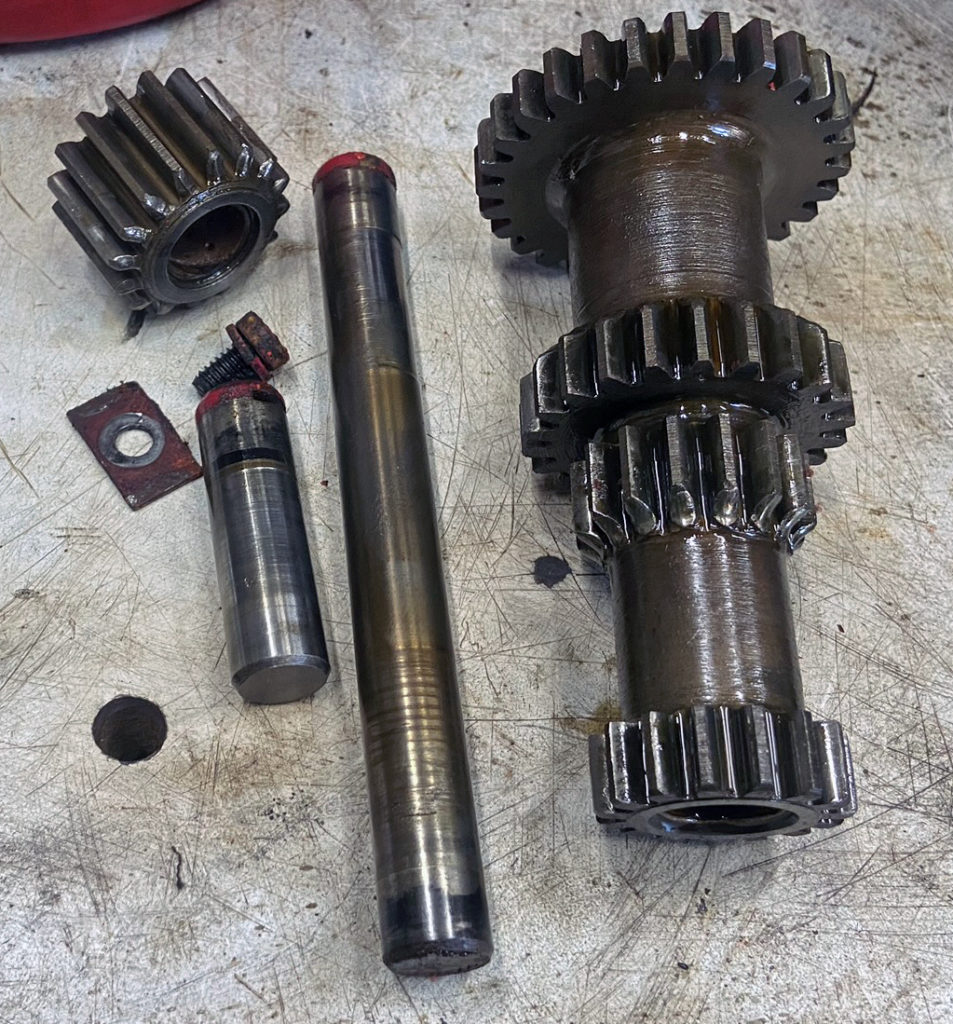
Cluster gear, reverse idler gear, shafts, lock plate, lock plate screw.
(Photo © Russ Chastain)

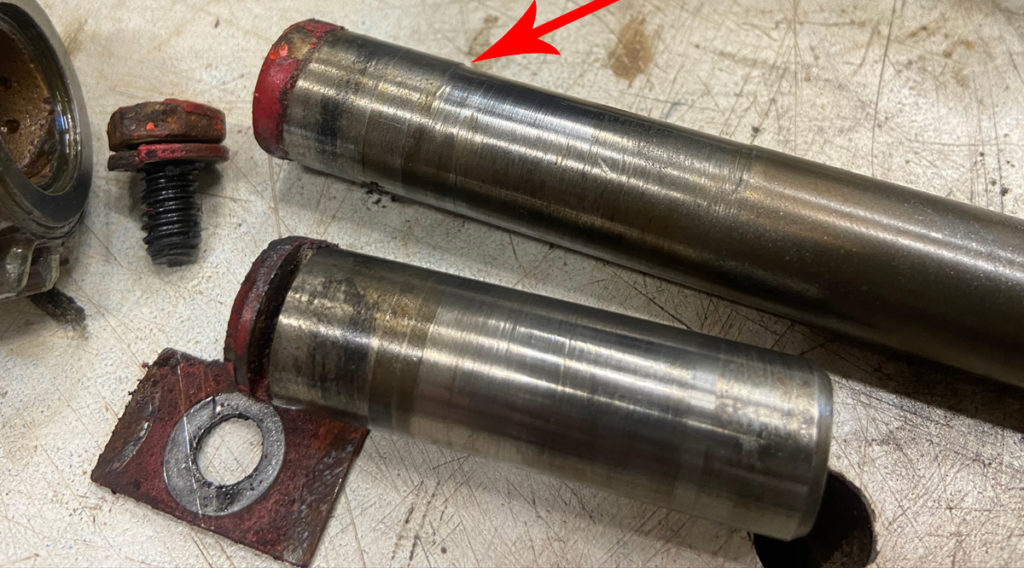
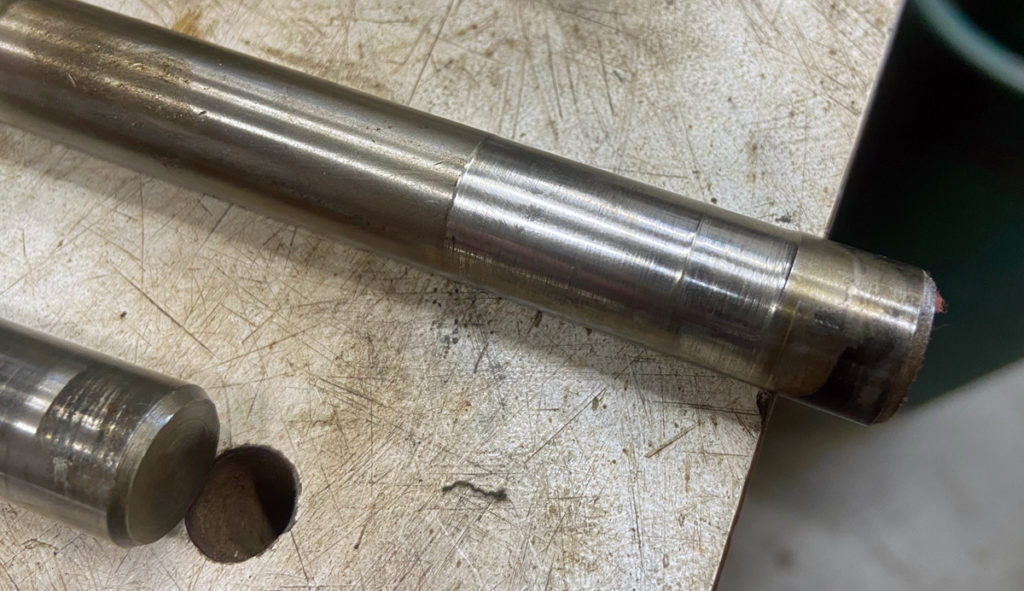
The shafts get worn… especially the longer one. Thankfully you can cut another lock plate slot opposite the original one using a grinder cutoff wheel so the gear bushings will then ride against an unworn surface. But I digress…


This shaft shows a lot of wear. Thankfully, you can reverse the shaft to give it a whole new life.
(Photo © Russ Chastain)

More wear on the cluster gear countershaft.
(Photo © Russ Chastain)

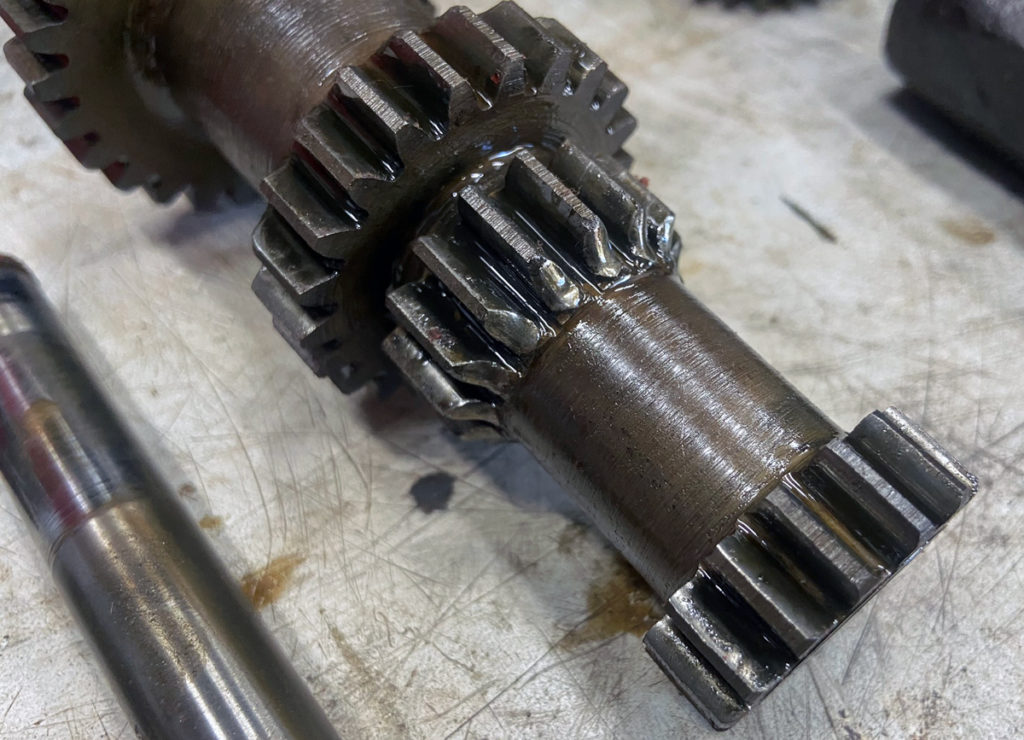
Grinding the gears while shifting is what causes this rounding of the gears.


These gear teeth are worn from improper shifting.
(Photo © Russ Chastain)

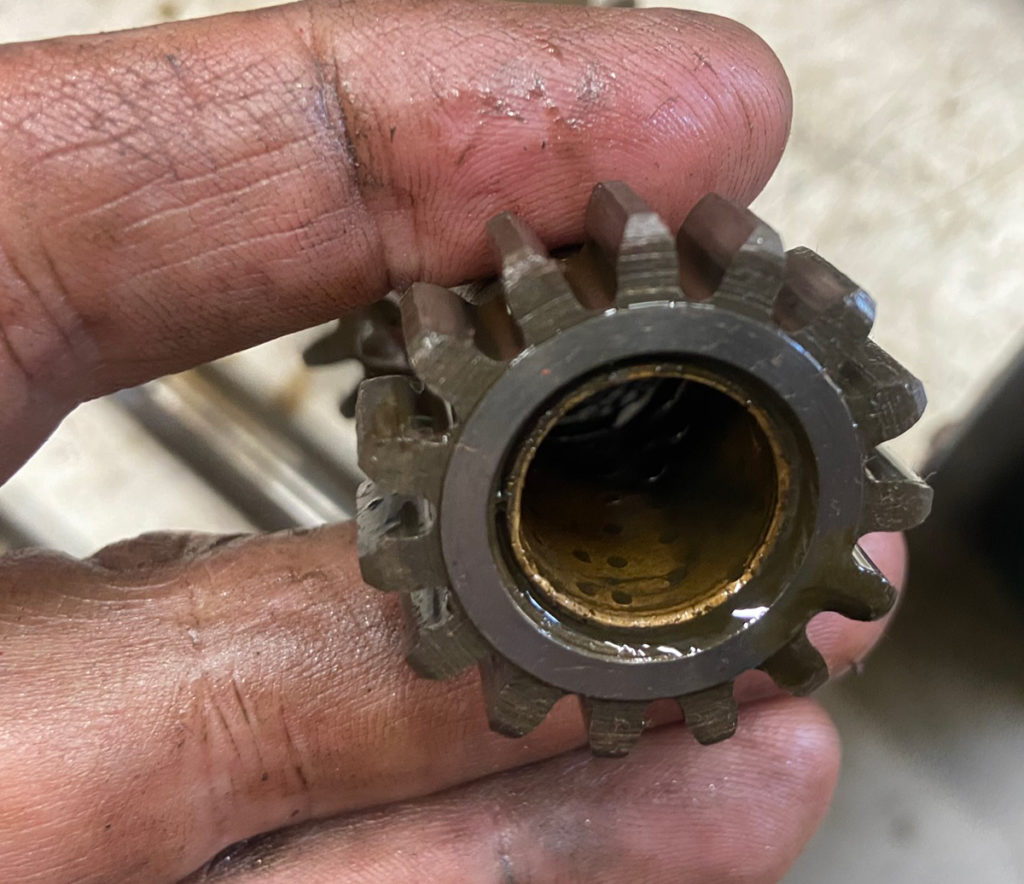
The bronze bushings are probably okay, believe it or not. Most of the time they can go right back in without any problem.


These bushings are usually good. I think they wear better than the steel shafts.
(Photo © Russ Chastain)

There’s another snap ring to locate the front edge of the rear bearing… just leave it in. My motto: Never remove a snap ring if you don’t have to.

Other than that, the case is empty now.


Empty transmission case.
(Photo © Russ Chastain)

Incidentally, this transmission only takes 8 OUNCES of lubricant! And that’s about one inch below the level of the fill plug seen here.

I normally pour in a pre-measured amount of 140w gear lube while the transmission top is off — after reassembly of course.

Well, that’s about it for part one of the T92 Transmission Teardown article.

See also:

— Russ

Throwout Bearing Info for EPCO Power King, Jim Dandy, Economy Steel Body Tractors

Power King tractor throwout bearing.

So you need a throwout bearing for your Power King, Economy, Jim Dandy, Country Squire, or Red-E EPCO tractor? Here’s what you need to know.

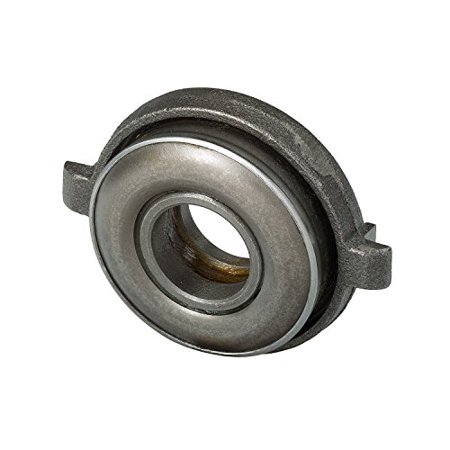
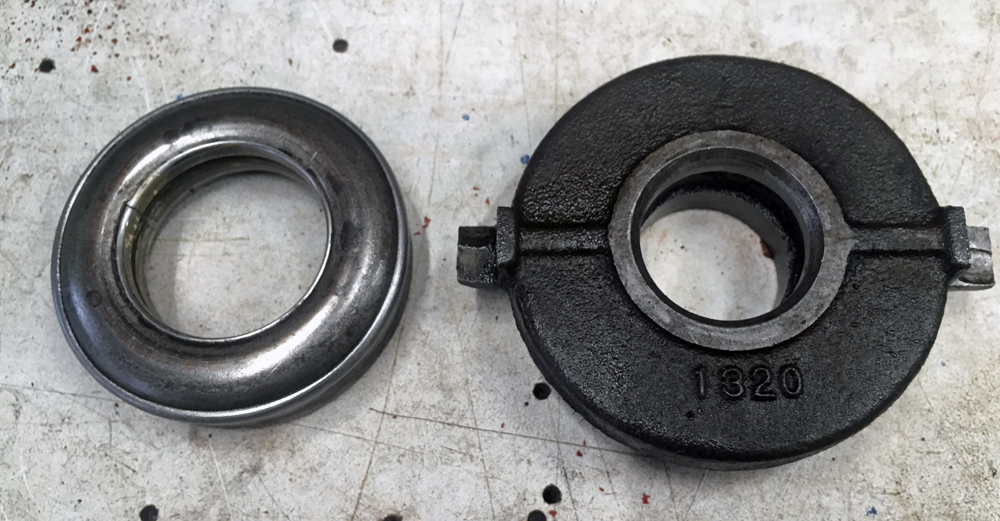
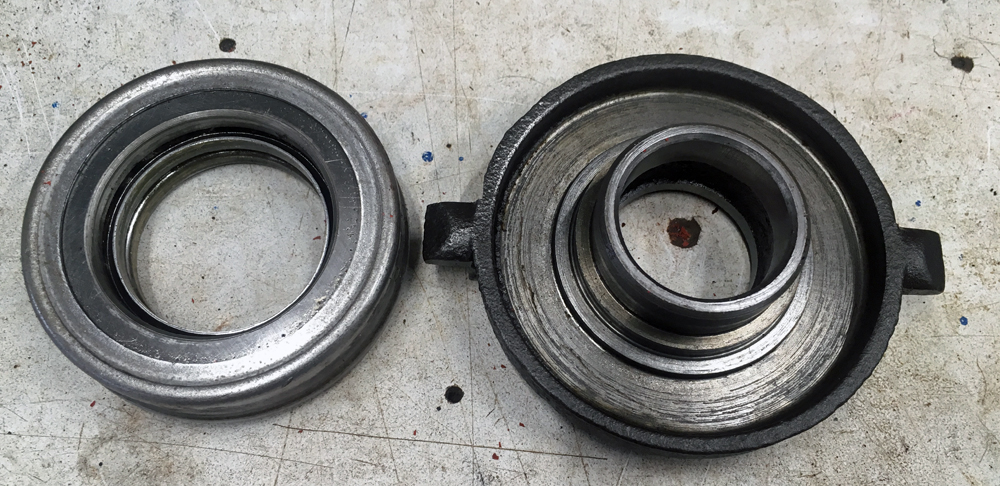
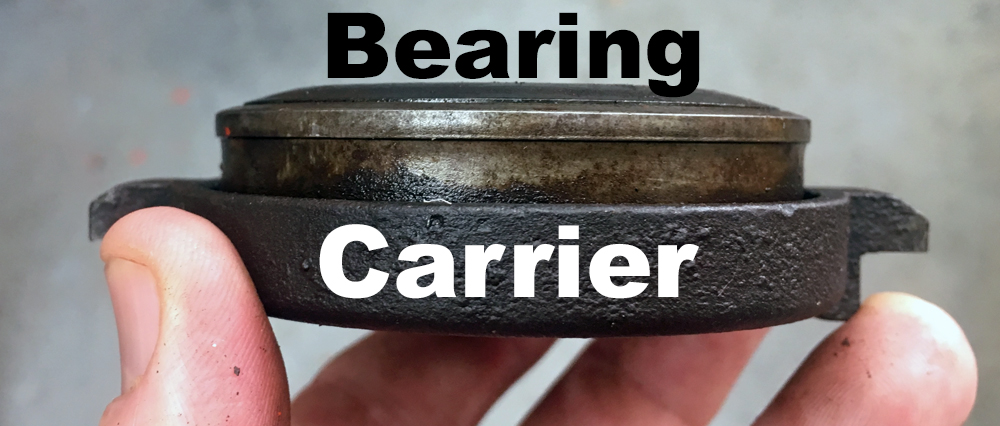
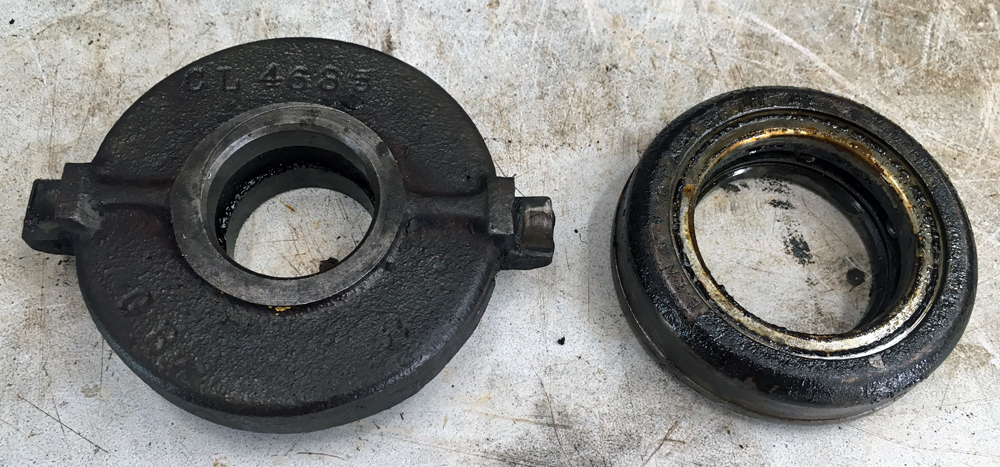
There are actually two parts to this throwout bearing: The carrier and the bearing itself.

Power King throwout bearing carrier (right) and bearing. (Photo © Russ Chastain)

It’s not readily apparent that you have a two-piece assembly because they are pressed together, but you should separate the two parts if you need to give your bearing a thorough cleaning and lubrication.

Power King throwout bearing carrier (right) and bearing.
 (Photo © Russ Chastain)

Power King throwout bearing carrier (right) and bearing.
(Photo © Russ Chastain)

Here’s one I pulled out of a tractor and added to my parts stash. For disassembly, you can use a bearing puller to grip the bearing under that lip near the top.

Power King tractor throwout bearing.  (Photo © Russ Chastain)
Power King tractor throwout bearing. (Photo © Russ Chastain)

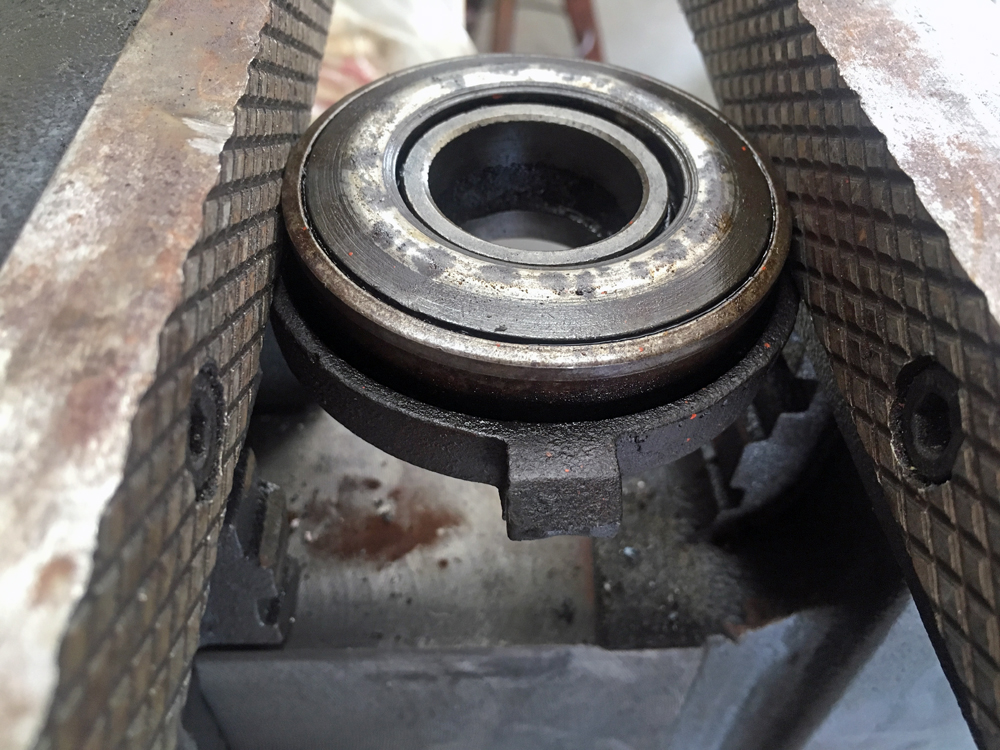
For a quick and dirty separation for this article, I just gripped the bearing — lightly! — in a bench vise.

 Dissassembling a Power King tractor throwout bearing.  (Photo © Russ Chastain)
Dissassembling a Power King tractor throwout bearing. (Photo © Russ Chastain)

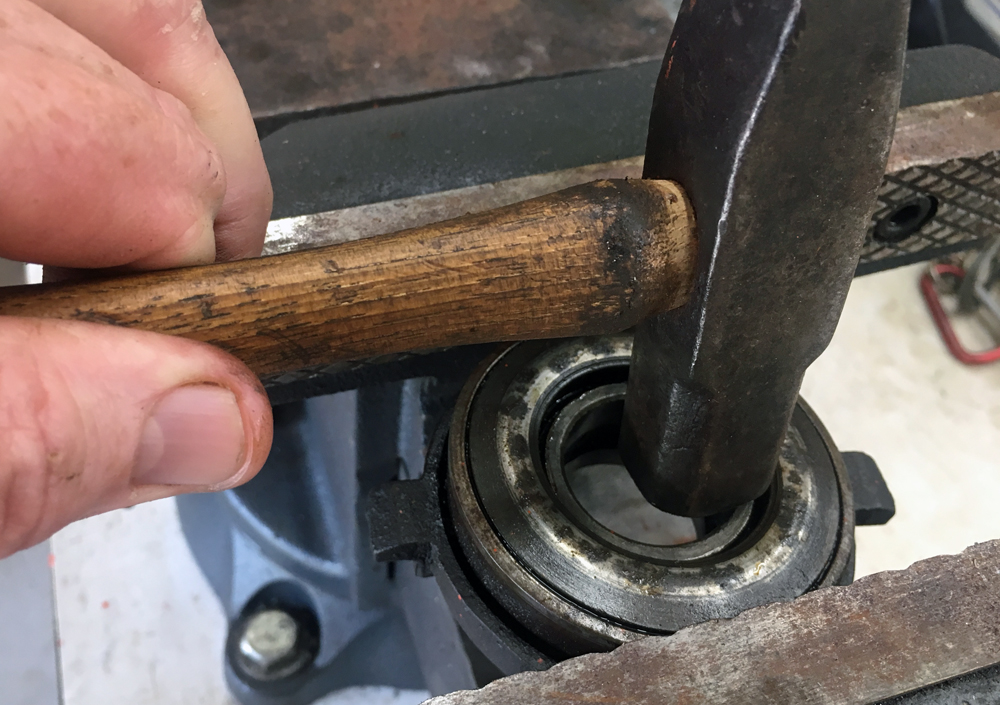
Then I lightly tapped on the inside portion of the carrier, which is that middle ring my hammer is touching in this picture. This allowed me to drive the carrier out of the bearing.

Dissassembling a Power King tractor throwout bearing.  (Photo © Russ Chastain)
Dissassembling a Power King tractor throwout bearing. (Photo © Russ Chastain)

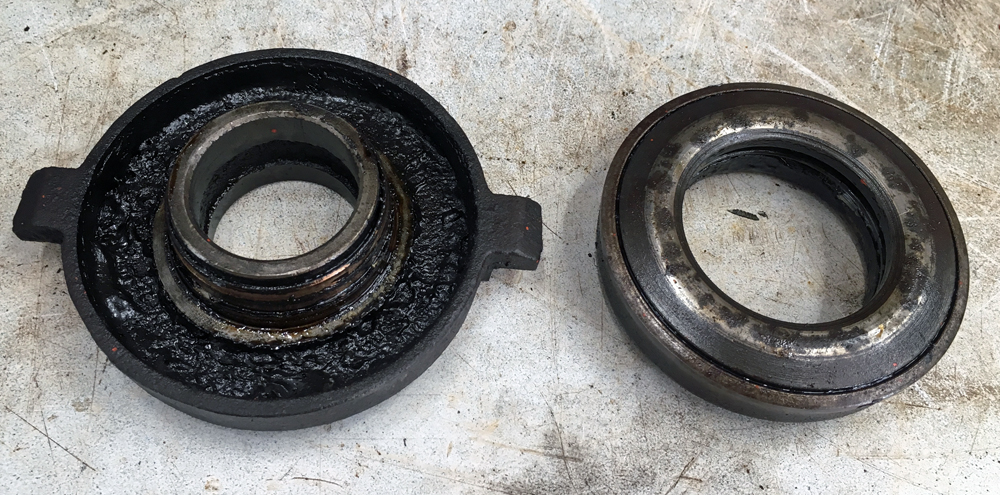
This exposed gunk I couldn’t have cleaned out without taking it apart.

Throwout bearing carrier (left) has a bunch of gunk in it.  (Photo © Russ Chastain)
Throwout bearing carrier (left) has a bunch of gunk in it. (Photo © Russ Chastain)

I like to keep using anything that’s still usable, and I hate to waste anything. For this reason, I will soak these parts in kerosene/diesel fuel to dissolve all the old crud, thoroughly rinse with same, then lubricate the bearing with bearing grease by forcing it into the bearing.

 Throwout bearing and carrier (left).  (Photo © Russ Chastain)
Throwout bearing and carrier (left). (Photo © Russ Chastain)

This is assuming the carrier is not overly worn where the clutch fork rides against it, and the bearing is in good shape mechanically & spins freely under pressure when it’s clean.

To reassemble, press the two parts together carefully, making sure they are square with one another. A bench vise makes a reasonable “press” for doing this.

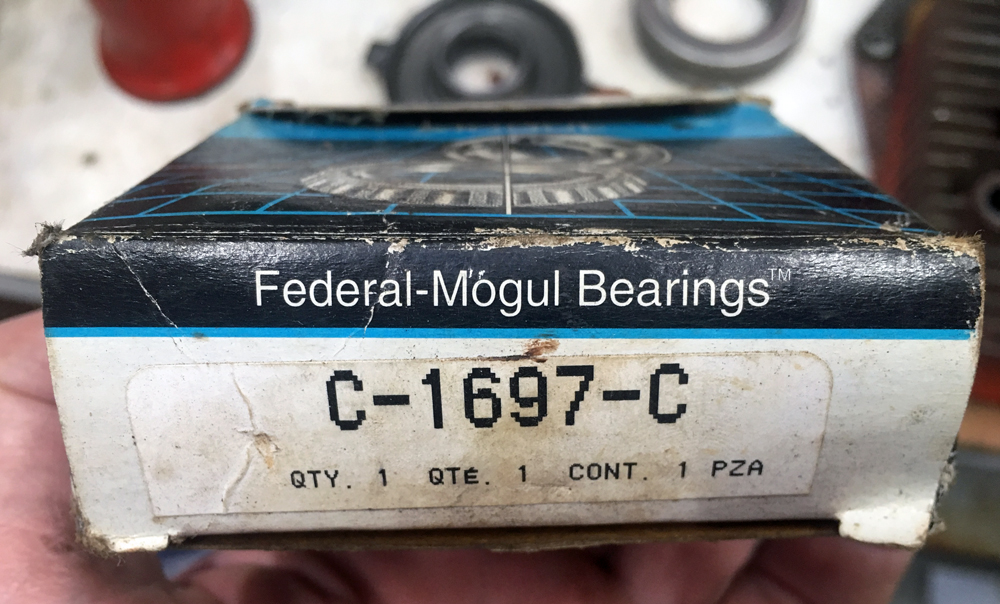
If you wish to replace instead of reusing or if your bearing is beyond repair, you can buy a new one. The part number is Federal-Mogul C-1697-C, and this gets you the bearing and carrier. Just be careful while shopping; some throwout bearings listed under this number are quite different. Make sure it looks like those pictured here.

A new throwout bearing in the box.  (Photo © Russ Chastain)
A new throwout bearing in the box. (Photo © Russ Chastain)

Here’s a link to the best price I could find: Buy a Power King tractor throwout bearing

Good luck and thanks for reading.

— Russ

How to Remove Clutch Flywheel on EPCO Power King, Jim Dandy, Economy Steel Body Tractors

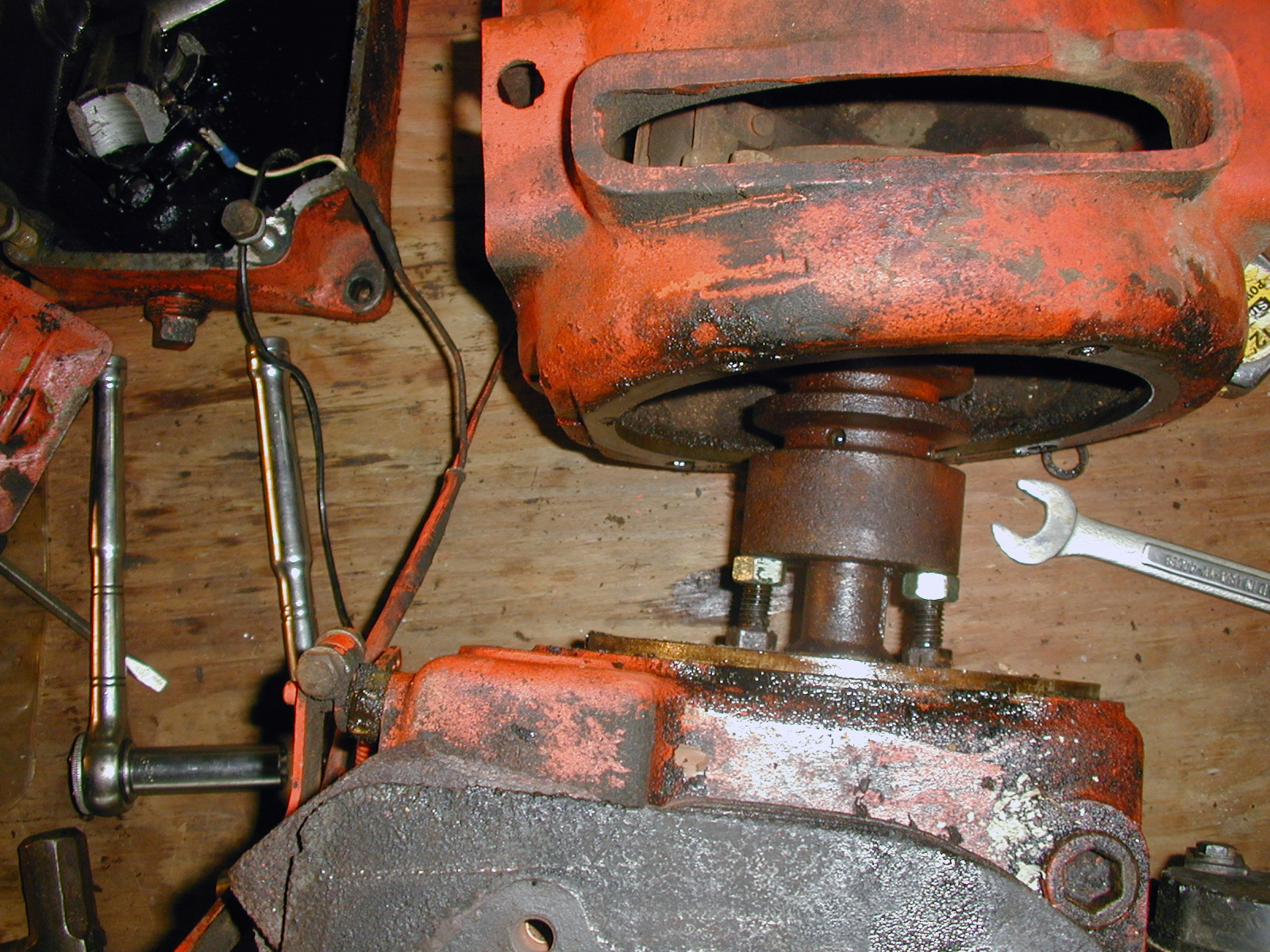
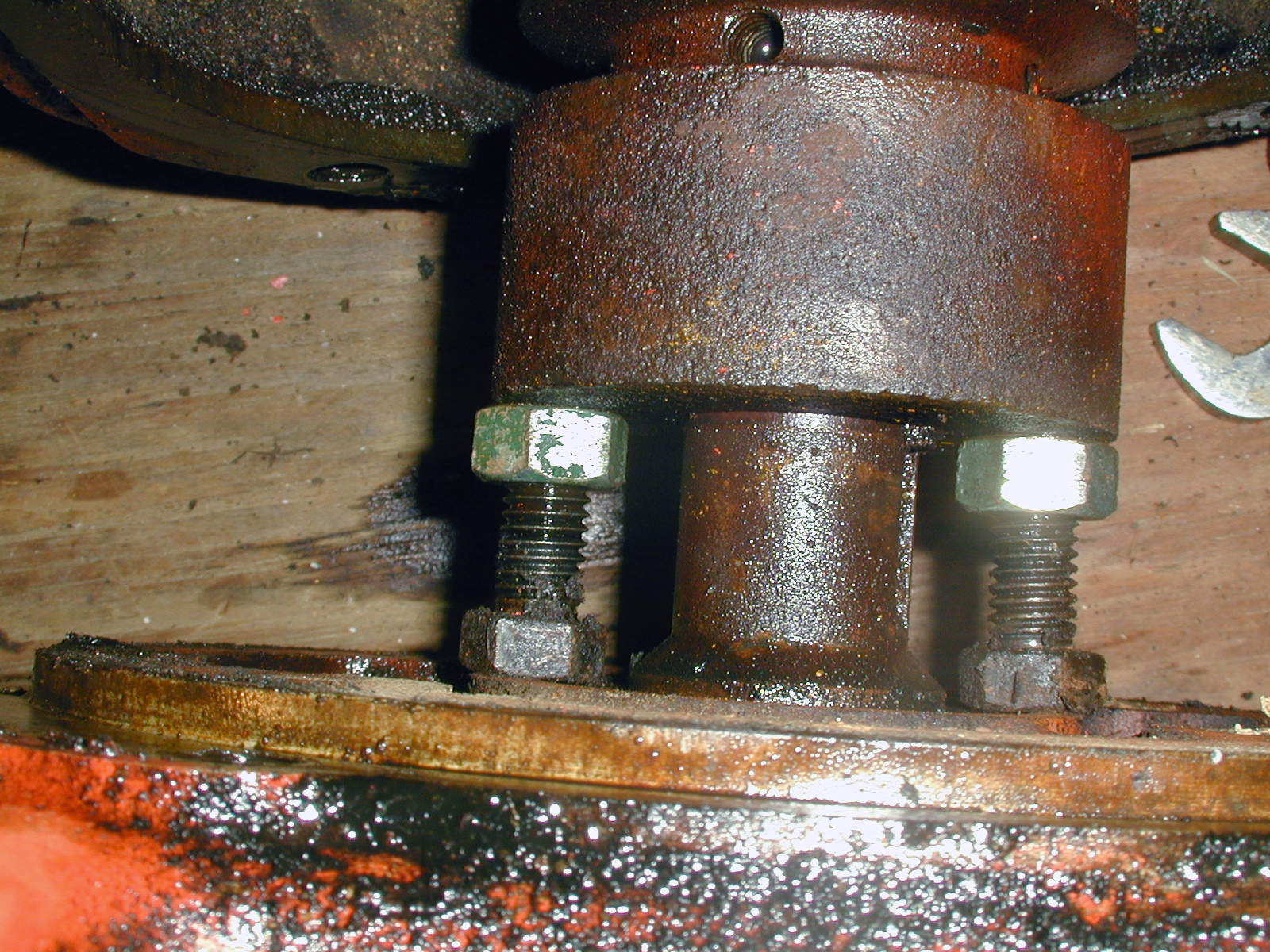
The nut & bolt method of removing Power King clutch flywheel.


If you need to pull your tractor’s engine apart to work on it, you will probably want to remove the clutch flywheel from the rear end of the crankshaft. There are several ways to do this, but the first thing you need to know is this: DO NOT USE A JAW PULLER ON THE CLUTCH FLYWHEEL. The flywheel WILL break.

Usually, the clutch flywheel will be stubborn and won’t want to come off. The second clutch flywheel I ever removed was my first stubborn one. I learned that this is the rule rather than the exception…. they are usually stuck on there good.

First Step

Remove the set screws securing the flywheel to the crankshaft. Don’t just loosen them; remove them entirely. There are two threaded holes, and sometimes each hole will have two set screws, one on top of the other. Make sure all the screws are out of there, and squirt some penetrating oil into the holes.

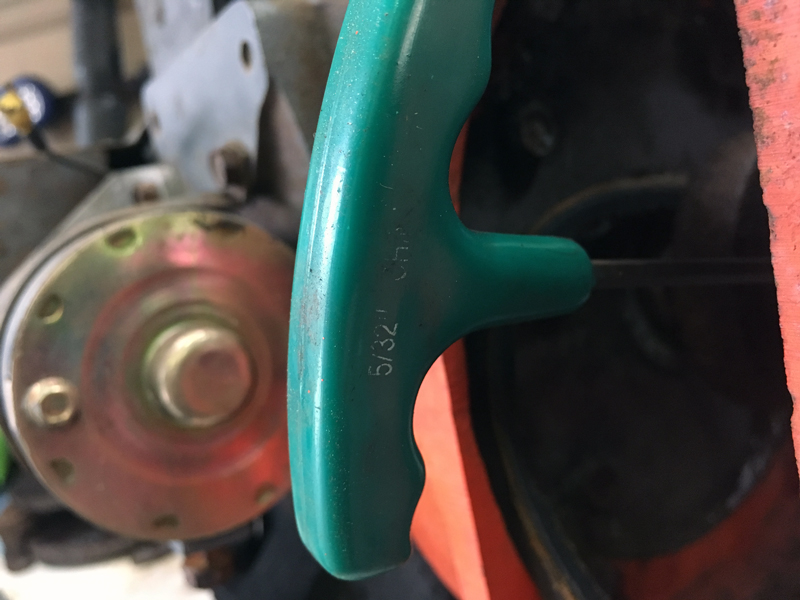
I have a cheap set of T-handle allen wrenches that work well for removing the set screws. (Photo © Russ Chastain)
I have a cheap set of T-handle allen wrenches that work well for removing the set screws.
(Photo © Russ Chastain)

Use a 5/32″ allen wrench to remove the set screws. Make sure the hex-shaped hole is nice and clean before inserting the hex wrench. A small-bladed screwdriver is handy for that.

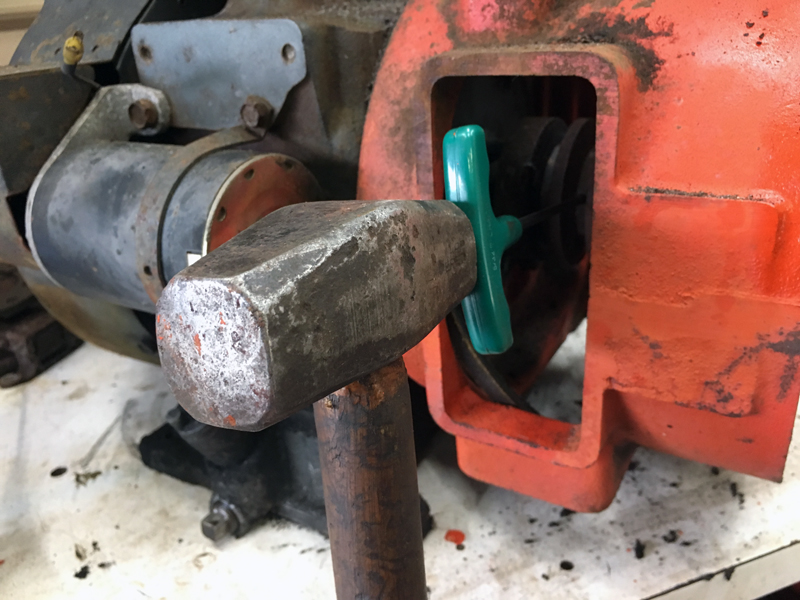
I like to tap the wrench in lightly with a hammer to ensure it goes all the way into the hole. This greatly reduces the chance of stripping the hex hole in the set screw, which would be tragic.

Tap the wrench lightly with a hammer to be sure it's fully inserted in the set screw. (Photo © Russ Chastain)
Tap the wrench lightly with a hammer to be sure it’s fully inserted in the set screw.
(Photo © Russ Chastain)

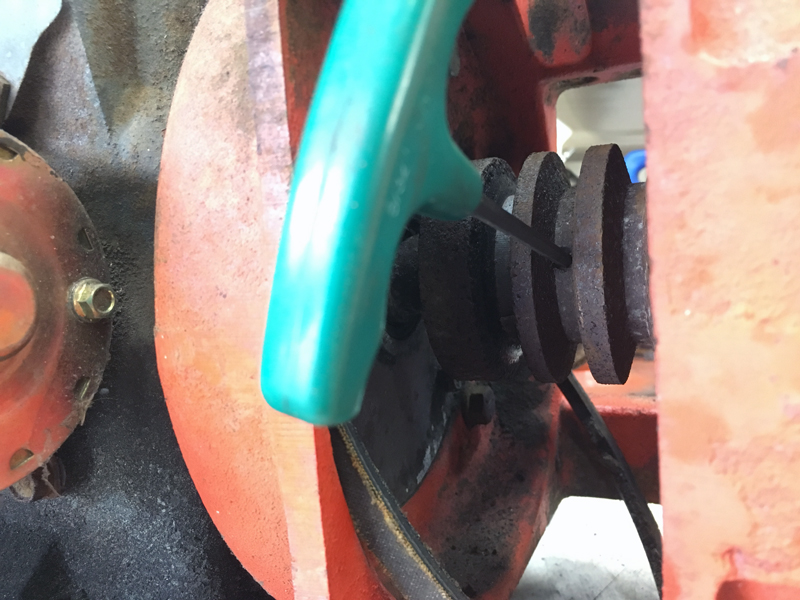
Ready to pull a set screw. (Photo © Russ Chastain)
Ready to pull a set screw.
(Photo © Russ Chastain)

Remove the screws entirely, so you can check for a second set screw below the first and get some penetrating oil onto the crankshaft through the screw hole.

Set screw success. (Photo © Russ Chastain)
Set screw success.
(Photo © Russ Chastain)

Nut & Bolt Method

I used a method that was suggested by a fellow PKer, and since that was back in 2004 I have no clue who it was. It’s a simple — but tedious — process. First, you remove the 4 bolts holding the clutch flywheel housing to the engine, and get that housing free so you can get to the area between flywheel and engine.

Remove the set screws securing the flywheel to the crankshaft. Don’t just loosen them; remove them entirely. There are two threaded holes, and sometimes each hole will have two set screws, one on top of the other. Make sure all the screws are out of there, and squirt some penetrating oil into the holes.

The nut & bolt method of removing Power King clutch flywheel.
(Photo © Russ Chastain)

Find a pair of bolts & nuts that will fit between the flywheel and engine. In my case it was a 1969 Jim Dandy with a Kohler K301 engine, but that’s not important. The bolts will act as screw jacks, which will place considerable pressure on your engine block. It may be wise to place some steel flat bar between the bolt heads and the engine. I did this at a later stage.

Close-up of the nut & bolt method of removing Power King clutch flywheel.
(Photo © Russ Chastain)

Simply use two wrenches and screw the nuts off of the bolts a little at a time, alternating between them to keep things even. You will run out of bolt before you’re done… that’s when you find longer bolts or use more/thicker spacers between bolts & engine. In the photo above, you can see that the flywheel has already moved away from the engine a little bit.

Fancy Custom Puller

Once I started working on PKs regularly, I decided to spring for a sure-nuff flywheel puller. I bought this custom puller made for and sold by the late Jerry Frank of Texas (USSUPPLY).

Specialized custom puller for pulling EPCO clutch flywheels.
(Photo © Russ Chastain)

Specialized custom puller for pulling EPCO clutch flywheels.
(Photo © Russ Chastain)

Specialized custom puller for pulling EPCO clutch flywheels.
(Photo © Russ Chastain)

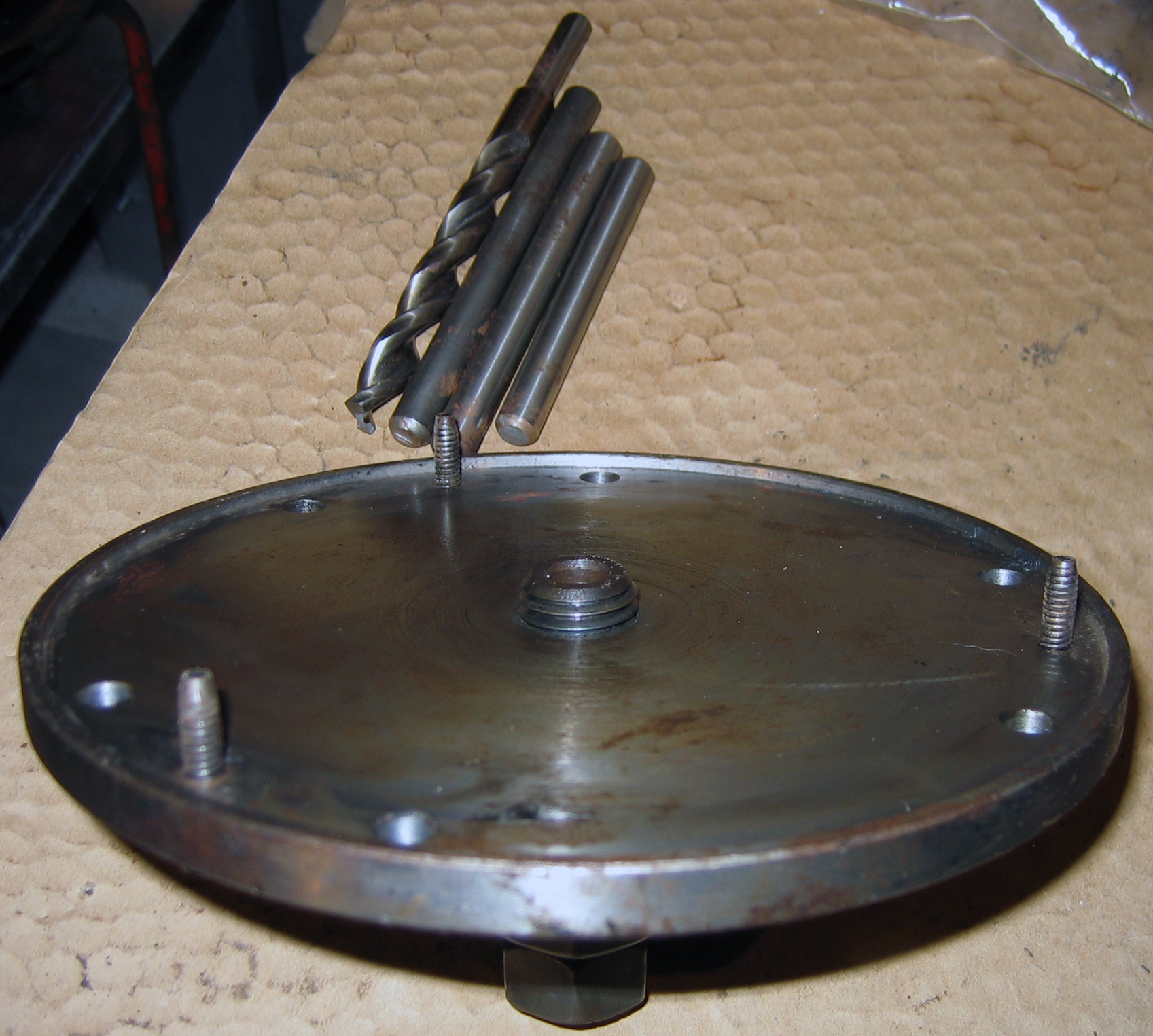
You remove the clutch fingers, pressure plate, and clutch disk, and bolt this to the flywheel using the six threaded holes in the flywheel normally used for attaching the clutch assembly.

Specialized puller, installed on a clutch flywheel. Arrows indicate bolts holding puller to flywheel. I use 6 of the 8 bolts from the clutch pedal housing. (Photo © Russ Chastain)
Specialized puller, installed on a clutch flywheel. Arrows indicate bolts holding puller to flywheel. I use 6 of the 8 bolts from the clutch pedal housing.
(Photo © Russ Chastain)

Then you use the threaded center puller bolt with various lengths of round rod inserts. I place a socket on the hex nut and tighten it with an impact gun, and the flywheel usually comes right off.

I use an impact gun with this puller, after fully removing all set screws and securing the puller to the flywheel. (Photo © Russ Chastain)
I use an impact gun with this puller, after fully removing all set screws and securing the puller to the flywheel.
(Photo © Russ Chastain)

Be careful not to let the flywheel get away from you, because it’s heavy. Once it comes free of the crankshaft, it’s gonna want to succumb to gravity’s pull.

Custom puller attached to a flywheel that's been pulled. (Photo © Russ Chastain)
Custom puller attached to a flywheel that’s been pulled.
(Photo © Russ Chastain)

Simple Homemade Puller

After I bought that expensive puller, I learned about this homemade puller that was made by a fellow PKer.

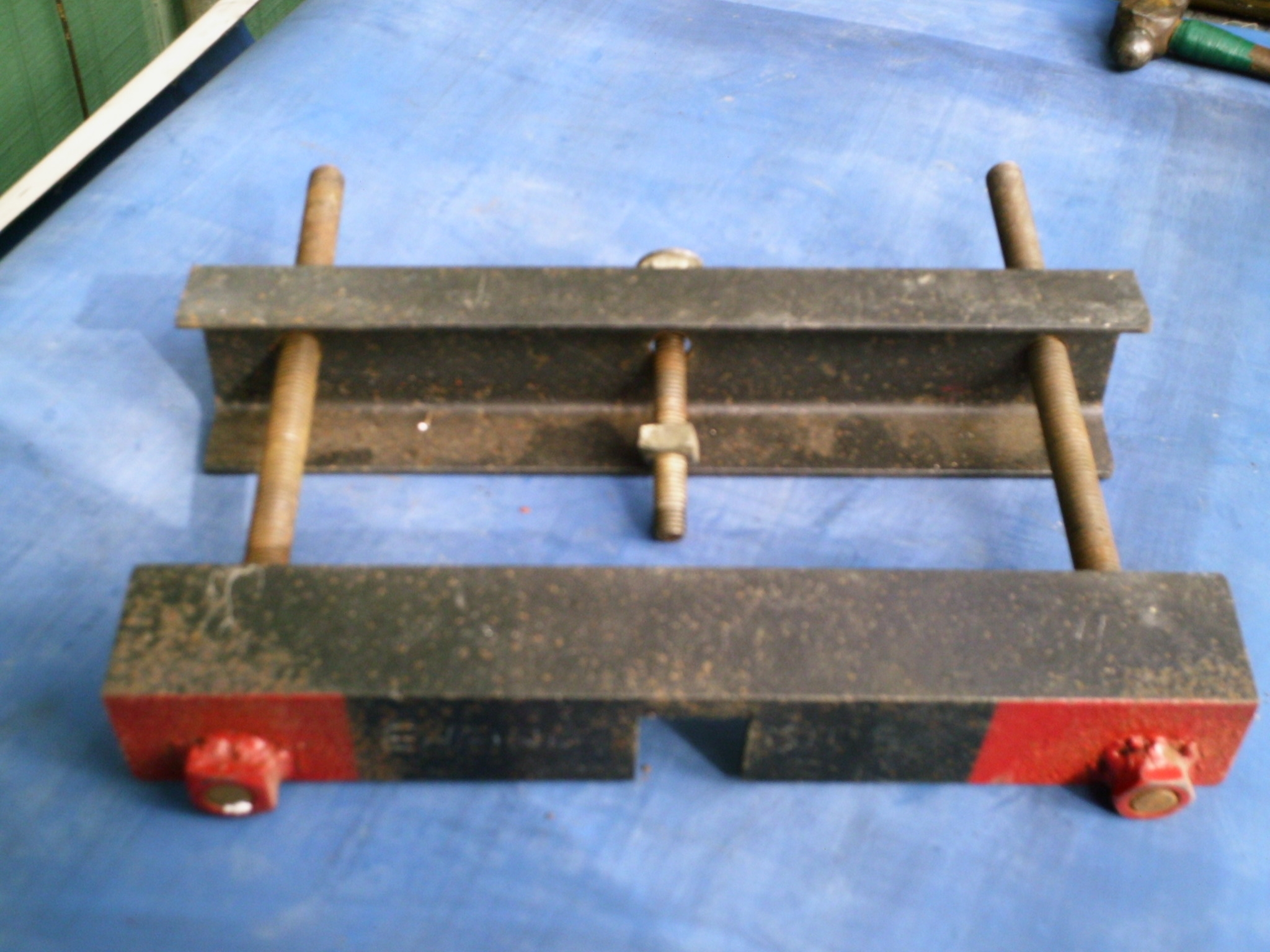
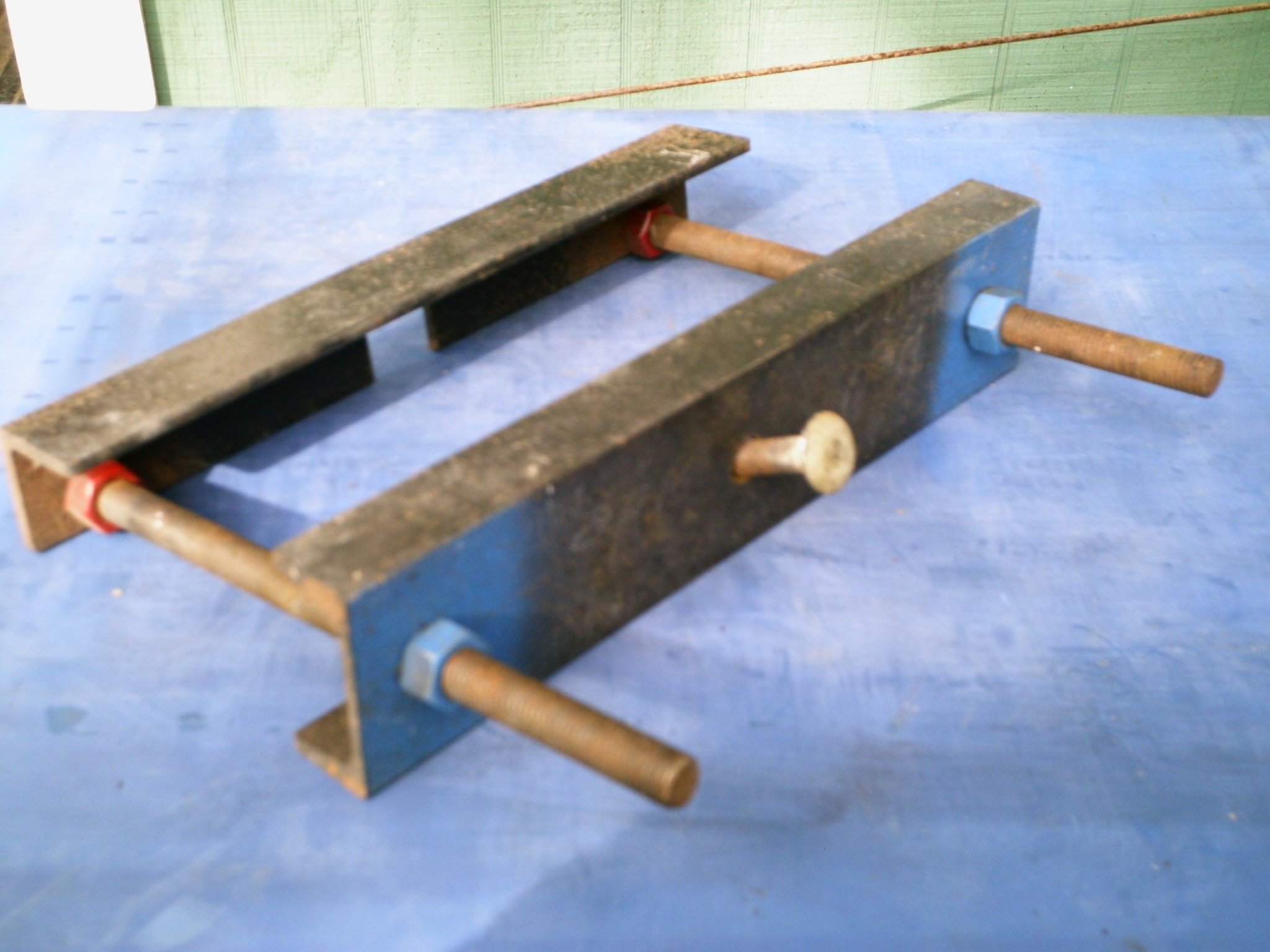
Simple homemade EPCO clutch flywheel puller

Simple homemade EPCO clutch flywheel puller

Official EPCO Puller

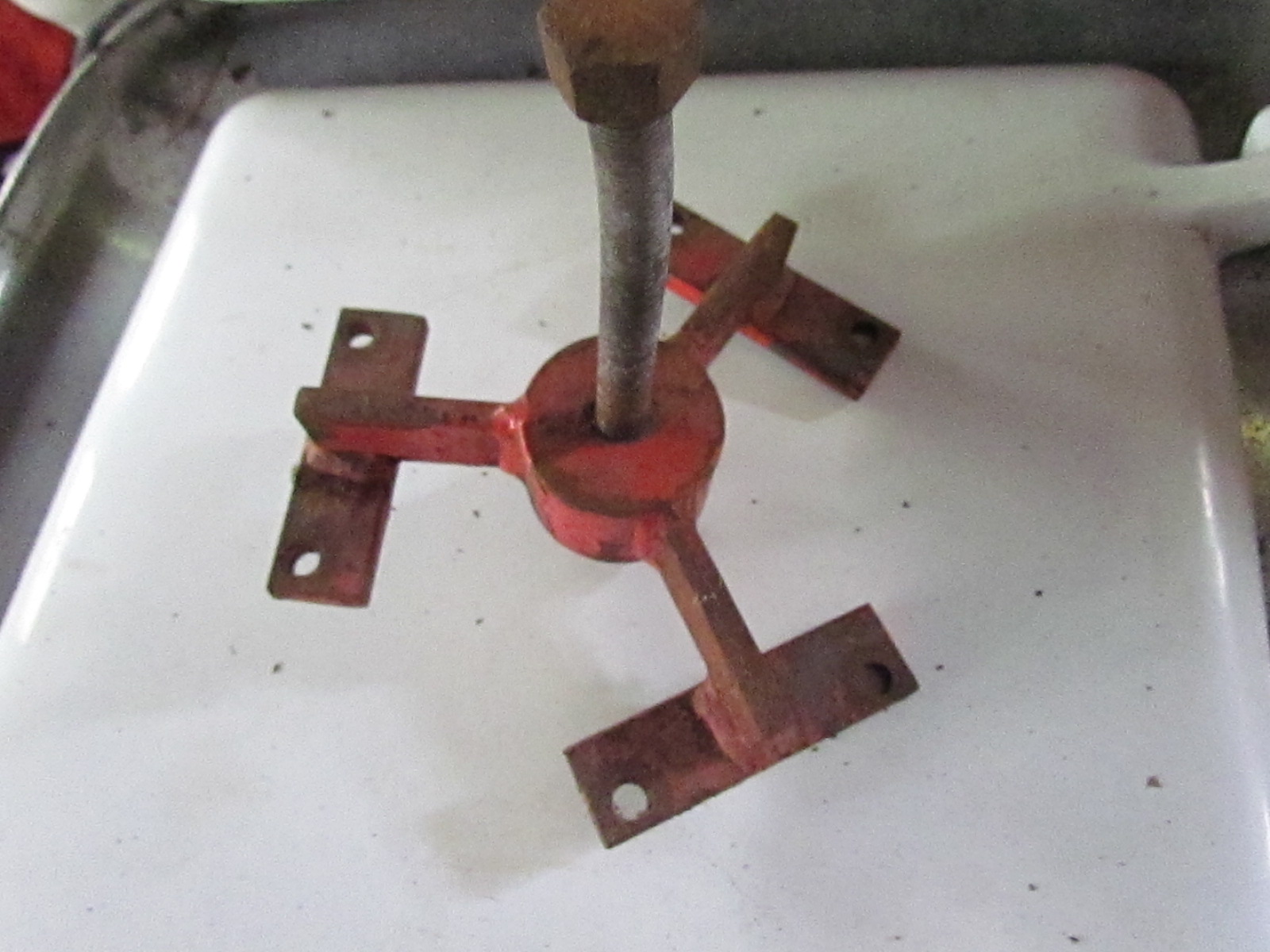
I’m told this puller was an “official” tool from EPCO — or as official as they ever got.

"Official" EPCO clutch flywheel puller
“Official” EPCO clutch flywheel puller

Like my puller, it attaches to the threaded holes for the clutch.

Drill & Tap for a Bolt-Type Puller

Some folks have been known to drill & tap new holes in the “meaty” central portion of a clutch flywheel so they can use a bolt-type puller (like you’d use to pull a Kohler engine flywheel).

In Closing

These are certainly not the only methods that will work, but hopefully they will give you some ideas.

I hope you found this helpful! Feel free to comment below.

– Russ


Howdy, Folks!

My name is Russ Chastain. I’m a freelance writer, editor, and photographer who loves hunting, shooting, guitars, and old tractors — especially those Economy/Power King/Country Squire/Jim Dandy/Power Queen/Red E/Farm King machines collectively known as EPCO (Engineering Products Co) tractors.

I’ve been hunting, shooting, and writing for more than 40 years, and I have a passion for accuracy with both language and firearms.

I was the sole editor and writer for the About.com Hunting and Shooting site 1998-2016. I began writing for AllOutdoor.com in 2014 and worked as editor there 2016-2021. I’ve also written for OutdoorHub.com over the years. I’ve also written for Source Outdoor and have worked as a Technical Editor as well.

Welcome!
Consider donating to help keep this site alive… it costs almost $170 per year just for hosting.